
Blue underwing
Catocala fraxini
Description
How to identify
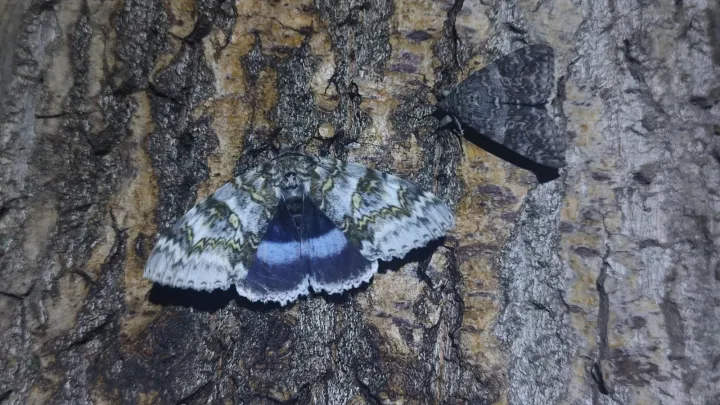
The Blue underwing (Catocala fraxini) is a large moth belonging to the family Erebidae. It is recognized as one of the largest moths found in Europe, with a wingspan of up to 110 mm.
The forewings have an intricate gray pattern that acts as perfect camouflage against the bark of host trees. The hindwings are velvet black with a striking bright blue central band.
Larvae (caterpillars) can grow up to 100 mm in length. They are grayish-brown and possess dorsal tubercles, which provide effective camouflage by mimicking tree branches and twigs.
The pupa is protected by a loose silken cocoon, often formed between leaves or in crevices on the tree trunk, and it is covered in a characteristic bluish, powdery bloom.
The adult moths are nocturnal, remaining hidden during the day and becoming active from late summer through early autumn to feed and mate.
What it damages
The primary hosts for the Blue underwing larvae are deciduous trees, particularly species such as ash (Fraxinus), aspen (Populus tremula), poplar, and willow.
Caterpillars cause damage by consuming the foliage of these trees. Early instar larvae skeletonize the leaves, while later instars consume entire leaves, leaving only the midribs.
While mature healthy trees can often withstand some defoliation, large populations of larvae can significantly weaken younger trees or those already stressed by environmental factors.
In forest plantations and ornamental parks, heavy infestation reduces the aesthetic value of the trees and can lead to a decrease in the annual timber growth rate.
Continuous defoliation over several consecutive years may predispose trees to secondary pests or infections, as the tree loses its ability to photosynthesize effectively.
When it appears
The species overwinters in the egg stage. Eggs are laid individually in the crevices of the host tree's bark, where they remain throughout the winter months.
Larval development typically occurs in spring, beginning when the host trees start to bud and leaf out, usually in May and continuing into June.
Pupation takes place mid-summer, in June or July. The moth remains in the pupal stage for approximately three to four weeks before emerging as an adult.
Adult flight takes place from late July through September. During this time, they feed on tree sap and nectar and prepare to lay eggs for the next generation.
The life cycle is univoltine, meaning there is only one generation per year, with the egg stage serving as the primary survival phase during the dormant season.
Signs of infestation
The most visible sign of an infestation is the presence of eaten foliage. Holes in the leaves and missing margins indicate active caterpillar feeding in the canopy.
Frass (larval droppings) falling from the canopy onto the ground or low-lying vegetation is a strong indicator of the presence of feeding larvae higher up in the tree.
Despite their size, larvae are very difficult to spot during daylight hours because their cryptic coloration makes them blend almost seamlessly with the tree twigs.
Late in the season, careful examination of the bark on the lower trunk may reveal eggs, although their small size and camouflaged color make them difficult to detect.
At night, adults may be attracted to artificial lights, which is a common method for researchers and foresters to monitor the population density in a specific area.
Control measures
Management of the Blue underwing generally focuses on biological controls, as widespread chemical applications are rarely needed unless a major outbreak occurs.
Promoting a healthy environment for natural predators, especially insectivorous birds, is a highly effective way to keep larval populations in check during the spring.
In ornamental or nursery settings, if infestation levels are high, biological insecticides (such as Bacillus thuringiensis) can be used to control the caterpillars.
Good silvicultural practices, including the removal of dead or dying trees and maintaining overall forest health, help reduce the attractiveness of the area to egg-laying females.
Regular monitoring using pheromone or light traps allows land managers to gauge the population density and decide if intervention is necessary to prevent significant damage.
Taxonomy
- Latin name
- Catocala fraxini
- Order
- Lepidoptera (butterflies)
- Family
- Erebidae
- EPPO code
- CATLFR
Discussion
No discussions yet — be the first.