
China-mark moth
Cataclysta lemnata
Description
How to identify
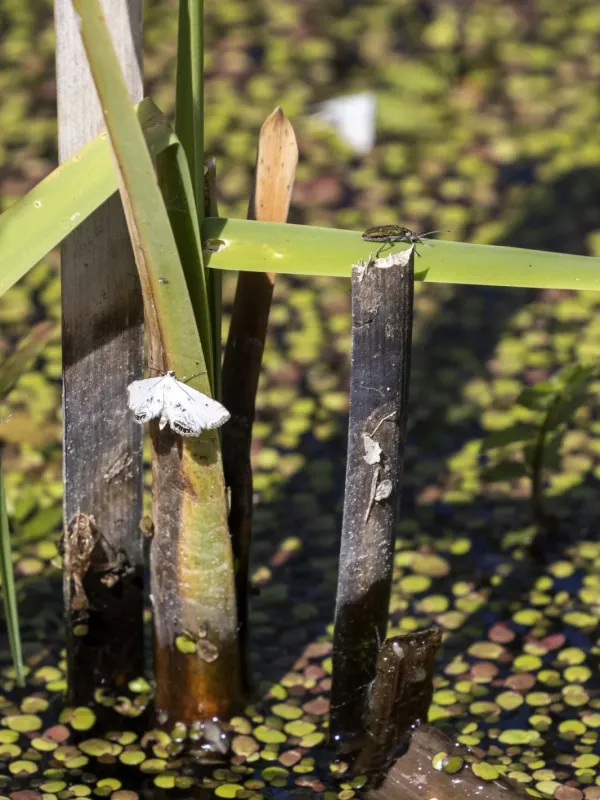
The China-mark moth Cataclysta lemnata is a fascinating species within the Crambidae family. It is distinct for being one of the few Lepidoptera with semi-aquatic larvae.
Adult moths feature a wingspan of approximately 20–25 mm. Their coloration ranges from white to creamy, decorated with intricate brown or ochre patterns that provide excellent camouflage against aquatic vegetation.
The larvae are highly adapted to underwater life. They possess specialized filamentous gills, which allow them to extract oxygen directly from the water throughout their larval development stages.
The moth's lifecycle is tied to stagnant or slow-moving water bodies. Adults are nocturnal, emerging in the evenings to lay eggs on the surface of floating host plants.
Pupation occurs in a robust silken cocoon. The caterpillar attaches this cocoon to the underside of a floating leaf or a submerged stem, creating a safe environment for transformation.
What it damages
Duckweed (Lemna species) is the primary host plant for these larvae, hence their common association with this aquatic plant. However, they also feed on various other hydrophytes including water lilies.
In ornamental ponds or hydroponic systems, the China-mark moth can be quite destructive. High larval populations can quickly decimate the aesthetic value and health of the vegetation.
Damage involves larvae skeletonizing the leaves by consuming the epidermis and parenchyma tissues. This leaves behind only the main veins, leading to rapid tissue death and plant collapse.
When infestation occurs in natural ponds, the loss of duckweed can disrupt the local ecosystem, affecting oxygen levels, water clarity, and food sources for other aquatic organisms.
Plants weakened by the moth’s feeding are highly susceptible to secondary pathogens, including various fungal infections and opportunistic bacteria that thrive in aquatic environments.
When it appears
Adult moths are active during the warmer months, typically from June to August. This period corresponds with their mating and egg-laying cycle.
Larval activity is most intense during the summer. As ectothermic organisms, their growth rate and feeding efficiency increase significantly with higher water temperatures.
The larvae overwinter in later developmental stages. They find refuge on the pond bottom, often buried in detritus or decaying plant matter where temperatures remain relatively stable and safe from freezing.
With the warming of the water in spring, the larvae resume feeding to complete their development. They then pupate, emerging as adults in early summer to start the cycle anew.
In regions with mild autumns, there may be a partial second generation, leading to prolonged pressure on aquatic plant populations throughout the growing season.
Signs of infestation
The primary symptom of infestation is the presence of irregular, skeletonized patches on the leaves of duckweed and other floating plants.
Small, white, web-like silken cases or cocoons on the undersides of leaves are a diagnostic sign of larval presence. These are often hidden and require careful inspection to detect.
The presence of pale, small moths fluttering near the water surface during dusk is a strong indicator of an active population breeding in the vicinity.
Unexplained browning, wilting, or sinking of floating plant clusters often points toward larval feeding activity deep within the colony.
- Skeletonized leaf tissue.
- Webbed silken shelters on leaves.
- Adult moth flight at dusk.
Control measures
Manual removal of infested plant material is the most direct and effective method for small-scale pond management or hydroponic setups.
Biological controls, specifically products containing Bacillus thuringiensis, are highly effective against these larvae while remaining safe for fish and other aquatic wildlife.
Keeping ponds free of excessive organic debris is essential, as this material serves as the primary overwintering and pupation site for the larvae.
Light traps used at night can help reduce the population of adult moths, thereby limiting the number of eggs laid on the water surface.
In managed systems, temporary water level manipulation can disrupt the larvae's habitat, forcing them to abandon their cocoons or exposing them to natural predators.
Taxonomy
- Latin name
- Cataclysta lemnata
- Order
- Lepidoptera (butterflies)
- Family
- Crambidae
- EPPO code
- KTKLLE
Discussion
No discussions yet — be the first.