
China-mark moth
Cataclysta
Description
How to identify
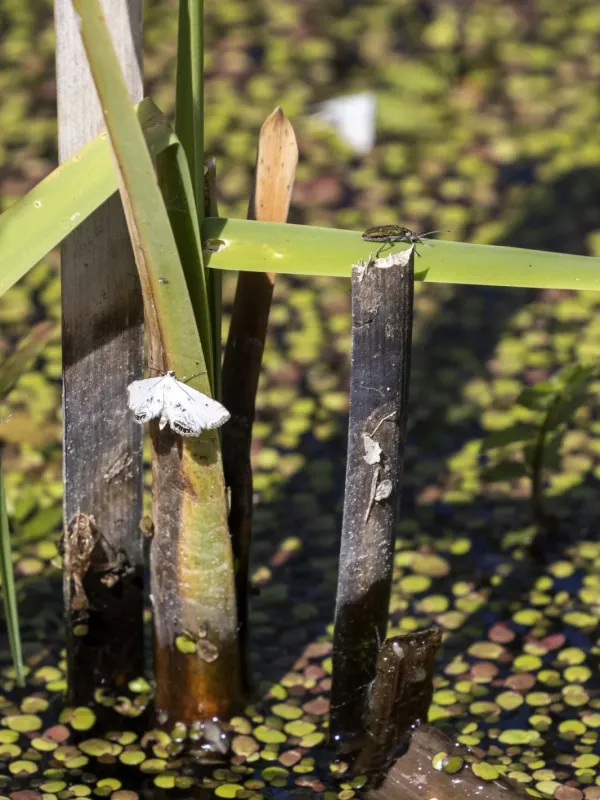
The China-mark moth (Cataclysta lemnata) is a moth of the Crambidae family. Its adults have a distinctive appearance with white wings decorated with brown markings and a row of dark spots along the edges.
A remarkable adaptation of this species is that its larvae are fully aquatic. The caterpillars possess specialized hairs that trap air bubbles, allowing them to respire while submerged under water.
The life cycle involves a metamorphosis where the larvae pass through several stages, feeding exclusively on aquatic plant tissues.
Pupation occurs within a protective case, which the caterpillar constructs using cut fragments of host plant leaves. This structure is often attached to the underside of leaves.
This species is widely distributed throughout Europe and Asia, thriving in stagnant or slow-moving water bodies rich in vegetation.
What it damages
The larvae of the China-mark moth feed on a variety of floating aquatic plants, most notably duckweed (Lemna) and water lilies (Nymphaea).
Feeding damage manifests as irregular holes or consumption of the leaf margins, which skeletonizes the foliage over time.
Heavy infestations can significantly weaken aquatic plants, reducing their vitality and photosynthetic capacity, which leads to poor growth.
The damage often triggers secondary decay in the affected leaves, further degrading water quality and the visual appeal of the pond.
In ornamental water gardens, significant populations of these larvae can destroy prized aquatic plants, leading to severe aesthetic and health issues for the vegetation.
When it appears
The flight period for the first generation of adults typically begins in early summer, often around June, depending on water temperature.
Larval activity reaches its peak in July and August, as the caterpillars grow rapidly and prepare for their transition into pupae.
There can be multiple generations per year under favorable conditions, which exacerbates the pressure on aquatic plants during mid-summer.
The species overwinters as larvae, often sheltering in cocoons within plant debris or attached to submerged structures at the bottom of the pond.
Spring activity resumes once water temperatures rise, prompting the larvae to exit winter dormancy and begin feeding on early vegetation.
Signs of infestation
The presence of irregular or rounded feeding holes on the surface of floating leaves is the most common early sign of an infestation.
Small, leaf-constructed cases floating on the surface of the water are a definitive indication of the presence of the larvae.
Examining the underside of the leaves often reveals the caterpillars themselves, although they can be well-hidden among the vegetation.
Widespread yellowing and premature death of floating foliage often signal heavy feeding by larvae hidden beneath or within the plant material.
Sightings of small white moths fluttering near the pond during dusk indicate an active adult population and ongoing egg-laying cycles.
Control measures
Manual removal of damaged leaves and the larval cases is the safest and most effective method for controlling the population in small ponds.
Maintaining a healthy fish population in the pond can help reduce the number of larvae, as some fish species will prey upon them.
Biological control using formulations of Bacillus thuringiensis can be effective against the larvae while maintaining the safety of the pond's ecosystem.
Fall and spring clean-up, which involves removing decaying plant matter, helps eliminate overwintering sites for the larvae.
The use of harsh chemical insecticides is strongly discouraged, as they are toxic to fish and other beneficial aquatic organisms, leading to long-term ecological imbalance.
Taxonomy
- Latin name
- Cataclysta
- Order
- Lepidoptera (butterflies)
- Family
- Crambidae
- EPPO code
- KTKLSP
Discussion
No discussions yet — be the first.