
Buffalo treehopper Campylenchia latipes
Campylenchia latipes
Description
How to identify
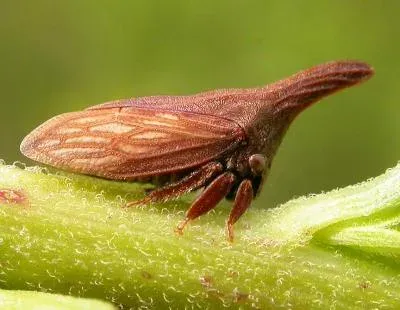
The Campylenchia latipes belongs to the Membracidae family, commonly known as treehoppers. It is distinguished by a prominent backward-pointing pronotal horn that resembles a thorn.
Adults typically measure between 6 and 8 mm in length. Their coloration ranges from grayish-brown to yellowish-tan, providing excellent camouflage against plant stems.
The insect possesses piercing-sucking mouthparts specialized for feeding on plant phloem. Nymphs, or immature stages, lack wings and feature unique, spiny protuberances on their bodies.
The life cycle encompasses the egg stage, five nymphal instars, and the adult stage. In most climates, the species completes one generation per year, overwintering as eggs within plant tissues.
They are primarily diurnal and are frequently found on herbaceous plants, showing a particular preference for members of the Fabaceae and Asteraceae families.
What it damages
This pest affects a broad spectrum of cultivated and wild plants. It poses a significant risk to alfalfa, clover, and various vegetable crops, causing cumulative stress to the host.
Both adults and nymphs consume sap from stems and leaf petioles. This constant feeding leads to a significant decline in plant vigor and overall development.
Mechanical injury caused by female egg-laying activities often creates entry points for secondary pathogens. Tissue necrosis is frequently observed around these oviposition sites.
The impact is most severe during drought conditions, as the plants are already under water stress and have less ability to recover from sap-sucking damage.
The pest's harmfulness is compounded by its potential to act as a vector for various phytopathogenic viruses, which can lead to widespread crop loss across infested fields.
When it appears
Adult activity typically begins in late May or early June. The insects remain active throughout the summer months until early September.
Mass nymph emergence usually occurs in mid-summer, when temperatures are favorable for rapid development and high-intensity feeding on the host plants.
The latter half of the summer marks the peak of the pest population. This is a critical time for farmers to conduct consistent crop monitoring and scouting.
Activity levels drop significantly with the first frosts. Fertilized females focus on selecting suitable plant tissues to deposit their eggs for the winter season.
In southern regions, the timing of these biological events may shift earlier in the season depending on the specific environmental conditions and the growth stage of the crops.
Signs of infestation
The primary indicator of an infestation is the presence of noticeable swellings or splits in the epidermis of the stems, indicating sites where eggs were laid.
Symptoms include yellowing (chlorosis) of the leaves and stunted growth patterns. In severe infestations, foliage may turn brown and wither prematurely.
Close visual inspection often reveals the insects themselves, which tend to remain stationary on the stems. They are highly reactive and will jump quickly if disturbed.
The secretion of honeydew on the underside of leaves attracts ants, which can serve as a helpful secondary sign that treehopper colonies are present in the area.
- Yellowing of stem tips.
- Curling or wilting of young leaves.
- Localized necrosis on plant stems.
- Presence of ant colonies on affected plant areas.
Control measures
The most effective management strategy is cultural control, which involves the removal of weeds that act as alternate hosts or overwintering reservoirs.
Crop rotation is strongly recommended to prevent the buildup of pest populations, especially in areas where legumes are grown continuously.
Chemical control should be implemented only when population thresholds are exceeded. Systemic insecticides are most effective when applied during the period of mass nymph emergence.
It is crucial to time applications during early morning or evening to minimize the impact on non-target beneficial insects, such as pollinators and natural predators.
Biological control can be enhanced by encouraging natural predators, such as predatory bugs, lady beetles, and spiders, which help suppress treehopper numbers in the ecosystem.
Taxonomy
- Latin name
- Campylenchia latipes
- Order
- Hemiptera (bugs, aphids, leafhoppers)
- Family
- Membracidae
- EPPO code
- CAMCLA
Discussion
No discussions yet — be the first.