
Buffalo treehopper
Campylenchia
Description
How to identify
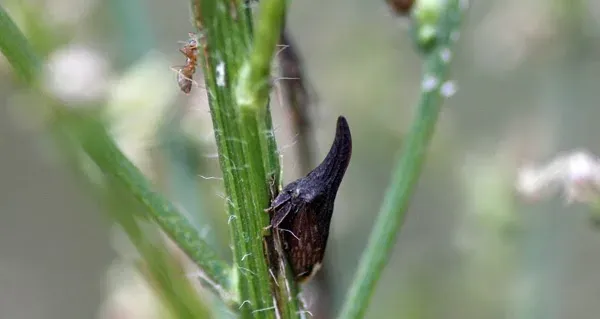
The Buffalo treehopper (Campylenchia latipes) belongs to the Membracidae family, commonly known as treehoppers. It is easily identified by the prominent, horn-like projection on its pronotum.
The insect typically measures about 5 to 7 millimeters in length and exhibits a coloration ranging from light brown to tan, which helps it blend perfectly with plant stems.
Adults possess powerful hind legs adapted for jumping, allowing them to escape quickly when disturbed by predators or human activity in the field.
Nymphs are often covered in waxy secretions and lack the fully developed horns of the adults, but they are equally skilled at hiding in tight crevices on plants.
This species is widely distributed and is known for its ability to thrive in various habitats, particularly in meadows, pastures, and agricultural fields.
What it damages
This pest is a significant threat to various legumes, including alfalfa and clover, as well as many grass species and some ornamental plants.
Both adults and nymphs feed on the phloem sap of the host plants, which drains essential nutrients and weakens the plant's overall vitality.
The primary damage occurs through numerous small punctures in the stem tissue, which can lead to localized wilting and stunting of the affected parts.
Furthermore, these punctures create wounds that facilitate the entry of secondary plant pathogens, leading to more severe diseases and potential crop loss.
The honeydew excreted by the insects provides a substrate for sooty mold growth, which inhibits photosynthesis and reduces the aesthetic and commercial quality of the foliage.
When it appears
The lifecycle of the Buffalo treehopper usually starts with eggs overwintering within the stem tissues of host plants or woody debris.
As temperatures rise in the spring, the eggs hatch into nymphs, which immediately begin to seek out tender shoots and new leaves to feed upon.
The adult stage is most active during the summer months when mating and dispersal occur, leading to the colonization of new host plants.
Environmental conditions play a crucial role in their development, with warm and humid weather favoring faster growth rates and higher population densities.
By late summer or early fall, the adults prepare for the next generation, ensuring their eggs are securely deposited before the onset of winter.
Signs of infestation
Key signs of an infestation include small, distorted spots on stems where the insects have inserted their mouthparts to feed on plant juices.
The presence of sticky honeydew on the leaves and stems is a strong indicator of treehopper activity, often accompanied by foraging ant colonies.
Visual confirmation involves locating the insects perched on stems, as they tend to be shy and often move to the opposite side of the stalk when approached.
Severely infested plants may exhibit stunted growth, yellowing of leaves, and an overall lack of vigor that cannot be attributed to soil or water deficiencies.
Deformation of young growth is another telltale sign, as the damage interferes with the plant's normal development and nutrient transport processes.
Control measures
Managing this pest begins with cultural practices, such as removing infested plant debris and keeping field borders free of weeds that host the insects.
Effective crop rotation is a vital strategy, as it disrupts the availability of host plants necessary for the treehopper's survival and reproduction.
Chemical control, including the application of contact or systemic insecticides, may be necessary if monitoring reveals that pest populations exceed economic thresholds.
Maintaining strong, healthy crops through proper fertilization and irrigation helps plants recover from the stress caused by treehopper feeding.
- Regular monitoring using sticky traps to track population spikes.
- Encouraging natural predators such as lady beetles, lacewings, and parasitic wasps.
- Targeted application of insecticides early in the season when nymphs are most vulnerable.
Taxonomy
- Latin name
- Campylenchia
- Order
- Hemiptera (bugs, aphids, leafhoppers)
- Family
- Membracidae
- EPPO code
- CAMCSP
Discussion
No discussions yet — be the first.