
Cales noacki
Cales noacki
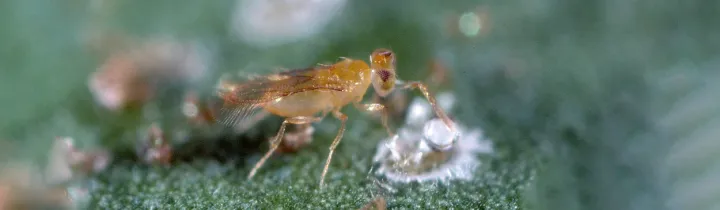
Description
How to identify
Cales noacki is a tiny parasitic wasp belonging to the Aphelinidae family. It is renowned for its role as a specialized parasitoid of the citrus whitefly, which is a major pest in citrus-growing regions.
The adult wasp is extremely small, typically measuring less than one millimeter in length. Its body color usually ranges from yellow to dark brown, which helps it blend into the foliage environment.
Identification in the field is challenging due to the insect's microscopic size. Agronomists typically identify its presence by observing the parasitized, darkened nymphs of the target whitefly.
The life cycle of the wasp is perfectly synchronized with its host. The female wasp deposits its eggs inside the larval stages of the whitefly, ensuring that the offspring have sufficient resources to develop.
Because of its specific host requirements, this parasitoid is highly efficient at tracking whitefly populations, making it a reliable tool for natural pest regulation.
What it damages
It is crucial to clarify that Cales noacki is not a pest. On the contrary, it is a beneficial organism that provides significant economic value to farmers by suppressing pest populations.
The organism it parasitizes, the citrus whitefly, causes direct damage to plants by extracting sap, leading to stunted growth, leaf chlorosis, and the production of honeydew which attracts sooty mold.
By controlling the whitefly population, Cales noacki prevents the indirect damage caused by the accumulation of sooty mold, which can block photosynthesis and degrade fruit quality.
The presence of this parasitoid reduces the need for frequent chemical interventions, which helps maintain the overall health of the agricultural ecosystem.
There are no negative impacts on the crops associated with the activity of this parasitoid, making it a safe and essential component of sustainable citrus management.
Control measures
Protecting Cales noacki populations is a fundamental objective in Integrated Pest Management (IPM). The primary strategy involves the selective use of pesticides.
Broad-spectrum insecticides, particularly those containing organophosphates or pyrethroids, must be avoided as they are highly toxic to the parasitoids and can lead to secondary pest outbreaks.
Agronomists are encouraged to use soft chemicals, such as horticultural oils or insecticidal soaps, only when absolutely necessary and in a way that minimizes contact with the wasp.
Cultural practices, such as maintaining windbreaks and ensuring adequate humidity, help support the survival and dispersion of the parasitoid within the orchard.
In cases of high whitefly pressure, augmentative biological control programs are used, involving the systematic release of laboratory-reared Cales noacki into the affected orchard areas.
Taxonomy
- Latin name
- Cales noacki
- Order
- Hymenoptera
- Family
- Aphelinidae
- EPPO code
- CAESNO
Discussion
No discussions yet — be the first.