
Cales
Cales
Description
How to identify
The genus Cales, notably the species Cales noacki, belongs to the family Aphelinidae within the order Hymenoptera. In agricultural science, this insect is highly regarded as a beneficial parasitoid rather than a plant pest.
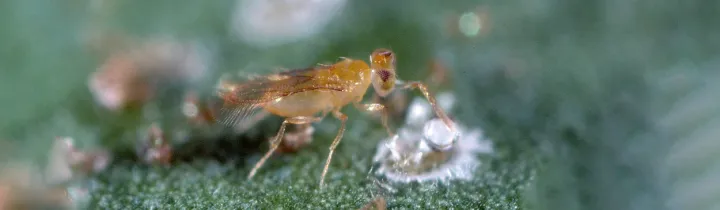
These are extremely small wasps, often less than 1 mm in length. They possess the typical morphological features of Aphelinidae, including delicate veined wings and a compact body structure adapted for life as an endoparasite.
The life cycle involves the female wasp laying eggs directly into the larval stages of its host, primarily whitefly species. This reproductive strategy makes them a cornerstone of biological pest management programs.
Accurate identification requires professional entomological expertise, as these insects are difficult to distinguish in the field without the aid of magnifying lenses or microscopic examination.
Understanding their taxonomy is crucial for agronomists to ensure that these beneficial organisms are protected and not erroneously targeted during routine pesticide applications.
What it damages
The primary target of Cales is the citrus whitefly (Aleurothrixus floccosus). Rather than causing damage, these insects mitigate the destruction caused by the whitefly infestation.
If beneficial populations are suppressed by non-selective chemical treatments, the underlying whitefly population can explode, causing severe damage to citrus groves and ornamental plants.
Whitefly damage itself includes the extraction of plant sap, which leads to leaf yellowing, stunting, and the excretion of honeydew that promotes the growth of sooty mold.
Sooty mold growth on leaves inhibits photosynthesis, significantly reducing plant vigor and overall fruit quality in commercial citrus production.
Therefore, Cales serves as an essential natural regulator, providing a sustainable way to keep whitefly populations below economic threshold levels.
When it appears
The activity of Cales is highly dependent on environmental conditions, with peak performance occurring during the warmer seasons when hosts are most abundant.
In greenhouse environments, they can maintain continuous generations throughout the year, provided there is a constant supply of whitefly larvae to serve as hosts.
Wintering occurs primarily in the larval stage inside the host, or as adults in protected micro-habitats where they can survive until temperatures become favorable again.
Monitoring efforts should intensify during spring and summer months when the synchronization between the parasite and the host is at its highest point.
Temperature and humidity fluctuations can influence the developmental speed, making climate monitoring essential for successful biological control implementation.
Signs of infestation
The presence of Cales is marked by a noticeable decline in whitefly density on the undersides of leaves throughout the growing season.
Microscopic evidence of parasitism includes the darkening of host larvae or the appearance of exit holes where the adult wasp has emerged after pupation.
A reduction in the amount of honeydew and sooty mold on the foliage is a primary field sign that the parasitoids are effectively suppressing the pest population.
Consistent monitoring of the whitefly colony structure will reveal a higher proportion of parasitized larvae over time as the Cales population stabilizes.
Absence of new, fresh whitefly infestation sites often indicates a well-established and active population of beneficial wasps within the managed area.
Control measures
The central management strategy involves preserving natural populations of Cales by strictly limiting the use of broad-spectrum insecticides.
Integrated Pest Management (IPM) practices should prioritize the use of biorational pesticides that are non-toxic to Hymenoptera parasitoids.
Cultural practices, such as maintaining appropriate plant spacing to ensure good airflow, help reduce the overall susceptibility to whitefly outbreaks.
Field scouting should utilize yellow sticky cards to detect whitefly presence while taking care to identify and protect the presence of natural enemies.
- Avoid synthetic pyrethroids during the wasp's peak activity window.
- Maintain surrounding vegetation to provide nectar and refuge for adult wasps.
- Implement regular population surveys to evaluate the efficacy of natural control.
Taxonomy
- Latin name
- Cales
- Order
- Hymenoptera
- Family
- Aphelinidae
- EPPO code
- CAESSP
Discussion
No discussions yet — be the first.