
Grape leaf blister mite
Calepitrimerus cerosus
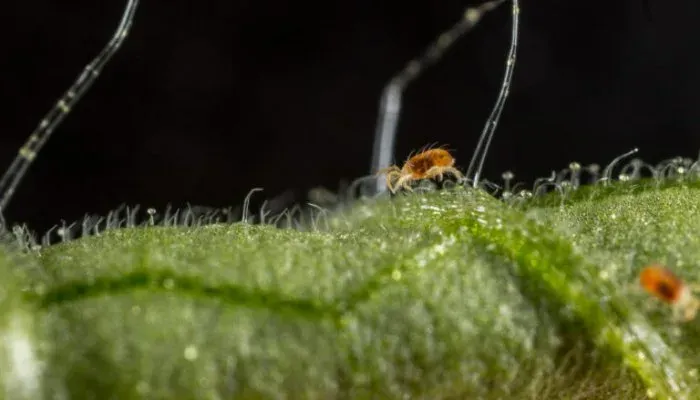
Description
How to identify
The grape leaf blister mite (Colomerus vitis), a member of the Eriophyidae family, is a microscopic pest that causes significant damage to grapevines.
Measuring only about 0.15 to 0.2 mm in length, these mites are impossible to see with the naked eye, making the observation of plant symptoms the primary diagnostic tool.
They possess a worm-like, elongated body with a light yellow or white color, protected by a series of fine rings that characterize the Eriophyid family.
These mites overwinter as fertilized females, primarily hiding under the scales of dormant buds near the base of the vine canes to survive the winter cold.
Dispersal within a vineyard occurs mainly through wind drift, as well as being transported by larger insects, birds, or human activity like pruning and handling vine material.
What it damages
The primary host for this species is the common grapevine (Vitis vinifera), though it can also infest other Vitis species and their hybrids.
By using their piercing-sucking mouthparts, these mites feed on the epidermal cells of leaves, triggering an abnormal growth response from the plant tissue.
The feeding process interrupts photosynthesis, causing the vine to lose its vitality, which can lead to delayed growth and poor vine development throughout the season.
High infestation levels may cause the mites to attack developing flower buds, leading to stunted growth, reduced fruit set, and significant losses in overall yield.
Persistent attacks over several seasons weaken the entire plant, making it more susceptible to environmental stressors, such as frost and drought, or secondary infections.
When it appears
The mites emerge from their overwintering sites during the spring, coinciding with the swelling and opening of the grape buds.
Early symptoms usually manifest in late spring, as the mites move onto the newly emerging leaves to establish their feeding colonies.
The mite population continues to grow and multiply during the summer, with several overlapping generations occurring if weather conditions remain warm and favorable.
Peak activity is typically observed during the height of the summer, as humidity and temperature promote the rapid colonization of young, tender leaves.
As autumn approaches and temperatures drop, the mites migrate back to the dormant buds, where they will spend the winter months in a state of diapause.
Signs of infestation
The most distinctive sign of infestation is the appearance of raised, blister-like galls on the upper surface of the leaves, which may be red, yellow, or green.
On the underside of the leaves, these galls are marked by a dense, felt-like patch of trichomes, which turns from white to rusty-brown as the season progresses.
In severe cases, the leaf lamina becomes severely curled, distorted, and stunted, which impairs the plant's ability to create energy for fruit production.
Bud infestation can lead to the "bunching" or malformation of leaves and shoots, giving the grapevine a stunted or deformed appearance.
- Raised blister galls on leaf surfaces.
- Felt-like patches on the underside of leaves.
- Distorted, curled, or stunted leaf development.
- Premature yellowing and leaf abscission.
Control measures
Prevention begins with the selection of certified, clean nursery stock to ensure that no mites are introduced into new vineyard plantings.
Early season applications of sulfur-based pesticides are highly effective as they target the mites when they are most vulnerable during their emergence from winter buds.
For established infestations, systemic or contact acaricides should be used during the growing season, strictly following the manufacturer's dosage and timing instructions.
Cultural practices such as pruning and removing heavily infested shoots can help significantly lower the mite population density within the vineyard.
Maintaining balanced vine nutrition and adequate water supply improves the plant's stress tolerance and supports a faster recovery after mite damage.
Taxonomy
- Latin name
- Calepitrimerus cerosus
- Order
- Mites
- Family
- Eriophyidae
- EPPO code
- CALECE
Discussion
No discussions yet — be the first.