
Purple tea mite
Calacarus carinatus
Description
How to identify
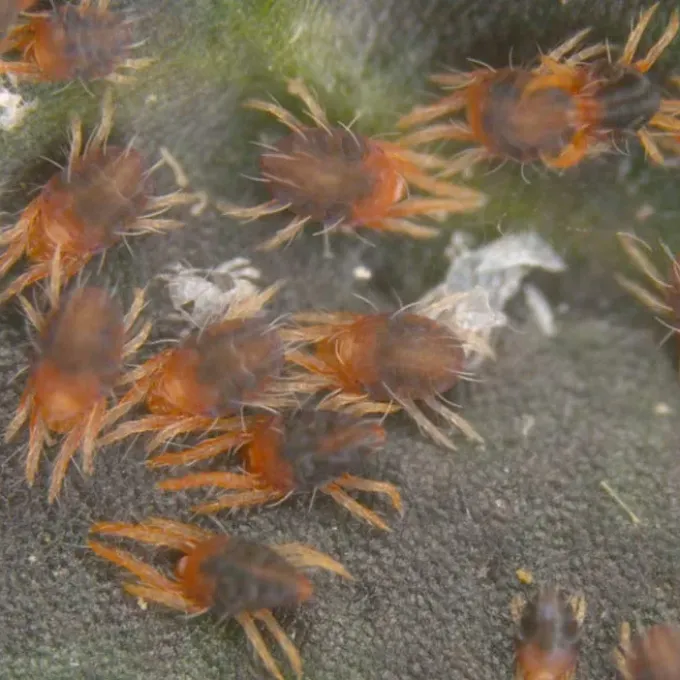
The purple tea mite (Calacarus carinatus) is a microscopic pest belonging to the family Eriophyidae. It is characterized by an elongated, spindle-shaped body, typically purple or dark brown, with longitudinal ridges along its dorsal side.
Adult mites measure only about 0.15–0.2 mm in length, making them invisible to the naked eye. Unlike spider mites, they do not produce silk webs, which often causes their presence to be overlooked until significant damage occurs.
The life cycle includes an egg stage, two nymphal stages, and an adult stage. Under optimal warm and humid conditions, a generation can develop within 7 to 14 days, leading to rapid population explosions.
Continuous reproduction throughout the growing season allows the pest to spread quickly across large tea plantations, often facilitated by wind or farm machinery.
Correct identification requires laboratory analysis or the use of magnifying lenses to inspect the underside of leaves for these distinctively ridged, slow-moving mites.
What it damages
The primary host for Calacarus carinatus is the tea plant (Camellia sinensis). These mites prefer to feed on the underside of mature leaves, though they can also infest young buds and tender stems.
By piercing the epidermal cells and consuming the cell contents, the mites disrupt the plant's ability to conduct photosynthesis and regulate transpiration, causing general physiological stress.
While the mite is most economically damaging to tea plantations, it can occasionally be found on other plant species, but the impact on tea leaf yield and quality is its most significant agricultural concern.
Severe infestations lead to premature leaf drop and weakened plants, making the plantation more susceptible to other diseases and environmental stress throughout the winter months.
Financial losses occur not only through direct reduction in tea leaf weight but also through the degradation of leaf quality, which directly affects the processing value of the harvest.
Signs of infestation
The earliest symptom of infestation is the loss of the leaf's natural sheen, followed by a color shift to a dull bronze, grey, or purple hue due to cell death.
Growers should look for inward curling of leaf margins and the presence of fine, necrotic spots that develop as the mite population increases over time.
Leaves affected by high mite populations become leathery, stiff, and brittle. This damage is often mistaken for nutrient deficiencies or natural senescence if not checked properly.
The overall appearance of the affected tea bush becomes stunted, with reduced production of high-quality young flushes that are essential for premium tea production.
Timely field scouting is critical, as initial signs are localized and can be easily missed if inspection is limited only to the upper surfaces of the foliage.
Control measures
Management of the purple tea mite relies on integrated pest management (IPM) strategies, combining chemical interventions with cultural practices to suppress population growth.
Acaricides must be applied cautiously, ensuring that the substances used comply with international food safety standards for tea, given the potential for residue on the final harvest.
Improving plant vigor through balanced fertilization and proper water management can reduce the vulnerability of the crop to mite outbreaks during dry spells.
Biological control, using predatory mites of the Phytoseiidae family, serves as a sustainable way to maintain mite populations below the economic injury level.
- Regular monitoring of the underside of leaves using a 10x hand lens.
- Application of sulfur-based products where permitted.
- Sanitation protocols for pruning equipment to prevent cross-contamination.
- Rotation of chemical classes to manage the risk of mite resistance.
Taxonomy
- Latin name
- Calacarus carinatus
- Order
- Mites
- Family
- Eriophyidae
- EPPO code
- ERPHCA
Discussion
No discussions yet — be the first.