
Natterjack toad
Bufo calamita
Description
How to identify
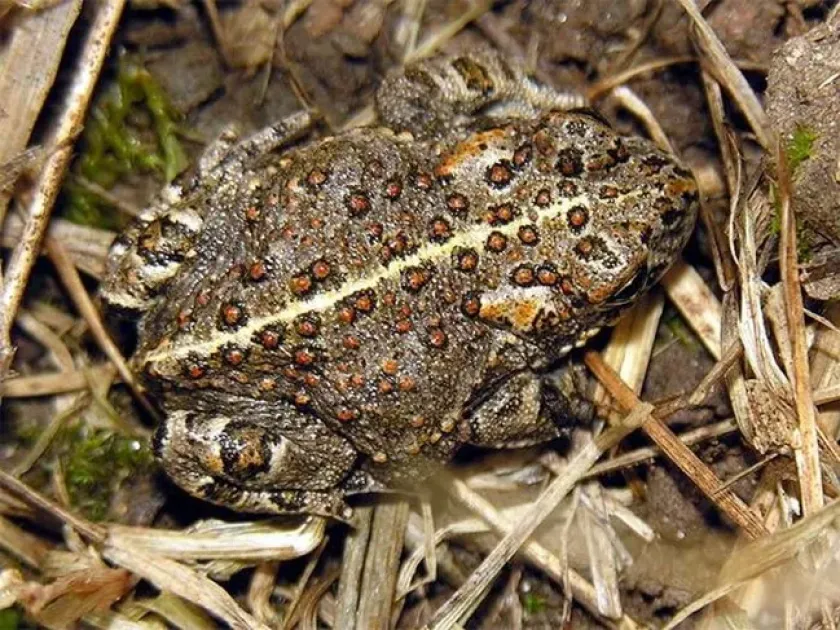
The Natterjack toad (Bufo calamita) is a unique amphibian species easily recognized by a prominent, narrow yellow stripe running down the middle of its back. Adults are typically 6–8 cm long with warty, olive-brown skin.
A distinctive behavioral trait of this species is its movement; unlike other toads that hop, the Natterjack prefers to scurry or run quickly. It has horizontal pupils and distinct glands located behind its eyes.
During the mating season, males produce an extremely loud, rattling call that can be heard from a significant distance, often resembling the sound of a mechanical engine or a rhythmic buzz.
Tadpoles are dark in color and develop rapidly in shallow, sun-warmed temporary pools, which is an evolutionary adaptation to avoid predators and desiccation in larger bodies of water.
The species prefers sandy or heathland soils, making it an occasional visitor to the borders of agricultural fields, particularly in areas near coastal zones or marshy lands where ground conditions are loose.
What it damages
It is important to emphasize that the Natterjack toad is not an agricultural pest. It does not feed on crops, damage roots, or consume leaves, and it lacks the biological mechanisms to harm vegetation.
In fact, the toad acts as a predator of various invertebrates, including insects, beetles, and larvae that are often classified as pests. By controlling these insect populations, they contribute positively to the ecosystem.
The only potential for "damage" arises from technical interactions with farming infrastructure, such as individuals accidentally blocking irrigation filters or getting stuck in drainage valves during their seasonal movements.
Because the Natterjack toad is a protected species under international and local wildlife legislation, its presence is a sign of a healthy, biodiverse landscape that should be respected by farmers.
Economic damage is nonexistent; instead, the value of the species lies in its role as a natural regulator of insect populations, which helps maintain the biological stability of the farm environment.
When it appears
Natterjack toad activity typically begins in early spring, around April, when soil temperatures rise enough to allow them to emerge from hibernation and migrate toward suitable breeding ponds.
The peak activity and breeding period occur from late spring through mid-summer. During this time, they are most concentrated around shallow, stagnant water bodies that provide the necessary warmth for egg development.
As temperatures increase during the peak of summer, these toads become more nocturnal, hiding during the day to prevent dehydration and re-emerging at night to forage for insects in cool, shaded areas.
Autumn brings a decline in activity, as individuals begin to search for overwintering sites, often moving deep into soil, rock crevices, or rodent burrows to wait out the freezing months.
Throughout the winter, the species remains in a state of hibernation, meaning there is zero interaction with agricultural equipment or crops during the cold season.
Signs of infestation
The most reliable sign of their presence is the characteristic, loud mechanical-sounding chorus produced by males on warm spring nights, usually near irrigation ditches or water-filled depressions.
Finding long, thin egg strings attached to aquatic vegetation in shallow water is a definitive indicator that the area is being used for breeding and is an ecologically stable site.
Evidence of their activity may include sightings of toads near field edges or irrigation pumping stations during evening or night hours, especially after rain when they are most mobile.
The presence of biological debris or small amounts of mucus in water filters can sometimes serve as a sign of their interaction with irrigation infrastructure, indicating a need for minor mechanical shielding.
A reduction in insect pest activity in fields bordering suitable toad habitats can also be viewed as a positive sign of the ecological services provided by this species to the agricultural enterprise.
Control measures
The use of chemical pesticides or any form of extermination against the Natterjack toad is strictly prohibited due to its endangered status and protected nature globally.
Effective management focuses on physical exclusion rather than control; installing fine-mesh screens on irrigation inlets prevents toads from entering water systems without causing them any harm.
Agricultural operations can be optimized by keeping drainage channels and maintenance areas clear of thick debris, which reduces the temptation for the toads to reside in high-traffic infrastructure.
Where necessary, animals found in dangerous locations can be gently relocated to nearby natural habitats, ensuring their safety and the continued smooth operation of agricultural equipment.
Promoting a harmonious co-existence is the recommended strategy, leveraging the presence of these natural pest controllers to support sustainable and environmentally friendly farming practices.
Taxonomy
- Latin name
- Bufo calamita
- Family
- Bufonidae
- EPPO code
- BUFOCA
Discussion
No discussions yet — be the first.