
Ground moth
Bryotropha terrella
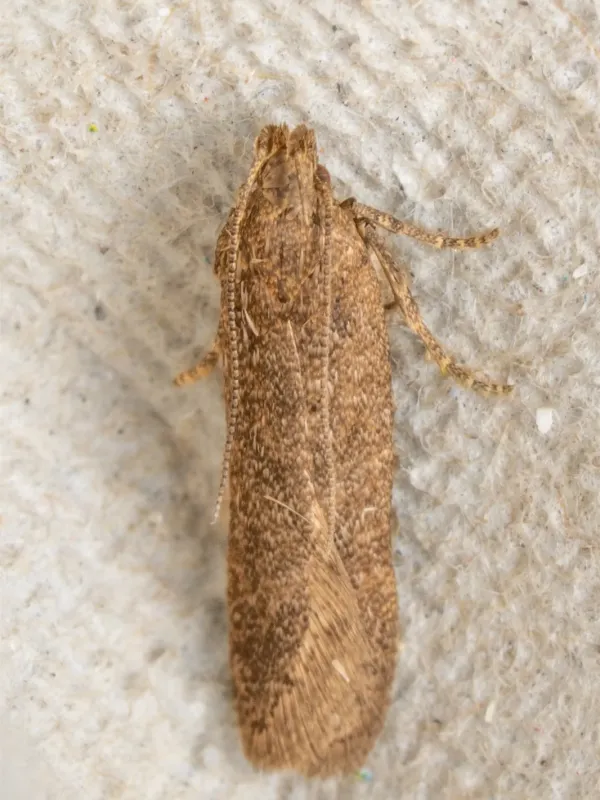
Description
How to identify
The ground moth (Bryotropha terrella) is a member of the order Lepidoptera and the family Gelechiidae. It is a small moth species that typically maintains a secretive, nocturnal lifestyle.
Adult insects have narrow wings with an inconspicuous greyish or brownish coloration, providing excellent camouflage against soil surfaces and dry vegetation.
The wingspan of the moth usually ranges from 13 to 18 millimeters, and its body is covered in small scales, which is a morphological characteristic of this family.
The larvae possess a well-developed head and thoracic legs, allowing them to move efficiently through the root zone of their host plants.
Accurate species identification often requires genital analysis, as the external appearance can be easily confused with other members of the Bryotropha genus.
What it damages
This pest is primarily associated with herbaceous plants and cereals, often inhabiting dry soils, grasslands, and various open landscapes.
Larvae feed on plant tissues, often establishing themselves in the root zone or the base of the stems, where they construct protective silk tubes.
Major damage occurs during active plant growth, as the destruction of growth points or stem tissues can lead to stunted development and eventual wilting.
In agricultural settings, this species can pose a threat to pastures and perennial grass crops, significantly reducing their biomass production.
Physical damage to the stem disrupts photosynthesis and nutrient transport, which is particularly detrimental during the early stages of vegetation.
When it appears
The lifecycle of Bryotropha terrella typically consists of one generation per year, a common pattern for species of this genus in temperate climates.
Adult moth activity is recorded during summer months, primarily from June to August, when environmental conditions favor mating and egg-laying.
Overwintering takes place in the larval stage, with caterpillars hiding in plant debris or the upper layer of soil to survive low winter temperatures.
In the spring, as temperatures rise, the larvae resume feeding on young shoots of grasses, coinciding with the start of the intensive growth period.
Pupation occurs within the soil or in sturdy cocoons hidden among dry grass debris, signaling the final stage before the emergence of the next generation.
Signs of infestation
The primary sign of infestation is the presence of silk webbing around the root collar of the plant, which larvae use to create their shelters.
Yellowing and subsequent wilting of individual shoots in localized patches are strong indicators of larval feeding activity in the root zone.
Fine frass (larval excrement) found near the base of the stem is a reliable indicator of the presence of these pests in a field.
Adult moths are nocturnal and are attracted to artificial light, which allows entomologists to use light traps to monitor population density.
Inspection of crop residues and dry vegetation often reveals empty pupal casings or larval skins, confirming the presence of the infestation.
Control measures
Effective management begins with proper agronomic practices, such as the removal or deep incorporation of crop residues that harbor overwintering larvae.
Deep plowing or mechanical tillage of the soil is an effective way to physically destroy larvae and disrupt their hibernation habitats.
Crop rotation is a essential strategy to prevent the buildup of pest populations, especially in areas dedicated to perennial grass production.
If the infestation exceeds the economic threshold, the application of registered insecticides is recommended for effective crop protection.
Promoting the population of natural predators and parasitoids is a sustainable approach to managing these pests within an integrated pest control framework.
Taxonomy
- Latin name
- Bryotropha terrella
- Order
- Lepidoptera (butterflies)
- Family
- Gelechiidae
- EPPO code
- BRYTTE
Discussion
No discussions yet — be the first.