
Bradybaena despecta
Bradybaena despecta
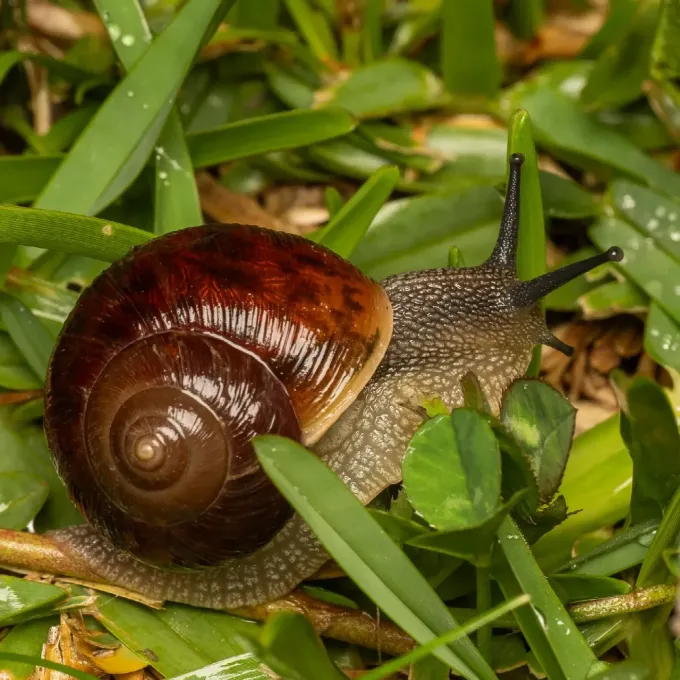
Description
How to identify
Bradybaena despecta is a terrestrial gastropod mollusk belonging to the family Bradybaenidae. These snails possess a distinct rounded-conical shell, typically colored in light brown or yellowish hues with subtle spiral banding.
The species is well-adapted to varied environments, relying on a thick layer of mucus to prevent desiccation. This mucus is crucial for their movement and survival in fluctuating humidity conditions.
Taxonomically, they are classified under the order Stylommatophora. Like many land snails, they are hermaphroditic, allowing for rapid reproduction and population growth in suitable habitats.
Their activity is strongly tied to moisture levels. During dry periods, they seek shelter under debris, inside dense foliage, or deep within the soil profile to minimize water loss.
Identification is most easily achieved by observing the shiny, silvery trails of dried mucus left on plant surfaces, which serve as a reliable indicator of their recent presence.
What it damages
This snail is a known polyphagous pest, capable of feeding on a wide range of horticultural crops. They frequently target leafy vegetables such as lettuce, cabbage, and spinach, causing significant biomass loss.
The damage typically manifests as irregular holes in the leaf blades. In cases of high infestation, they can skeletonize leaves, leaving only the primary veins intact, which stresses the plant.
They are particularly problematic in seedling production, where young plants can be completely consumed overnight. This causes severe economic losses in both greenhouses and open fields.
Besides leaf damage, they may feed on young fruits or the skin of ripening produce, creating entry points for secondary bacterial and fungal infections that lead to premature decay.
Their feeding activity not only impacts the visual quality of the crop but also slows down the vegetative growth rate of affected plants, often leading to stunted development.
When it appears
Activity cycles of Bradybaena despecta are governed by climatic conditions, with high activity observed during warm, humid months. Spring rains typically trigger the emergence of overwintered individuals.
Summer marks the peak breeding season, as favorable moisture levels allow for consistent egg-laying. Population density can escalate quickly during wet summer months if no control measures are taken.
Autumn remains a period of significant feeding activity, especially during extended rainy spells. The snails continue to consume available vegetation until temperatures drop significantly.
Wintering occurs in the form of adult snails or egg clutches hidden deep within the soil or beneath thick layers of organic mulch, where they wait for spring to emerge.
Monitoring for the pest should begin early in the season, focusing on the first signs of moisture-dependent activity when plants are most vulnerable in their early stages of growth.
Signs of infestation
The primary symptom of infestation is the presence of uneven, jagged holes in foliage. Unlike insect pests that may leave clean-cut edges, snail feeding is slower and less precise.
Silvery, glistening trails of dried mucus are a tell-tale sign of their activity. These trails are usually found on stems, leaf surfaces, and the surrounding soil surface.
Massive skeletonization is common in areas of high population density. When leaves are stripped to the veins, the plant loses its ability to photosynthesize effectively, leading to rapid decline.
Observation during dawn or dusk is often fruitful, as the snails emerge from their daytime refuges to feed during the cooler, more humid hours of the day.
Secondary signs include the appearance of localized rot on stems or fruits, often linked to the introduction of soil-borne pathogens by the snails as they move and feed.
Control measures
Effective control strategies emphasize cultural practices, such as removing weeds and plant debris to eliminate the daytime hiding spots that snails rely on to survive.
Improving greenhouse ventilation and avoiding evening irrigation can significantly reduce the attractiveness of the environment to this moisture-loving pest.
Physical barriers, such as sharp-edged gravel or specialized copper-based tapes around the base of vulnerable plants, can successfully deter movement and protect seedlings.
Chemical control involving molluscicides, particularly those based on iron phosphate, provides a safer alternative for gardens while effectively managing population spikes.
- Encouraging natural predators like ground beetles, toads, and birds.
- Using manual traps like boards or moist burlap sacks for collection.
- Tilling the soil regularly to destroy overwintering egg clusters.
Taxonomy
- Latin name
- Bradybaena despecta
- Order
- Molluscs
- Family
- Bradybaenidae
- EPPO code
- ACUSDE
Discussion
No discussions yet — be the first.