
Blepharipa schineri
Blepharipa schineri
Description
How to identify
Blepharipa schineri is a species of tachinid fly (family Tachinidae) known for its role as a specialized parasitoid of the gypsy moth (Lymantria dispar). It is a significant biological control agent in forest ecosystems.
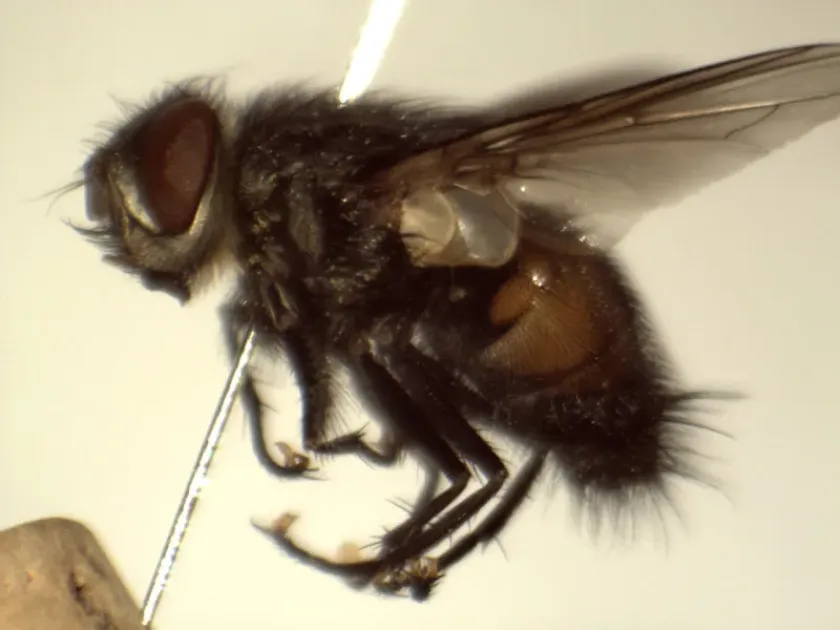
Adult flies are robust, generally gray or black, and covered in dense bristles typical of the Tachinidae family. Their eyes are large, enabling precise movement and navigation through forest foliage.
The larvae are internal parasites that have evolved specialized hooks and mouthparts to consume the soft tissues of their host without immediately killing it, ensuring sufficient food supply during their growth.
Identification often requires expert taxonomic knowledge due to the high diversity of the Tachinidae family. Microscopic analysis of the larval mouthparts or the puparium structure is often necessary for confirmed identification.
Their morphological adaptations, such as a specialized ovipositor or egg-laying strategy, allow them to successfully target host larvae in the complex environment of tree crowns.
What it damages
This species is not a pest; rather, it is a beneficial organism that limits the population of the gypsy moth, which is a major defoliator of broad-leaved trees.
The female fly lays micro-eggs on the leaves of host trees. When a gypsy moth larva consumes these eggs, the larvae hatch inside the gut and begin their parasitic development within the host's body.
The parasitoid consumes the internal tissues of the gypsy moth larva, leading to the eventual death of the host once the parasitoid has reached maturity and is ready to pupate.
By killing the gypsy moth larvae, Blepharipa schineri reduces the overall defoliation of forest trees, contributing to the health and resilience of the woodland.
Therefore, its impact is categorized as highly beneficial in forestry. The "damage" it causes is entirely restricted to the populations of the harmful gypsy moth.
When it appears
The adult flies are active during the late spring and early summer months. This corresponds with the presence of susceptible stages of gypsy moth larvae in the field.
Development occurs throughout the summer as the larvae mature inside the host. Upon finishing their development, they leave the dying host to pupate in the soil or leaf litter beneath the trees.
Overwintering occurs at the puparium stage, buried in the soil or protected under forest debris, allowing the population to survive the harsh winter temperatures.
The lifecycle is tightly synchronized with the development of the gypsy moth. This seasonality ensures that the next generation of flies emerges exactly when the next generation of host larvae is available.
There is typically one generation per year, which is consistent with the annual cycle of the gypsy moth in temperate forest regions.
Signs of infestation
Signs of parasitism are mostly seen during post-mortem examination of gypsy moth pupae. Exit holes on the pupal casing indicate that a tachinid fly has successfully completed its development and emerged.
A sudden decline in the density of gypsy moth larvae in a known outbreak area often signals the presence of high parasitism levels, with Blepharipa schineri playing a key role.
In laboratory studies or field monitoring, parasitized larvae often show symptoms of lethargy, reduced feeding, and eventually, the formation of abnormal, empty pupal shells.
Finding puparia in the leaf litter at the base of infested trees is a clear indicator of the presence of the parasitoid within the ecosystem.
Entomologists monitor these signs to assess the effectiveness of natural biological control, which helps decide whether chemical intervention is necessary or if the population will collapse naturally.
Control measures
Preservation of this species requires minimal human intervention. The most effective strategy is the maintenance of healthy forest habitats that support diverse populations of natural enemies.
Avoidance of broad-spectrum insecticide sprays during the period of adult fly activity is crucial. Such pesticides often kill the beneficial parasitoids, leading to secondary outbreaks of the gypsy moth.
Forest management should prioritize integrated pest management (IPM) practices, utilizing biological controls and selective biopesticides that have no negative impact on tachinid flies.
Enhancing the forest understory with flowering plants can provide adult flies with nectar, increasing their longevity and reproductive efficiency in the field.
Monitoring the population dynamics of Blepharipa schineri is essential for predictive modeling in forestry, allowing managers to rely on biological regulation rather than costly and ecologically harmful chemicals.
Taxonomy
- Latin name
- Blepharipa schineri
- Order
- Diptera (flies)
- Family
- Tachinidae
- EPPO code
- BLEPSH
Discussion
No discussions yet — be the first.