
Blepharipa
Blepharipa
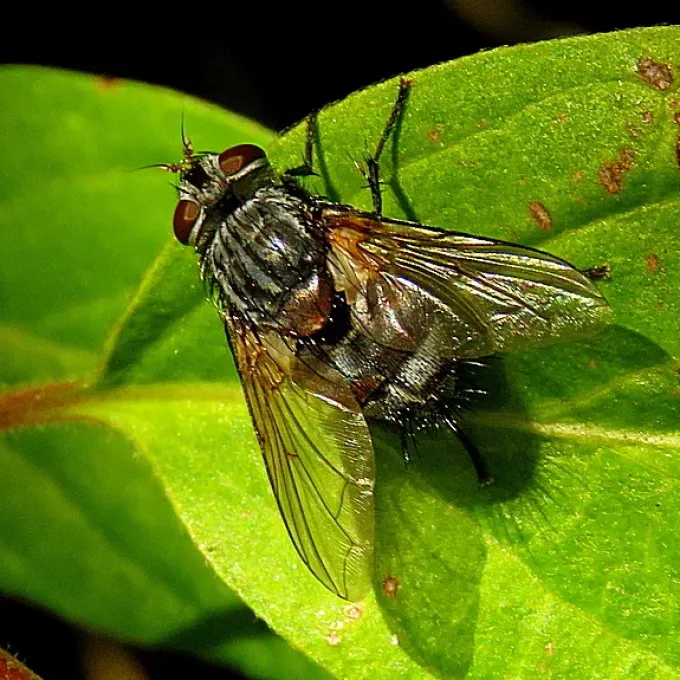
Description
How to identify
Blepharipa is a genus of tachinid flies (family Tachinidae) belonging to the order Diptera. These insects are known for their strong, bristly bodies and their role as specialized parasitoids of various lepidopteran caterpillars.
Adult flies resemble common houseflies but are distinguishable by their specific set of cephalic and thoracic bristles. They possess a well-developed proboscis, primarily used for feeding on floral nectar.
The genus is biologically significant because the larvae develop inside the host body, ultimately leading to the death of the caterpillar. This process makes them a key natural enemy of several forest and agricultural pests.
Identification to the species level is complex and usually requires an examination of the male genitalia and specific chaetotaxy. They are widely distributed across various climate zones.
In the field, adults are often observed hovering around foliage where hosts (caterpillars) are present, indicating a symbiotic relationship within the local ecosystem.
What it damages
Blepharipa is not a plant pest; it is a beneficial insect. It does not feed on plant tissues, nor does it destroy crops. Instead, it targets the larvae of moths that are often destructive to orchards and forests.
The only "damage" caused is the termination of the host caterpillar's life. In agricultural contexts, this is considered a positive contribution to integrated pest management (IPM) strategies.
The hosts for Blepharipa species include various species of silk moths, leafrollers, and loopers, which are notorious for defoliating trees and reducing fruit yields.
By consuming the internal organs of these caterpillars, the fly larvae prevent further feeding damage to the host plant, effectively saving the foliage from complete destruction.
Therefore, Blepharipa is classified as a biological control agent rather than a pest, and its presence should be encouraged by farmers and foresters.
When it appears
The lifecycle of Blepharipa is synchronized with the activity of its host insects. Adults typically emerge in late spring or early summer, corresponding with the early stages of caterpillar development.
Females are highly active during the daylight hours, searching for host larvae to deposit their eggs on. Depending on the species, they may produce one or two generations per year.
The overwintering stage usually takes place as a puparium, buried in the soil or beneath forest leaf litter. This allows them to survive cold winter temperatures successfully.
As temperatures rise in the spring, the pupae break dormancy, and the adult flies emerge to begin the cycle again. The timing of this emergence is crucial for effective pest suppression.
Monitoring the population of these flies is best conducted during the flowering stage of nearby trees, where adults aggregate to forage.
Signs of infestation
The most common sign of Blepharipa activity is the presence of small, white, oval eggs attached to the dorsal surface of a caterpillar. These are easily visible with a magnifying glass.
Parasitized caterpillars often show signs of lethargy, reduced feeding activity, and gradual discoloration. Their growth rate slows down significantly before they finally succumb to the parasitoid.
After the larvae finish their development inside the host, they emerge and drop to the ground to pupate. One might find the empty, desiccated skin of the caterpillar near the base of the plant.
The presence of adult flies in the vicinity of host plants is another strong indicator of their activity. Farmers often observe these flies patrolling tree branches in search of larvae.
Empty pupal cases found in the topsoil under tree canopies indicate that the parasitoids successfully completed their development cycle in the previous season.
Control measures
Control measures are unnecessary for Blepharipa as it is a beneficial organism. The management goal should be conservation and habitat improvement to boost its population.
To support these beneficial flies, growers should minimize the use of broad-spectrum insecticides, especially during the peak flight season when adults are active.
- Plant diverse nectar-producing flowers around fields to provide food for adults.
- Preserve leaf litter and undisturbed soil patches for overwintering pupae.
- Implement IPM to ensure compatibility between chemical applications and biological agents.
By shifting towards selective, reduced-risk pesticides, farmers can protect the natural population of tachinid flies, allowing them to provide free biological control services.
Conservation biological control, such as maintaining hedgerows or wild borders, is the most effective way to sustain high numbers of Blepharipa in an agricultural landscape.
Taxonomy
- Latin name
- Blepharipa
- Order
- Diptera (flies)
- Family
- Tachinidae
- EPPO code
- BLEPSP
Discussion
No discussions yet — be the first.