
Bistrispinaria fortis
Bistrispinaria fortis
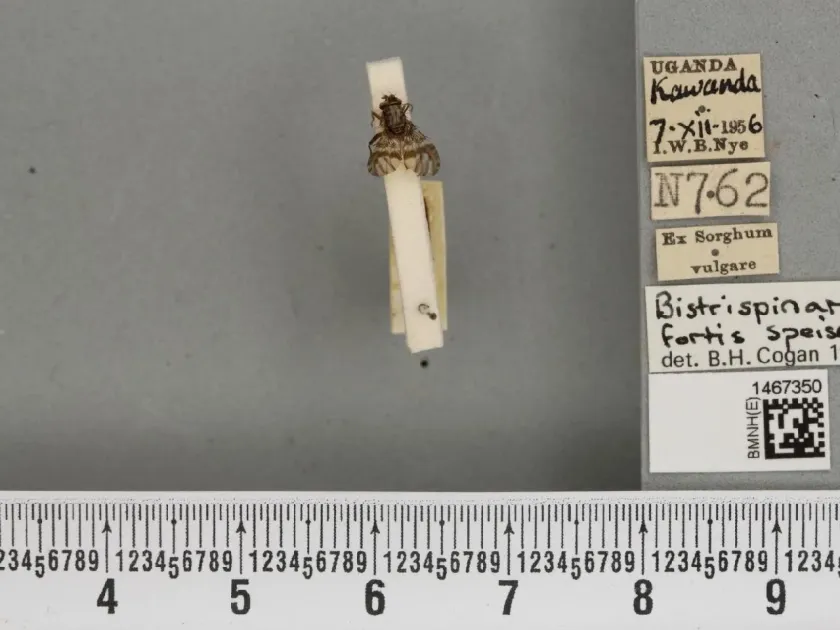
Description
How to identify
Bistrispinaria fortis is a species of grasshopper belonging to the order Orthoptera and the family Acrididae. It is recognized by specific morphological features, including the structure of its pronotum and the arrangement of spines on the hind tibiae.
Adults possess cryptic coloration that allows them to blend in with arid and dry landscapes. Their size varies based on environmental conditions and the availability of food sources throughout the growing season.
The insect possesses strong, robust mandibles designed for consuming coarse vegetation. Like other grasshoppers, it undergoes incomplete metamorphosis, with nymphs appearing as miniature versions of the adults but without fully developed wings.
Identification of the species can be complex due to its similarity to other regional Acrididae, often requiring microscopic examination of specific anatomical features for precise taxonomic confirmation.
This species is well-adapted to high-temperature environments, which drives its survival strategy and enables it to maintain large populations in suitable agricultural habitats.
What it damages
The pest primarily infests cereal crops such as wheat, barley, and maize. In cases of severe outbreaks, it may also attack various legumes and vegetable crops if primary food sources are depleted.
The greatest damage is caused by late-instar nymphs and adult insects, both of which have voracious appetites. They consume leaf blades, stems, and sometimes even the flowering parts of the crops.
Young seedlings are particularly vulnerable, as even minor feeding activity can lead to complete plant death, significantly reducing the density and overall yield of the stand.
Feeding activity often weakens the plants, making them susceptible to secondary stressors, including pathogens and fungal infections that further impact crop quality and harvest potential.
Because these insects move in groups, the speed of crop loss can be very high, necessitating immediate monitoring and intervention to prevent large-scale destruction of the fields.
When it appears
The life cycle of Bistrispinaria fortis is strictly synchronized with seasonal temperature shifts. Nymphs typically emerge from egg pods in the spring once soil temperatures reach a specific threshold.
The peak period of activity and damage occurs during the mid-summer months of June and July, when nymphs mature into winged adults capable of migrating across larger areas.
Egg-laying takes place in late summer, with females depositing their eggs in sturdy pods within the soil. They often select compact, dry ground along road margins or field edges.
The species survives the winter by remaining in the egg stage, which is buried deep within the soil profile, protected from freezing temperatures and desiccation.
Year-to-year population fluctuations are highly sensitive to weather patterns, with hot, dry spring seasons favoring higher survival rates for the emerging nymphs.
Signs of infestation
One of the earliest signs of infestation is the appearance of jagged, uneven edges on leaf blades, indicating that the tissue has been torn rather than neatly cut by other pests.
Damage often manifests in patches that grow progressively larger over time as the swarm migrates across the field, leading to the creation of barren areas in the canopy.
The presence of fine, granular insect droppings at the base of the plants is a reliable indicator that Bistrispinaria fortis is actively feeding in the vicinity.
Movement of the grasshoppers within the crop can often be detected by a characteristic rustling sound, which becomes more pronounced when walking through the field during the day.
Large-scale defoliation is a clear sign that the pest population has exceeded the economic threshold, requiring immediate tactical action to save the remaining crop.
Control measures
Integrated pest management strategies are essential for controlling Bistrispinaria fortis, starting with regular scouting and economic threshold monitoring.
- Application of contact or systemic insecticides during the early nymph stages to prevent maturation.
- Deep autumn plowing to disturb the soil and destroy the overwintering egg pods.
- Implementation of biological controls, such as using specific entomopathogenic fungi to suppress local populations.
- Maintenance of weed-free field borders to minimize the habitat available for the insects to accumulate before migrating.
- Using pheromone-based monitoring tools to identify the exact timing for insecticide applications to maximize effectiveness.
Proper control measures must prioritize the safety of non-target species, particularly pollinators, by selecting environmentally sound timing and methods for chemical applications.
Taxonomy
- Latin name
- Bistrispinaria fortis
- Order
- Diptera (flies)
- Family
- Tephritidae
- EPPO code
- BISRFO
Discussion
No discussions yet — be the first.