
Bembecia
Bembecia
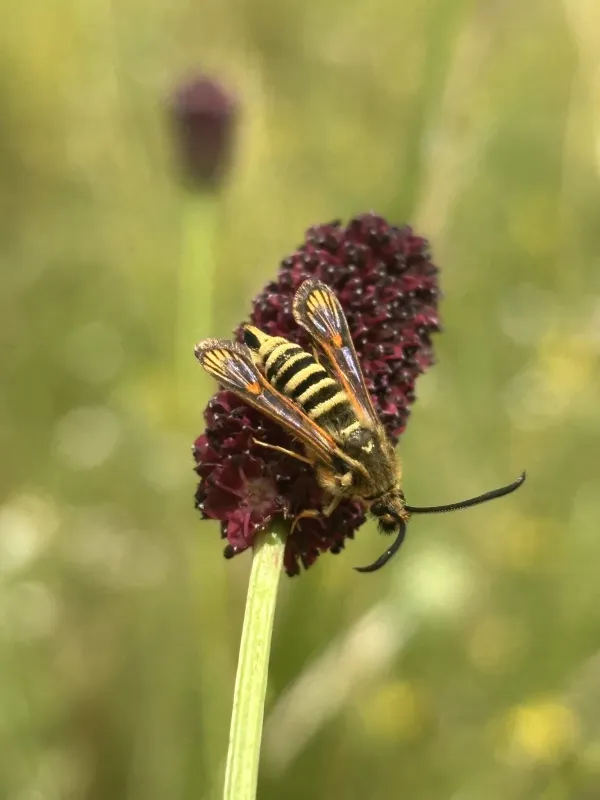
Description
How to identify
Bembecia is a genus of moths belonging to the family Sesiidae, commonly known as clearwing moths, which are recognized for their remarkable mimicry of stinging insects like wasps.
These moths have clear, scale-free areas on their wings and distinctive abdominal bands, which serve as a defense mechanism against potential avian predators.
The larvae, which are the main destructive stage, have a creamy-white body with a sclerotized brown head capsule, perfectly adapted for boring into plant tissues.
Unlike many other moth species, Bembecia are diurnal, actively flying in warm, sunny weather, which often makes them visible in fields during their mating period.
Identification often relies on the observation of adult moths resting on flowers or the detection of specific entry holes in the root zone of host plants.
What it damages
Bembecia species are primarily known for causing significant damage to leguminous crops, with sainfoin being one of the most susceptible hosts in agricultural ecosystems.
The larvae tunnel deep into the roots and root crowns, destroying the internal vascular tissue and disrupting the plant's ability to transport water and nutrients.
This internal tunneling leads to stunted growth, wilting of the above-ground biomass, and, in severe cases, the complete death of the infested plant.
By damaging the primary root system, the larvae also create entry points for soil-borne pathogens, leading to secondary rot and further plant decline.
The cumulative effect of larval feeding over multiple seasons can lead to significant thinning of stands, resulting in reduced forage and seed yields.
When it appears
The adult flight period typically occurs in the late spring and early summer, when environmental conditions are optimal for mating and oviposition.
Females lay their eggs on the root collar or the base of host stems, ensuring that neonate larvae can easily penetrate the plant tissue immediately after hatching.
Larval development spans the majority of the year, with the insects spending the winter as larvae inside the protective environment of the plant roots.
As temperatures rise in the spring, the larvae resume feeding to gain the necessary energy for pupation, which takes place within the larval gallery.
The duration of the life cycle can be univoltine or multivoltine depending on the specific Bembecia species and the climatic conditions of the region.
Signs of infestation
The primary symptom of an infestation is the premature wilting or yellowing of foliage, particularly during dry spells when the damaged root system fails to meet demand.
Careful inspection of the root crown often reveals small exit or entry holes, sometimes surrounded by frass (larval excrement), indicating active larval presence.
Plants affected by Bembecia larvae may exhibit poor anchorage in the soil and can often be pulled up easily due to the compromised integrity of their main roots.
- Wilting foliage during the active growth season.
- Visible holes at the plant base near the soil surface.
- Frass accumulation near the root collar.
- Thinning and patchy stands in perennial fields.
Dissecting the root crown of suspect plants will reveal the internal galleries and the white larvae, confirming the presence of this pest.
Control measures
Crop rotation is the most critical management strategy; avoiding leguminous crops on the same field for several consecutive years effectively breaks the pest cycle.
Deep plowing after the final harvest can expose larvae to environmental stress and predators, significantly reducing the population density in the soil.
Pheromone-baited traps can be deployed for monitoring adult activity, allowing farmers to time chemical interventions effectively if the population exceeds economic thresholds.
Targeted insecticidal applications are most effective when timed precisely to coincide with the period of neonate larval hatching before they bore into the roots.
Maintaining high-quality agronomic practices, such as balanced fertilization and proper moisture management, helps plants tolerate minor infestations and recover faster.
Taxonomy
- Latin name
- Bembecia
- Order
- Lepidoptera (butterflies)
- Family
- Sesiidae
- EPPO code
- BEMBSP
Discussion
No discussions yet — be the first.