
Bathyplectes
Bathyplectes
Description
How to identify
Bathyplectes is a genus of parasitic wasps within the Ichneumonidae family. While often categorized under pest management, these insects are actually highly effective beneficial entomophages that act as natural predators of specific agricultural pests.
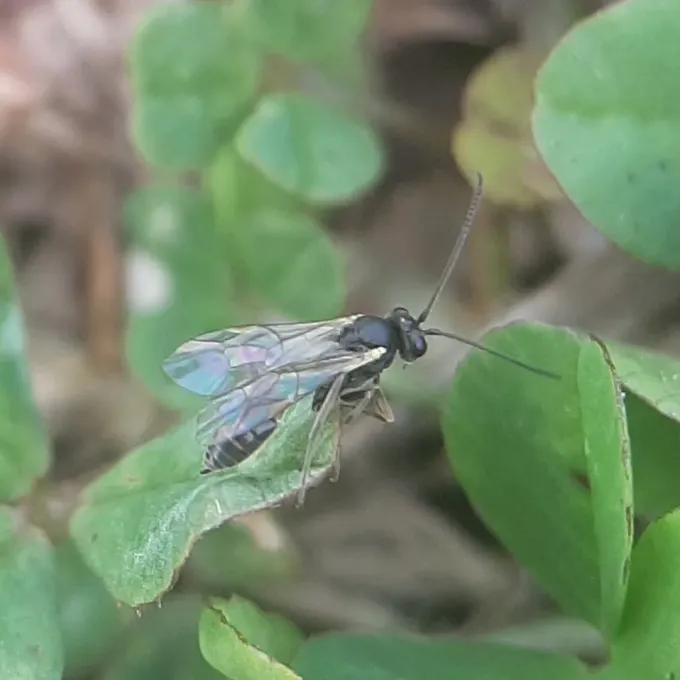
Adult wasps are small, typically measuring 3–6 mm in length. They possess a slender, black body and transparent wings, making them well-adapted for searching for their hosts within dense crop canopies.
The larval stage develops internally inside the host, specifically the alfalfa weevil (Hypera postica). This endoparasitic lifestyle allows the wasp to weaken and eventually kill the pest from within.
Identification in the field is most easily achieved by spotting their distinct cocoons. These cocoons are oval-shaped, dark brown, and feature a characteristic white band around the center, which serves as a tell-tale sign of their presence.
As highly specialized parasitoids, they focus their efforts almost exclusively on weevil larvae, making them vital biological control agents in alfalfa and other legume production systems.
What it damages
Bathyplectes does not cause damage to crops. It is entirely beneficial. Its biological function is to suppress pest outbreaks, which significantly contributes to the overall stability of the agroecosystem.
By preying on alfalfa weevil larvae, these wasps help maintain pest populations below the economic injury level, often reducing the need for synthetic insecticide applications.
Their role in natural regulation is vital for sustainable agriculture, providing a free and self-sustaining service that protects yields while maintaining environmental quality.
The primary threat to these beneficial wasps is the improper use of broad-spectrum insecticides, which can decimate their populations and disrupt the natural balance they help maintain.
Professional agronomic management involves acknowledging the presence of Bathyplectes and prioritizing selective management practices that do not disrupt these beneficial parasitic populations.
When it appears
The activity cycle of Bathyplectes is closely synchronized with the development of the alfalfa weevil. Adults emerge in early spring, precisely when environmental conditions become suitable for both the wasp and its host.
Peak activity is generally observed during the late spring months, coinciding with the growth and development stages of the first and second cuts of alfalfa, where they actively seek out hosts.
The wasp is capable of producing multiple generations within a single growing season, ensuring continuous pest pressure throughout the warmer months.
Winter is typically spent in the pupal stage protected inside their cocoons, hidden within crop residues or the top layer of soil until the following spring.
This synchronization makes them an exceptionally efficient tool for long-term biological regulation in perennial legume fields, as their population density naturally tracks that of the host.
Signs of infestation
The first sign of Bathyplectes activity is a decrease in the feeding rate and overall vigor of the weevil larvae. Infected larvae eventually become lethargic and cease feeding entirely.
Visual verification is confirmed by the presence of their iconic brown cocoons with the light-colored equatorial band, which can be found in the lower foliage or on the soil surface.
Microscopic inspection of the weevil larvae can reveal the developing parasitoid larva inside, providing definitive proof of biological control in action.
A reduction in the number of adult weevils toward the end of the season, correlated with a high density of wasp cocoons, is a clear indicator of successful biological management.
Regular field scouting using sweep nets allows agronomists to determine the population ratio between the pest and the parasite, aiding in informed decision-making regarding potential field interventions.
Control measures
Management of Bathyplectes is not about control, but about conservation. The goal is to provide an environment where these wasps can thrive and exert maximum pressure on host populations.
Adopting Integrated Pest Management (IPM) practices, such as avoiding prophylactic insecticide use, is crucial for maintaining the wasp population at functional levels.
If chemical intervention is absolutely necessary due to extreme pest pressure, agronomists should select target-specific insecticides that have minimal toxicity to beneficial parasitic wasps.
Maintaining floral borders and natural refugia around crop fields can provide supplementary food sources (nectar) for adult wasps, thereby increasing their lifespan and reproductive success.
- Avoid broad-spectrum pesticide applications.
- Utilize selective products when intervention is required.
- Maintain non-crop vegetation to support natural wasp populations.
Taxonomy
- Latin name
- Bathyplectes
- Order
- Hymenoptera
- Family
- Ichneumonidae
- EPPO code
- BATYSP
Discussion
No discussions yet — be the first.