
Banchus femoralis
Banchus femoralis
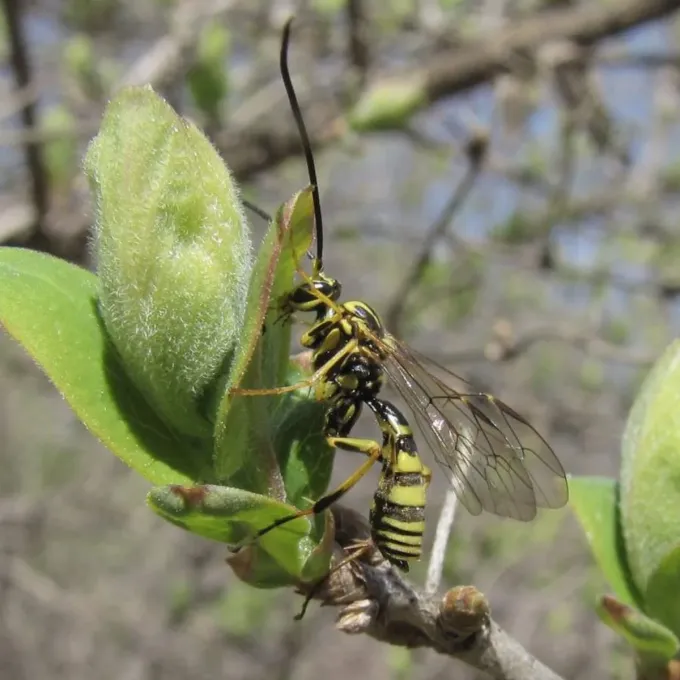
Description
How to identify
Banchus femoralis is a species of parasitic wasp belonging to the Ichneumonidae family. These insects are known for their slender body shape and specific interaction with moth larvae.
The adult wasp typically reaches 10 to 15 millimeters in length. Its body color is predominantly dark, often accented with distinct yellowish or reddish-brown markings on the thorax and abdomen.
The legs of this wasp show a characteristic reddish-brown color, which is a key identifying feature for researchers in the field. The wings are clear with well-defined venation patterns typical of the order Hymenoptera.
Females are equipped with a prominent ovipositor, which they use to accurately deposit eggs into the body of the host larvae during the spring and early summer months.
Identification often requires careful inspection of wing venation and body markings to distinguish this species from other members of the Banchus genus found in similar ecosystems.
What it damages
Banchus femoralis is not an agricultural pest; rather, it is a highly beneficial parasitoid that helps maintain the health of forest ecosystems.
Its primary host is the Pine Beauty Moth (Panolis flammea), a serious pest that can cause significant damage to coniferous forests and protective tree belts.
By parasitizing the larvae of these moths, Banchus femoralis significantly reduces the population of pests that might otherwise defoliate large areas of forest.
Therefore, its impact is entirely positive for foresters and farmers, acting as a natural regulator of harmful insect populations that cross over into arable land.
Eliminating such beneficial wasps through the misuse of broad-spectrum pesticides can lead to an ecological imbalance and subsequent outbreaks of harmful moths.
When it appears
The flight period for adult Banchus femoralis wasps usually occurs in late spring and early summer, aligning perfectly with the growth of host moth larvae.
The species overwinters in a pupal stage, protected by a dense, dark-brown cocoon buried in the soil or the organic leaf litter of the forest floor.
The emergence of adults is highly synchronized with the lifecycle of the Pine Beauty Moth, ensuring that the next generation of larvae is ready for infestation.
Generally, there is one generation per year, making the species highly sensitive to annual weather patterns, particularly spring soil temperatures and humidity.
Warm, stable springs favor the early emergence of these wasps, which enhances their ability to control the first-stage larvae of the host insects.
Signs of infestation
One of the main signs of this wasp's activity is the discovery of lethargic moth larvae that show stunted growth or abnormal movement patterns.
Field experts can detect the presence of the parasitoid by finding its characteristic tough, dark cocoons within the soil under infested pine trees.
A noticeable drop in the overall moth larvae density during the summer season often indicates that the parasitic wasp population is successfully suppressing the pest.
Systematic sampling of host larvae to check for internal parasitism rates is a common method for monitoring the population dynamics of this natural enemy.
Observing adult wasps visiting nectar-rich plants on the edges of pine forests can also serve as a positive indicator of their presence in the local ecosystem.
Control measures
The most effective strategy to support Banchus femoralis populations is to avoid using broad-spectrum insecticides during the wasp's peak flight season.
Preserving the natural leaf litter and soil structure in coniferous forests is essential, as this provides the necessary overwintering habitat for their cocoons.
Promoting floral diversity near forested areas provides adult wasps with vital carbohydrate sources, such as nectar, which they need for survival and reproduction.
When pest control measures are absolutely necessary, using selective biological agents like Bacillus thuringiensis is preferred to protect these beneficial parasitoids.
Long-term forest management plans should prioritize biological control by encouraging the presence of endemic natural enemies rather than relying solely on chemical interventions.
Taxonomy
- Latin name
- Banchus femoralis
- Order
- Hymenoptera
- Family
- Ichneumonidae
- EPPO code
- BANCFE
Discussion
No discussions yet — be the first.