
Banchus
Banchus
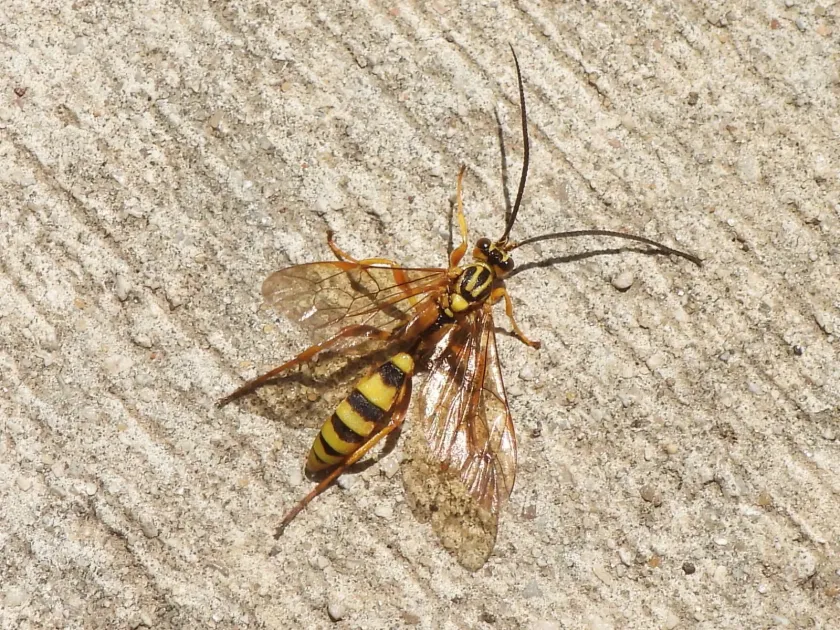
Description
How to identify
The genus Banchus belongs to the order Hymenoptera and the family Ichneumonidae. These insects are well-known parasitoid wasps that play a significant role in ecosystems.
They are characterized by a slender body, long antennae, and often striking coloration patterns, which include shades of black, yellow, or orange.
Their wings are transparent with a distinct venation pattern, which is a key trait for taxonomists. Females possess an ovipositor used for laying eggs inside host insects.
Unlike many other insects found on farms, these are not plant-eaters. They are specialized predators that target other insects, specifically lepidopteran larvae.
Identification is essential for farmers to distinguish them from harmful insects, ensuring that beneficial populations are protected from unnecessary pesticide application.
What it damages
The genus Banchus causes no damage to agricultural crops. They do not feed on plant tissues, stems, leaves, or fruits, making them completely harmless to harvest.
Any perceived "damage" is simply a misunderstanding of their role. They are often seen on plants only because their prey, the caterpillars, are feeding there.
In fact, their presence is beneficial. They act as natural control agents, reducing the population of harmful pests that would otherwise cause significant crop loss.
These wasps provide a free biological service to the farmer, helping to keep caterpillar populations below the economic injury level.
Confusing these beneficial wasps with pests leads to incorrect management decisions that can destabilize the agroecosystem.
When it appears
The activity of Banchus adults is synchronized with the life cycles of their host caterpillars, typically peaking during late spring and summer months.
Their life cycle involves a complete metamorphosis: egg, larva, pupa, and adult. Females scout fields looking for specific caterpillar species to parasitize.
After finding a host, the female injects an egg into the caterpillar. The developing larva eventually consumes the host, which is a critical part of their biological cycle.
Pupation often occurs in a protected location, such as in the soil or within the remains of the host, allowing them to endure varying environmental conditions.
Multiple generations may occur depending on the local climate and the availability of their hosts, ensuring a continuous presence of these natural enemies.
Signs of infestation
Signs of their presence include observing slender wasps flying in a characteristic search pattern above the crop canopy.
You will not see feeding marks, chewed leaves, or wilting associated with Banchus. They are hunters, not herbivores.
An increased number of these wasps is an excellent indicator that a caterpillar infestation is being managed by natural forces.
While they are visible to the naked eye, they are elusive and spend most of their time searching for hosts rather than resting on plants.
Observing them should be taken as a positive sign of a balanced environment where natural enemies are actively reducing pest numbers.
Control measures
No control measures are necessary for Banchus. They are essential allies in integrated pest management (IPM) strategies.
To encourage their presence, avoid the use of broad-spectrum insecticides that kill both pests and beneficial parasitoids.
Maintain habitat complexity by planting flowering borders. Nectar sources provide the energy needed by adult wasps to survive and reproduce effectively.
Use selective pesticides only when strictly necessary and target specific pests to minimize collateral damage to the natural enemy complex.
Supporting these insects is a proactive and sustainable way to protect crops from caterpillar-based devastation.
Taxonomy
- Latin name
- Banchus
- Order
- Hymenoptera
- Family
- Ichneumonidae
- EPPO code
- BANCSP
Discussion
No discussions yet — be the first.