
Breadfruit fruit fly
Bactrocera umbrosa
Description
How to identify
The breadfruit fruit fly (Bactrocera umbrosa) belongs to the family Tephritidae in the order Diptera. It is a significant pest known for targeting specific host plants in tropical regions.
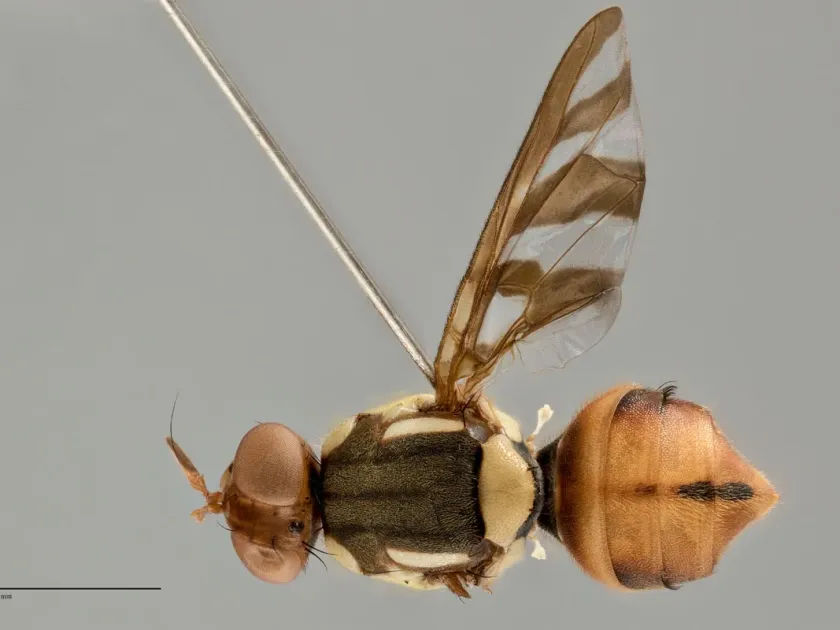
Adult flies are dark in color, typically featuring yellow markings on the thorax. A key diagnostic feature is the wing pattern, which consists of distinct dark bands on transparent wings.
Females are equipped with a sharp, elongated ovipositor designed to penetrate the rind of fruits to deposit eggs directly into the pulp.
The larvae, or maggots, are legless and creamy-white, characteristic of tephritid fruit flies. They develop rapidly within the infested fruit tissue.
Field identification can be difficult for laypeople, so entomological inspection of wing morphology and genitalia is often required for definitive taxonomic confirmation.
What it damages
This species primarily infests breadfruit (Artocarpus altilis) and jackfruit (Artocarpus heterophyllus), causing significant losses in yield and quality.
The damage is caused by the larvae feeding inside the fruit. As they tunnel through the pulp, they break down the structure of the fruit, rendering it inedible.
External puncture marks from the female's ovipositor serve as entry points for rot-causing bacteria and fungi, which exacerbate the degradation of the fruit.
Infested fruits typically drop prematurely, resulting in a total loss of the harvest on those specific branches or trees.
In addition to direct losses, the presence of these flies often leads to severe quarantine restrictions, preventing the export of produce from infested areas to other markets.
When it appears
The breadfruit fruit fly population is closely tied to the fruiting phenology of its host plants. In tropical environments, breeding can occur year-round.
The highest levels of adult activity and infestation coincide with the ripening stage of breadfruit, providing the optimal medium for egg development.
Development from egg to adult is rapid, often completed in just a few weeks under warm and humid conditions, allowing for multiple generations per year.
High humidity and temperatures accelerate the life cycle, leading to rapid population surges that can overwhelm local fruit production if left unmanaged.
During less favorable seasons, the fly may persist as pupae in the soil, emerging as adults only when the environmental conditions and host availability improve.
Signs of infestation
One of the earliest signs of infestation is the appearance of small, needle-like punctures on the surface of ripening fruits, sometimes surrounded by small, oozing sap drops.
Premature ripening and the sudden drop of fruits that are not yet fully mature are strong indicators of larval activity inside the fruit.
When an infested fruit is cut open, the internal flesh shows clear evidence of degradation, including tunnels, tunnels filled with frass, and a watery, fermented appearance.
The development of secondary rot and a noticeable smell of fermentation on hanging fruits are classic signs that the infestation is well-established.
Advanced signs include the presence of third-instar larvae migrating out of the fruit, typically seeking soil to undergo pupation.
Control measures
Management of the breadfruit fruit fly relies on a combination of cultural practices, mechanical exclusion, and targeted chemical or biological treatments.
The most fundamental control measure is strict orchard hygiene, which involves collecting and destroying all fallen fruit to kill larvae before they pupate in the soil.
Monitoring and suppression are often achieved using bait stations or traps containing male attractants (para-pheromones), which reduce the mating population.
Bagging individual fruits with protective paper or fabric covers provides a physical barrier, effectively preventing females from laying eggs on the fruit surface.
- Applying protein bait sprays mixed with insecticides to attract and kill adult females before they oviposit.
- Encouraging biological control agents, such as parasitoid wasps that target larvae.
- Enforcing quarantine regulations to prevent the movement of infested fruit between islands or regions.
Taxonomy
- Latin name
- Bactrocera umbrosa
- Order
- Diptera (flies)
- Family
- Tephritidae
- EPPO code
- BCTRUM
Discussion
No discussions yet — be the first.