
Japanese orange fly
Bactrocera tsuneonis
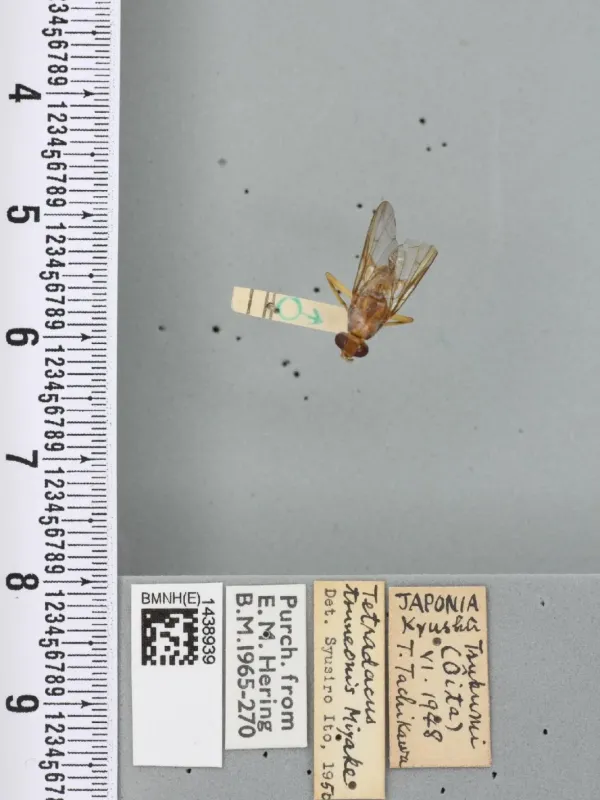
Description
How to identify
The Japanese orange fly (Bactrocera tsuneonis) is a significant pest belonging to the Tephritidae family, order Diptera. It is a notorious quarantine organism that specializes in attacking various species of citrus plants.
Adult flies are relatively small, usually measuring up to 10 mm in length. Their bodies are predominantly brownish-yellow, which provides excellent camouflage against citrus foliage.
The wings are transparent with distinct dark markings along the leading edge and at the apex. Females possess a robust ovipositor, enabling them to pierce the rind of developing fruit to lay eggs inside.
The larvae are cylindrical and creamy-white in color. During their development inside the fruit, they undergo three instars, feeding extensively on the pulp and causing significant internal damage.
The life cycle is closely synchronized with the phenology of citrus trees. Pupation occurs in the soil beneath the canopy, where the pupae can remain dormant until the next growing season.
What it damages
This pest primary targets commercial citrus varieties such as oranges and mandarins. Its geographic distribution is limited, but it poses a constant threat to citrus-growing regions globally.
The primary damage is caused by larvae that feed within the fruit. They consume the internal tissues, transforming the pulp into a rotting, unusable mass that is completely unfit for market.
Affected fruit often exhibit premature yellowing and heavy fruit drop. Small punctures from the female's ovipositor are visible on the surface, serving as entry points for secondary pathogens and bacterial decay.
The economic impact is severe, as infestations can lead to a 100% loss of harvest on affected orchards. The internal nature of the damage makes it difficult to detect by visual inspection alone.
The fact that infested fruit may appear healthy initially allows the pest to be transported across long distances via international trade if strict quarantine measures are not followed.
When it appears
Adult fly activity typically begins in late spring to early summer, coinciding with the stage when fruitlets are formed and become attractive for egg-laying.
Females are most active in mid-to-late summer, systematically laying eggs in developing citrus fruits. The period of activity depends largely on local temperature and humidity levels.
The larval stage lasts for several weeks, depending on the environmental conditions. After completing their development, larvae exit the fruit and drop to the soil for pupation.
The insect spends the winter in the soil in the pupal stage. This biological adaptation ensures survival through cold periods and allows for rapid emergence once temperatures rise in the spring.
Effective monitoring using pheromone traps is essential to detect the arrival of adults and determine the precise timing for intervention before significant damage occurs.
Signs of infestation
The earliest signs of an infestation are small, subtle punctures on the rind of the fruit. These represent the exact sites where females have injected their eggs.
Premature color change, where green fruit begins to turn yellow or orange before maturity, is a clear indicator that internal development of larvae is disrupting the fruit's metabolism.
When an infested fruit is opened, the internal structure is found to be destroyed, with tunnels made by larvae and a mushy, decaying texture accompanied by a foul odor.
Increased fruit drop, where immature citrus fruits fall to the ground in large numbers, often indicates a high level of larval activity within the canopy.
Adult flies present on sticky traps within the orchard are a definitive sign of infestation and signal the immediate need to begin control programs.
Control measures
Rigorous phytosanitary control is the primary defense strategy, aimed at preventing the introduction of infested fruit into regions where the fly is not yet present.
Cultural control practices are crucial; prompt collection and destruction of fallen fruit prevent larvae from completing their life cycle and pupating in the soil.
Chemical control involving systemic or contact insecticides can be effective when timed correctly during the adult flight period, though pre-harvest intervals must be respected.
Biological control methods, such as the use of attractant-based traps, provide an environmentally friendly way to monitor and reduce fly populations without heavy reliance on chemicals.
- Sanitary collection and disposal of fallen fruit.
- Deep tillage of soil in orchards during winter.
- Deployment of pheromone and food-based traps.
- Strategic insecticide applications during peak flight.
- Strict quarantine regulations for fruit movement.
Taxonomy
- Latin name
- Bactrocera tsuneonis
- Order
- Diptera (flies)
- Family
- Tephritidae
- EPPO code
- DACUTS
Discussion
No discussions yet — be the first.