
Queensland fruit fly
Bactrocera tryoni
Description
How to identify
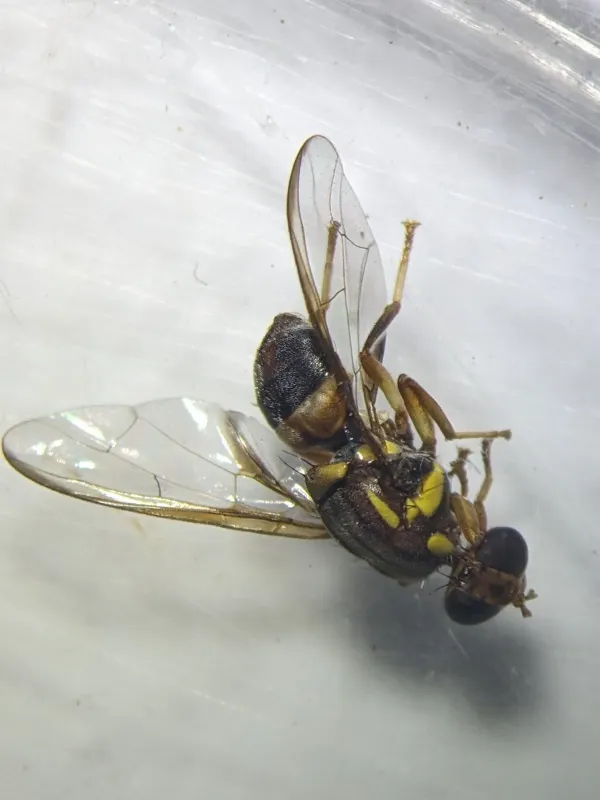
The Queensland fruit fly (Bactrocera tryoni) belongs to the Tephritidae family, also known as fruit flies. Adult flies are 6–8 mm long, typically reddish-brown, and can be distinguished by specific markings on their thorax and wings.
The lifecycle consists of egg, larva, pupa, and adult stages. Females use their ovipositor to pierce the skin of fruit and deposit eggs directly into the pulp, where larvae develop after hatching.
The larvae are creamy-white, maggot-like creatures that feed exclusively on the fruit tissue. They progress through three larval instars before exiting the fruit to pupate.
Pupation occurs in the soil beneath the host plant. The pupae are protected by a hard, brown casing called a puparium, which allows the insect to survive in the ground until the adult emerges.
Adults are strong fliers and can travel significant distances to find suitable hosts. They thrive in warm, humid conditions, which significantly boosts their reproductive rate.
What it damages
This species is an extreme polyphage, affecting hundreds of different fruit and vegetable crops. Major hosts include apples, pears, peaches, citrus, tomatoes, and various tropical fruits.
Economic damage is caused by the larvae feeding inside the fruit, which leads to rapid breakdown of the flesh and eventual rotting. Infested fruit is unmarketable and unsuitable for human consumption.
The punctures created by the female ovipositor serve as entry points for secondary pathogens, such as fungi and bacteria, which exacerbate fruit decay.
Heavy infestations can result in total yield loss for commercial orchards. The rapid life cycle allows multiple generations per year, leading to exponential population growth during the warmer months.
Due to its high invasive potential, the Queensland fruit fly is a major quarantine pest, and its presence often triggers trade restrictions for fruit-producing regions.
When it appears
The fly is most active during the spring, summer, and early autumn months. It prefers warm and moist conditions, with temperatures between 20°C and 30°C being optimal for rapid development.
In warmer climates, the fly can reproduce continuously throughout the year if host fruits are available. However, in cooler regions, the population drops significantly, with adults seeking shelter during winter.
Host availability acts as a seasonal driver for the population. As fruits begin to ripen, the fly population tends to congregate around orchards and gardens to maximize egg-laying opportunities.
Monitoring programs typically run throughout the entire growing season, utilizing traps to detect the arrival of the first generation of adults and determine the timing for control measures.
Weather conditions, particularly heavy rain and high humidity, often favor the survival of pupae in the soil, leading to an increase in adult numbers shortly after the wet season.
Signs of infestation
Early symptoms of an infestation include tiny sting marks or stings on the surface of ripening fruit. These are often difficult to spot without close inspection of the fruit skin.
As the infestation progresses, the area around the sting may become soft, discolored, or show signs of rotting. If the fruit is cut open, internal damage, including tunnels and larvae, will be visible.
Premature fruit drop is a classic sign of Q-fly activity. If fallen fruit is found with internal decay and larvae, it is a strong indicator of an ongoing infestation.
The presence of adult flies seen hovering around the canopy or caught in pheromone traps confirms the activity of the pest in the immediate area.
A sweet, fermenting smell emanating from ripening fruit or fallen produce on the ground often indicates that the fruit has been heavily infested and is rapidly decomposing.
Control measures
Biosecurity measures are paramount. Strict regulations govern the movement of fruit from infested regions to prevent the spread of this pest to new areas.
Trapping systems, including pheromone lures and protein-based food attractants, are highly effective tools for both monitoring and mass-trapping adult flies in small-scale gardens and orchards.
Good orchard hygiene is essential; this involves regular collection and disposal of fallen fruit. Burying fruit deeply or sealing it in plastic bags in the sun kills larvae before they pupate.
Chemical control often involves spot-spraying with an insecticide mixed with a protein-based attractant. This targets adult flies specifically, reducing the need for broad-spectrum pesticide applications.
Mechanical protection, such as using exclusion netting or individual fruit bags, is a highly successful non-chemical method for protecting high-value crops in backyard settings.
Taxonomy
- Latin name
- Bactrocera tryoni
- Order
- Diptera (flies)
- Family
- Tephritidae
- EPPO code
- DACUTR
Discussion
No discussions yet — be the first.