
Guava fruit fly
Bactrocera psidii
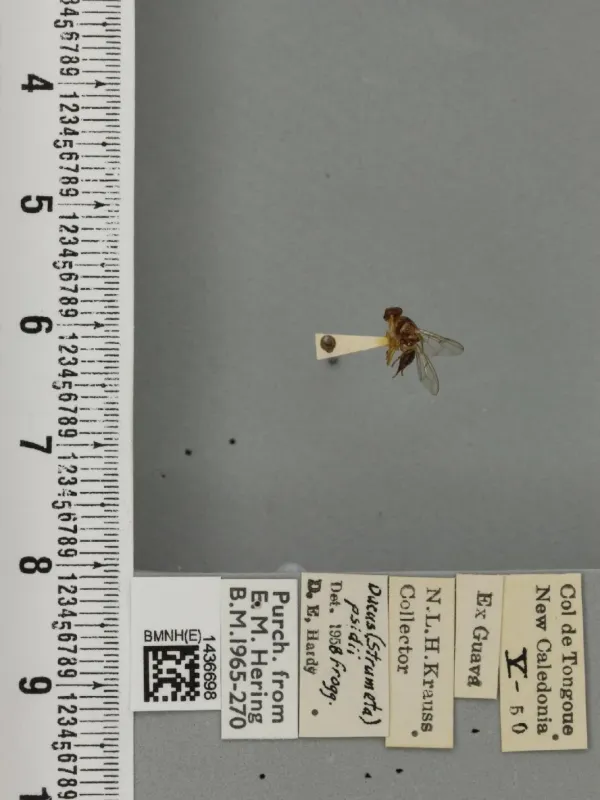
Description
How to identify
The guava fruit fly (Bactrocera psidii) belongs to the Tephritidae family, order Diptera. Adults are small insects, typically measuring between 5 to 7 millimeters in length.
The body of the adult fly is predominantly brown with distinctive yellow markings on the thorax and abdomen. Its wings are clear, with a noticeable dark vein running along the anterior margin, serving as a key diagnostic trait.
Eggs are elongated and creamy-white, typically deposited by the female beneath the skin of developing fruit using her ovipositor. Larvae are white, legless maggots that undergo three developmental instars.
Pupation occurs within a puparium, which is most commonly formed in the soil beneath the canopy of the host tree. The life cycle duration varies significantly depending on local ambient temperature and humidity.
Adult flies are highly mobile and are known for their ability to navigate across large areas in search of suitable host fruits for reproduction. They are most active during warm, humid seasons.
What it damages
The primary host for this pest is guava (Psidium guajava), which gives the species its name. It is capable of causing devastating losses in commercial orchards.
Beyond guava, the pest is known to infest a variety of other tropical and subtropical fruits, including mangoes, avocados, papayas, and various citrus varieties.
In the absence of preferred hosts, the fly can adapt to other fruits with similar flesh textures, making it a significant polyphagous threat to orchards.
Larval feeding destroys the internal structure of the fruit, rendering it completely unsuitable for fresh consumption or commercial processing due to rapid decay.
Economic damage is exacerbated by strict international quarantine regulations, which often lead to export bans for regions where the presence of the pest is confirmed.
Signs of infestation
Early signs of infestation include tiny puncture marks on the fruit skin, which may develop into localized dark spots or rot as the tissues begin to break down.
The internal flesh of the fruit softens and decomposes rapidly due to larval activity, often exacerbated by secondary fungal and bacterial colonization.
Premature fruit drop is a common indicator of a heavy infestation. Fallen fruits often contain numerous larvae tunneling through the softened pulp.
Upon cutting open an infested fruit, one may observe larvae or the tunnels created by their feeding, often accompanied by a foul, rotting odor.
Monitoring for adults on foliage or fruit using pheromone traps is the most reliable method for detecting the presence of the fly before visual signs become obvious.
Control measures
Sanitation is the cornerstone of control: regular collection and destruction of fallen fruit prevent larvae from completing their life cycle in the soil.
Chemical control programs often involve the use of bait sprays, which combine a protein-based attractant with an insecticide to target adult flies efficiently.
Pheromone traps are highly effective for both monitoring population levels and reducing the number of breeding males in the orchard environment.
Biological control initiatives, including the release of parasitoid wasps, have shown potential in managing fly populations while minimizing the use of synthetic pesticides.
Strict enforcement of quarantine protocols regarding the movement of fruit from infested zones is essential to prevent the spread of this pest to non-infested areas.
Taxonomy
- Latin name
- Bactrocera psidii
- Order
- Diptera (flies)
- Family
- Tephritidae
- EPPO code
- DACUPS
Discussion
No discussions yet — be the first.