
Fruit fly Bactrocera perfusca
Bactrocera perfusca
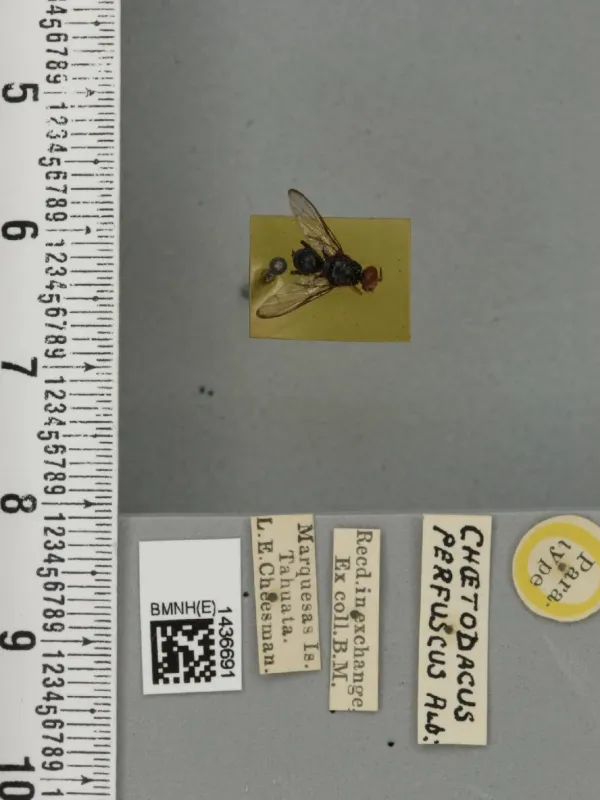
Description
How to identify
Bactrocera perfusca is a member of the Tephritidae family, also known as the fruit fly family. These insects are characterized by their distinct wing patterns and ability to deposit eggs directly into the fruit tissue, making them significant agricultural pests.
The adult flies are medium-sized with dark body pigmentation, which helps them camouflage within the foliage. Precise identification requires expert examination of the wing venation patterns and, in many cases, molecular analysis to distinguish them from closely related species.
The life cycle begins when a female uses her ovipositor to pierce the fruit skin and lay eggs. The larvae hatch inside the fruit and begin feeding immediately, which is the primary stage responsible for crop destruction.
Larvae are maggot-like, white to yellowish in color, and lack legs. They move through the fruit tissue, causing internal degradation. After completing their development, they drop to the ground to pupate in the soil.
Environmental factors like temperature and humidity heavily influence the speed of the life cycle. In warmer regions, these flies can complete multiple generations in a single growing season, leading to rapid population growth.
What it damages
This species primarily attacks a wide range of fruit crops. The damage is caused by the larvae feeding on the pulp, which destroys the internal structure of the fruit and causes it to rot quickly.
Infested fruits often show signs of premature ripening and drop from the trees prematurely. This significantly reduces the marketable yield for farmers and results in substantial economic losses.
Beyond direct damage, the entry points created by the female ovipositor and the larvae provide pathways for secondary infections such as fungi and bacteria. This can lead to a complete breakdown of the fruit's texture and flavor.
In many regions, the presence of Bactrocera perfusca triggers strict quarantine regulations. This creates significant barriers for the export of fresh produce, as the risk of spreading the pest to non-infested areas is high.
Even a small number of larvae can render a whole fruit inedible. The loss of produce quality makes it impossible to sell infested crops, forcing farmers to dispose of large portions of their harvest.
Signs of infestation
The earliest signs of infestation include tiny punctures on the fruit's skin, often surrounded by small dark spots or dimples. These punctures are the entry points used by the females for egg-laying.
As the larvae grow, the internal tissue begins to soften. Pressing on the affected areas may reveal a spongy texture, and in advanced stages, the fruit may collapse under light pressure.
The presence of larvae inside the fruit can often be confirmed by cutting it open. The interior will show tunnels carved by the larvae and a mushy consistency, often accompanied by a distinct smell of decay.
Monitoring the adult population using pheromone or food-based traps is the most reliable sign of the pest's presence in an orchard. Finding adult flies in traps indicates an immediate need for control interventions.
Increased fruit drop, even when the fruits look mostly healthy on the surface, is a classic symptom. If these fallen fruits are dissected and found to contain larvae, it confirms an active infestation of Bactrocera perfusca.
Control measures
Effective management relies on Integrated Pest Management (IPM) strategies. The most critical step is rigorous sanitation, which includes collecting and destroying all fallen fruit to prevent larvae from entering the soil for pupation.
Using bait traps, particularly those that combine pheromones and food attractants, can help manage adult fly populations. These traps should be placed well before the fruit reaches the ripening stage to prevent egg-laying.
Soil management, such as tilling the soil beneath the canopy, helps disrupt the pupation cycle of the fly. This exposes pupae in the soil to predators and adverse weather conditions, significantly reducing the next generation's survival.
Chemical control should be used sparingly and only when necessary, following local regulations regarding residue limits. Rotating insecticides with different modes of action is essential to prevent the development of resistance in the pest population.
- Strict collection and disposal of fallen fruit.
- Deployment of pheromone-based monitoring traps.
- Mechanical cultivation of soil under trees.
- Application of selective insecticides if thresholds are met.
- Compliance with regional quarantine and movement restrictions.
Taxonomy
- Latin name
- Bactrocera perfusca
- Order
- Diptera (flies)
- Family
- Tephritidae
- EPPO code
- BCTRPF
Discussion
No discussions yet — be the first.