
Bactrocera pedestris
Bactrocera pedestris
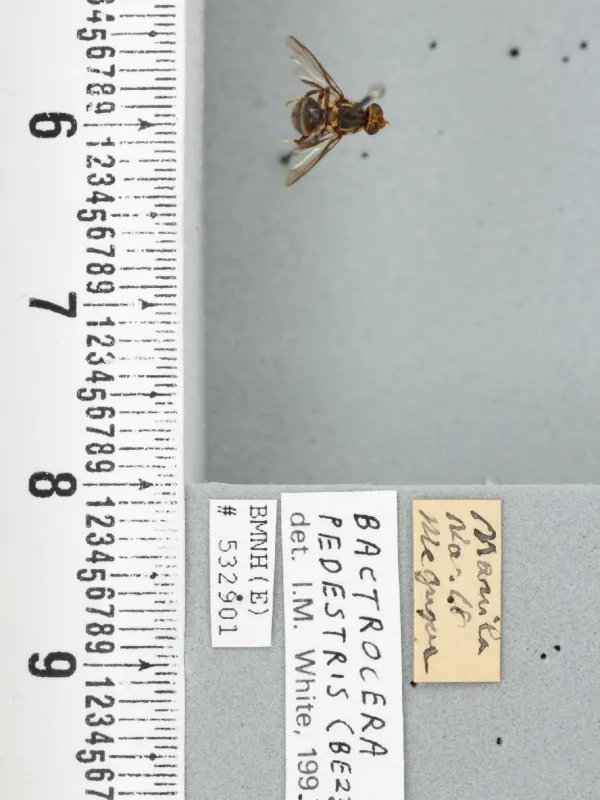
Description
How to identify
Bactrocera pedestris is a destructive fruit fly belonging to the family Tephritidae in the order Diptera. Adults are small insects, typically exhibiting the characteristic morphology of the Bactrocera genus, often featuring yellow-brown bodies with dark abdominal markings.
The life cycle consists of four distinct stages: egg, larva, pupa, and adult. The larvae appear as typical legless, creamy-white maggots that develop internally within host fruits. Proper identification is crucial for effective management but can be challenging due to the similarity between B. pedestris and other related regional fruit fly species.
Genetic analysis or expert examination of genital structures is often required for definitive identification. The insects are highly mobile, allowing them to traverse significant distances to find suitable host plants for oviposition.
Females possess a sharp ovipositor, which they use to pierce the fruit's skin and deposit their eggs directly into the pulp, providing an immediate food source for hatching larvae.
The seasonal emergence of adults is highly dependent on local climatic conditions and the availability of preferred host plants in the surrounding environment.
What it damages
The larvae are primary pests that feed on the succulent pulp of various agricultural crops. Solanaceous plants, including tomatoes, eggplants, and peppers, are particularly susceptible to infestation.
A broad range of tropical and subtropical fruits also serves as hosts for this pest. The larval feeding destroys the internal structure of the fruit, rendering it unfit for consumption or commercial sale.
Beyond direct feeding damage, the oviposition punctures made by the female provide entry points for secondary pathogens, including bacteria and fungi, which accelerate fruit decay and rotting.
Infestation frequently leads to premature fruit drop and the complete loss of marketable yields. Under heavy pressure, entire crops can be destroyed, making this fly a major economic threat to fruit producers.
Damaged fruits often show signs of softness, wateriness, and an unpleasant odor, which are consequences of the rapid decomposition triggered by larval activity.
Signs of infestation
The earliest sign of infestation is the appearance of minute oviposition punctures on the fruit surface. These small holes are often accompanied by subtle skin discoloration surrounding the site.
As the larvae feed internally, the fruit tissue begins to break down, resulting in localized sunken spots and soft patches. Infected fruits may prematurely change color, turning yellow or developing irregular blotches.
Internal examination of infested fruit reveals tunnels bored through the pulp, filled with larval frass and decaying plant tissue. The larvae themselves are often found feeding deep within the infested fruit.
Severe infestations often result in the premature dropping of young fruit, which then serves as a site for the larvae to emerge and pupate in the soil.
- Small puncture marks on the fruit skin.
- Soft, sunken areas on the fruit surface.
- Premature ripening and fruit drop.
- Internal tunnels filled with larval waste.
- Larval presence within the pulp upon sectioning.
Control measures
Strict quarantine measures are essential to prevent the spread of Bactrocera pedestris into new, non-infested regions. Monitoring the presence of the pest using pheromone traps is a key strategy for early detection.
Cultural control practices, such as the systematic collection and destruction of fallen fruit, are highly effective. Burying or bagging infested fruit prevents larvae from pupating in the soil and disrupts the life cycle.
Insecticide applications are used during periods of high adult fly activity to prevent egg-laying. It is important to utilize targeted, crop-specific products that are authorized for use to maintain food safety standards.
Physical barriers, such as individual fruit bagging or the use of insect-proof netting over whole plants, provide a reliable way to protect crops from infestation, particularly in small-scale or home gardens.
Biological control methods, focusing on the use of parasitoids that target eggs and larvae, are increasingly becoming a component of integrated pest management (IPM) programs to maintain populations below economic threshold levels.
Taxonomy
- Latin name
- Bactrocera pedestris
- Order
- Diptera (flies)
- Family
- Tephritidae
- EPPO code
- DACUPE
Discussion
No discussions yet — be the first.