
Bactrocera nigrotibialis
Bactrocera nigrotibialis
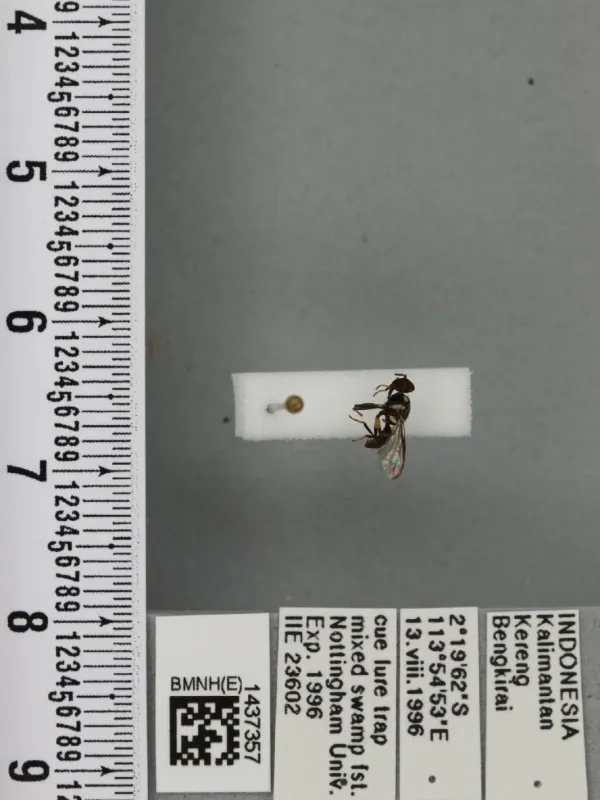
Description
How to identify
Bactrocera nigrotibialis is a member of the fruit fly family (Tephritidae), belonging to the order Diptera. The species exhibits the typical morphology of the Bactrocera genus: a small body, characteristic wing markings, and a developed ovipositor in females.
The coloration of adults varies, but this species is characterized by dark, almost black areas on the tibia of the legs, which is reflected in its specific Latin name. The head is rounded, and the eyes often have an iridescent sheen.
The larvae are typical of fruit flies: legless, whitish, and tapering towards the front. They develop hidden inside the fruits of host plants, which makes them difficult to detect at early stages.
Identification of adult individuals is mostly carried out using pheromone traps placed in fruit orchards. Morphological analysis requires professional entomological training.
The insect's development occurs through complete metamorphosis: egg, larva (having several instars), pupa in a puparium, and adult (imago).
What it damages
This pest attacks a wide range of fruit and vegetable crops, especially in tropical and subtropical regions. These are mainly members of the Solanaceae, Cucurbitaceae families, and various fruit trees.
Larvae feed on the pulp of the fruit, creating numerous tunnels. This leads to rapid softening of tissues and the development of secondary infections caused by bacteria and fungi.
Damaged fruits lose their commercial quality and become unsuitable for sale or processing. If the pest density is high, the entire harvest can be destroyed.
Damage is caused not only directly by the larvae but also by the females during oviposition. Punctures on the fruit skin serve as entry points for pathogens.
Economic losses consist of direct crop loss and additional costs for quarantine measures that restrict the export of products from infested zones.
When it appears
The activity of Bactrocera nigrotibialis adults depends directly on temperature and air humidity. In regions with favorable climates, reproduction can continue almost all year round.
Population peaks usually coincide with the ripening period of the main host crops. During this time, flies actively lay eggs inside the fruits.
The developmental cycle from egg to adult can range from a few weeks to a month, depending on temperature. This ensures several generations per season.
Pupae usually overwinter in the soil under the canopy of the host plant or in fallen fruits. In mild winters, the survival rate of pupae remains high.
Mass emergence of adults often coincides with the onset of flowering or fruit formation, which requires monitoring during these critical vegetative phases.
Signs of infestation
The first sign of infestation is the presence of punctures on the surface of the fruit skin. Small depressed areas or rot spots are often observed around these points.
When an infested fruit is cut, larvae are found inside. The pulp appears watery and has an unpleasant odor due to the activity of rot-inducing bacteria.
Premature ripening or fruit drop can also indicate the presence of hidden pests. Fruits that look healthy may be hollow inside when pressed.
The presence of large numbers of flies gathered on lures or traps is a critical signal to start control measures.
Sometimes, darkening can be noticed on the fruit surface, which eventually turns into a necrosis focus caused by the entry of infection through the ovipositor puncture.
Control measures
The main control method is the use of pheromone traps for monitoring and trapping males. This allows for early detection of the pest and population reduction.
Agrotechnical measures include regular collection and deep burial of fallen, rotting fruits. This breaks the developmental cycle by destroying larvae and pupae.
Chemical protection involves the use of insecticides, although application is complicated because larvae are protected by fruit tissues. Treatments are effective during the adult activity period.
Quarantine measures are the most important tool. A ban on the movement of infested fruits between regions prevents the spread of Bactrocera nigrotibialis.
The use of biological methods, such as the release of parasitoids or the use of sterile males, is being actively studied as an environmentally friendly alternative to chemical pesticides.
Taxonomy
- Latin name
- Bactrocera nigrotibialis
- Order
- Diptera (flies)
- Family
- Tephritidae
- EPPO code
- BCTRNI
Discussion
No discussions yet — be the first.