
Moluccan fruit fly
Bactrocera moluccensis
Description
How to identify
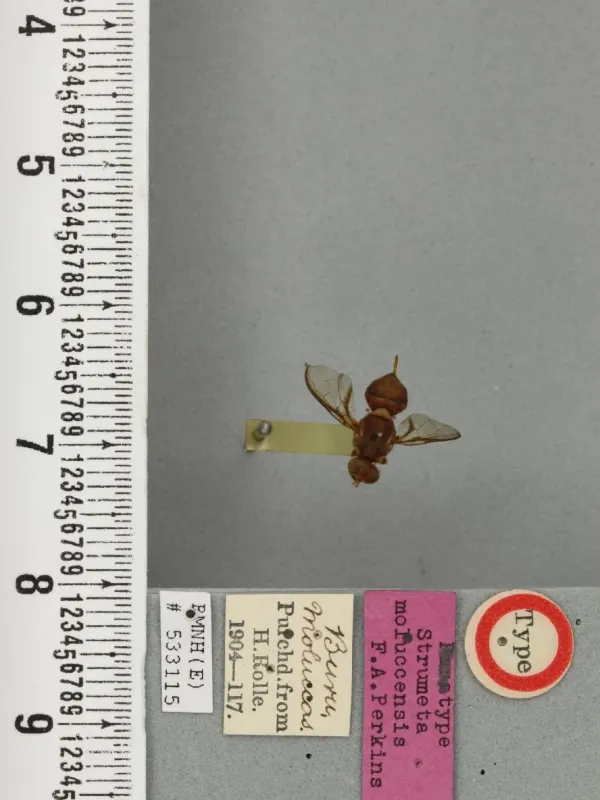
The Moluccan fruit fly (Bactrocera moluccensis) belongs to the order Diptera and the family Tephritidae. This pest is characterized by a yellowish-brown body with distinct black markings on the thorax and abdomen.
Adult flies have transparent wings with a dark costal band and a complex vein pattern. They typically measure between 6 to 8 millimeters in length, with females possessing a prominent, hardened ovipositor.
The larvae are typical of the family, being legless maggots that grow up to 10 millimeters long. They transition from a creamy-white color in early stages to a more opaque, yellowish hue before pupation.
The biological cycle is highly dependent on tropical and subtropical climates, where high humidity and moderate temperatures facilitate rapid population growth throughout the growing season.
Development proceeds through egg, three larval instars, pupa, and adult stages. Under optimal conditions, the life cycle can be completed in as little as three to four weeks.
What it damages
This pest infests a wide range of fruit and vegetable crops. It is particularly damaging to commercial fruit plantations located in tropical regions where it thrives.
Host crops include mango, papaya, guava, and various citrus species. The fruit fly is known for its ability to adapt and infest new host fruits in different environments.
Females use their ovipositor to pierce the skin of the fruit and deposit eggs directly into the pulp. This action alone causes significant mechanical damage and leaves the fruit vulnerable to pathogens.
Upon hatching, larvae feed internally on the fruit tissue, creating extensive galleries. This feeding process causes the fruit to soften and eventually collapse due to rapid decay.
The economic impact is severe, as damaged fruits are rendered unmarketable and unsuitable for human consumption due to the physical destruction and presence of secondary bacterial infections.
Signs of infestation
The primary sign of infestation is the presence of small puncture marks on the fruit skin, often surrounded by small dark spots or discoloration indicating internal rot.
A major symptom is the premature dropping of fruit. Affected fruits often appear visually fine on the outside but are already infested with larvae internally.
Upon cutting open an infested fruit, one will observe tunnels throughout the flesh, often accompanied by the presence of white maggots and localized dark decomposition.
Increased activity of adult flies around trees is frequently observed, as they are attracted to the volatile compounds released by ripening and decaying fruits.
In advanced cases, the skin of the fruit may become soft and depressed in specific areas, making the fruit susceptible to total collapse when handled or during transport.
Control measures
Monitoring using pheromone-based traps is the standard approach to identify the presence and density of adult flies, which helps in timing control measures accurately.
Sanitation practices are essential for management: the regular collection and proper destruction of fallen fruit prevent the completion of the life cycle by killing larvae inside.
Chemical control often involves the use of insecticide-laced protein baits applied to tree trunks, which selectively targets the adults while minimizing harm to beneficial insects.
Biological control, including the release of parasitoid wasps that prey on the larval stage, has proven effective in integrated pest management programs.
Strict quarantine measures and trade restrictions on produce originating from infested regions are critical to prevent the spread of the Moluccan fruit fly to new geographical areas.
Taxonomy
- Latin name
- Bactrocera moluccensis
- Order
- Diptera (flies)
- Family
- Tephritidae
- EPPO code
- BCTRMO
Discussion
No discussions yet — be the first.