
Kraus's fruit fly
Bactrocera kraussi
Description
How to identify
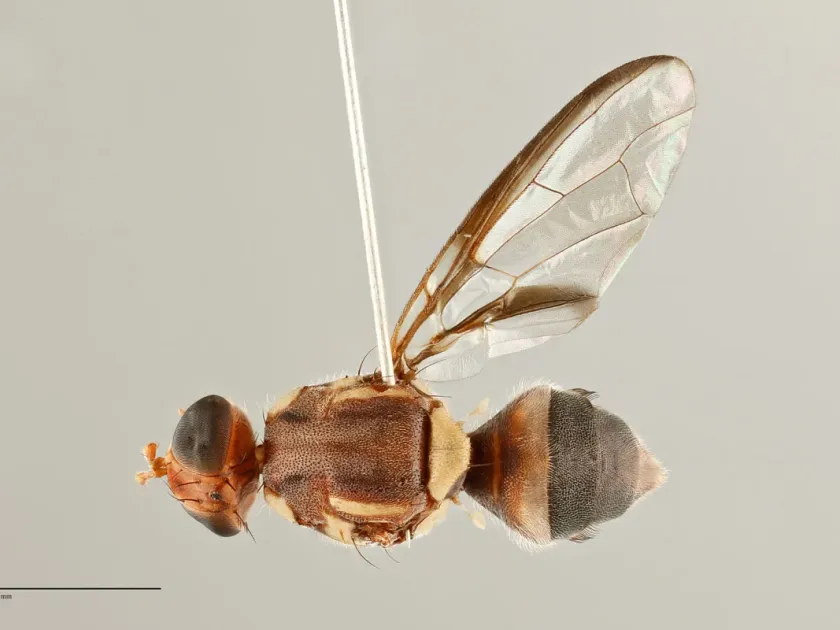
Kraus's fruit fly (Bactrocera kraussi) is a member of the Tephritidae family within the order Diptera. This species is morphologically very similar to other Bactrocera species, making field identification challenging for non-specialists.
The adult fly typically exhibits a yellowish to black body coloration with patterns characteristic of the genus. Its transparent wings feature a distinct dark band along the costal margin, which is a key morphological marker.
Accurate species determination often requires professional taxonomic examination of male genitalia or molecular DNA testing to differentiate it from closely related pests like the Queensland fruit fly.
Larvae are maggot-like, creamy-white, and legless. They are specifically adapted to feed within the mesocarp of fruits, causing significant internal damage that is often not visible until it is too late.
Effective identification usually involves deploying specialized male-lure traps in orchards to confirm the presence of the species through professional entomological monitoring.
What it damages
Bactrocera kraussi is a significant polyphagous pest that attacks a wide variety of tropical and subtropical fruits. It represents a major economic threat to fruit production sectors worldwide.
Common host plants include various commercial fruits such as mango, guava, and papaya, as well as native and ornamental fruiting plants that serve as reservoirs for the pest.
Damage is primarily caused by the female, which inserts eggs into the fruit flesh using its ovipositor. The punctures made by the ovipositor serve as entry points for secondary pathogens.
As the larvae hatch, they begin to consume the interior of the fruit, causing tissue breakdown, fermentation, and rapid decay. This makes the affected fruit completely unmarketable.
Beyond direct crop loss, the presence of this fly imposes severe quarantine restrictions on international trade, preventing growers from exporting their products to unaffected regions.
When it appears
The life cycle of Kraus's fruit fly is highly dependent on climate conditions. Warmer temperatures and high humidity create optimal conditions for rapid development and reproduction.
Under favorable climatic conditions, the species can undergo multiple generations per year, leading to exponential population growth during the fruit ripening season.
The pupal stage occurs in the soil beneath the host plant, where the larvae migrate after exiting the fallen fruit. This phase is critical as it protects the pest from many topical insecticide treatments.
Adult flies are most active during dawn and dusk. They spend their time searching for suitable hosts to lay eggs and seeking mates for reproduction, driven by environmental cues.
Seasonal monitoring programs are implemented to detect peak activity periods, allowing farmers to apply control measures before the population reaches an uncontrollable threshold.
Signs of infestation
One of the earliest signs of infestation is the appearance of tiny "sting" marks or oviposition punctures on the skin of the fruit, often accompanied by slight discoloration or bruising.
Premature ripening or unexpected fruit drop is a common indicator of a larval infestation. If fruit falls to the ground before it is ripe, it is almost certainly harboring larvae.
Cutting open a suspected fruit reveals internal tunnels and damaged tissue, often resulting in a watery consistency and a fermented odor due to the activity of larvae and secondary decay organisms.
Secondary infections, such as bacterial or fungal rot, often develop around the oviposition site, causing the fruit to collapse and liquefy internally as the infestation progresses.
The presence of adult flies in the orchard can be confirmed by using food-based or pheromone-based traps, which provide a clear warning of the pest's activity levels.
Control measures
Management of Bactrocera kraussi requires an Integrated Pest Management (IPM) approach to minimize economic damage while reducing reliance on broad-spectrum chemical sprays.
Sanitation is a cornerstone of control: the systematic collection and destruction of all fallen and infested fruit prevent larvae from entering the soil to pupate.
Chemical control often involves the use of "male annihilation" techniques, using specific lures combined with insecticides to reduce the male population density.
Biological control methods, including the release of parasitoid wasps that target larval stages, are being studied as sustainable alternatives to chemical pesticide applications.
- Consistent removal and deep burial of fallen fruit.
- Use of protective netting or bagging for individual high-value fruits.
- Application of bait sprays containing protein hydrolysates.
- Compliance with strict regional quarantine and movement protocols.
- Regular monitoring using male-attractant traps.
Taxonomy
- Latin name
- Bactrocera kraussi
- Order
- Diptera (flies)
- Family
- Tephritidae
- EPPO code
- BCTRKR
Discussion
No discussions yet — be the first.