
Jarvis fruit fly
Bactrocera jarvisi
Description
How to identify
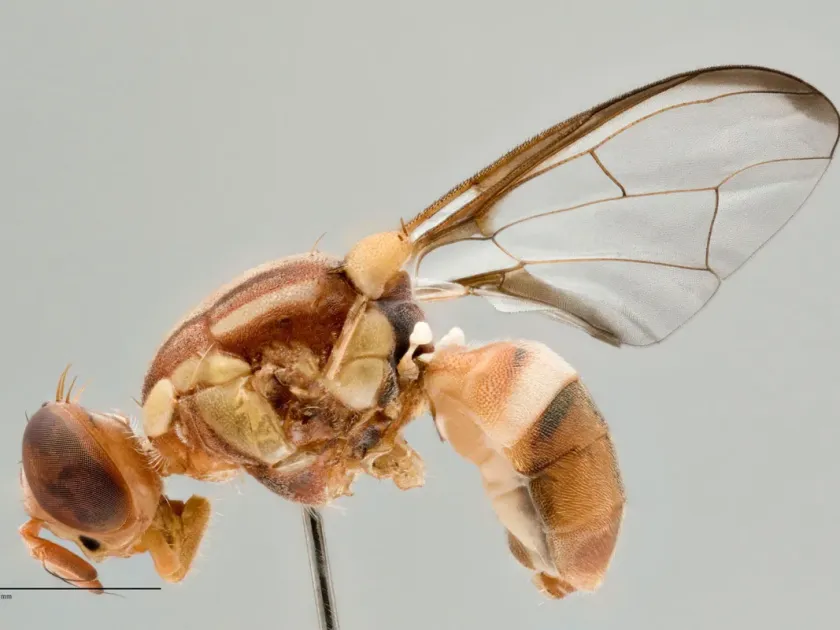
The Jarvis fruit fly (Bactrocera jarvisi) belongs to the Tephritidae family, a group known for causing significant damage to horticultural crops. It is an insect native to northern and eastern parts of Australia.
Adult flies are identified by their characteristic yellowish-brown bodies and patterned wings. The pattern of dark bands on the wings is a diagnostic feature used by entomologists to distinguish them from other Bactrocera species.
The larvae are typically creamy-white, legless maggots measuring about 8–10 mm when fully grown. They possess mouth hooks used to feed on the interior tissue of host fruits.
Proper identification often involves using male-attractant traps (parapheromones). Due to the high risk of spread, taxonomic confirmation via microscopic examination of the male genitalia is standard practice in agricultural quarantine.
This species is highly mobile and thrives in tropical and subtropical climates, making its rapid identification crucial for preventing its spread to new agricultural regions.
What it damages
Bactrocera jarvisi is a polyphagous pest, meaning it attacks a wide variety of fruit hosts. Common hosts include mangoes, guavas, papayas, and various types of pome and stone fruits.
The primary damage is caused by the larvae feeding inside the fruit. This destruction of internal tissues results in the rapid decay of the fruit, leading to premature ripening and drop.
The feeding activity creates entry points for secondary bacterial and fungal pathogens. This results in the complete loss of fruit marketability and significant reductions in yield for orchardists.
In regions where the Jarvis fruit fly is present, trade restrictions are often imposed. This creates economic pressure on the agricultural sector, even when the pest does not cause direct crop failure.
The economic threshold is very low, as even a small infestation can lead to the condemnation of an entire batch of harvested fruit intended for local or export markets.
When it appears
The life cycle of the Jarvis fruit fly is highly dependent on ambient temperature and humidity. Activity generally peaks during the warmer months when host fruits are maturing.
Female flies lay eggs under the skin of the host fruit. Depending on temperature, the egg-to-adult cycle can be completed in as little as three to four weeks, allowing for multiple generations in one season.
Once mature, the larvae exit the fruit and drop to the ground to pupate in the soil. The pupal stage is the overwintering phase, where the fly remains in a dormant state until environmental conditions improve.
Seasonal monitoring via lures is critical for planning control strategies. Understanding the timing of adult emergence allows growers to apply protective measures before significant egg-laying occurs.
In tropical areas with consistent warmth, breeding can continue year-round, posing a constant threat to any fruit crops currently in the ripening stage.
Signs of infestation
Early signs of infestation appear as small, subtle oviposition punctures on the fruit's surface. These small holes are often accompanied by slight discoloration or "weeping" of fruit sap.
Internal damage is visible upon cutting the fruit open, revealing tunnels and darkened, decaying tissue. In advanced cases, the internal structure is completely liquefied by the maggots.
Premature fruit drop is a classic indicator. If dropped fruit is discovered to contain maggots, it is a clear sign that a breeding population is active within the orchard.
The presence of adult flies around fruit trees, especially in the early morning or late afternoon, is another behavioral sign of an established infestation.
A foul, fermented odor emanating from the orchard often signifies severe infestation, as damaged, rotting fruit on the ground attracts more flies and accelerates the cycle of decay.
Control measures
Orchard hygiene is the primary line of defense. The daily collection and destruction of fallen or infested fruit is essential to break the life cycle and prevent maggots from pupating in the soil.
The Male Annihilation Technique (MAT) involves using bait stations with pheromones and insecticides to attract and kill male flies, thereby preventing females from being fertilized.
Protein-based bait sprays combined with insecticides provide a targeted way to control adult female flies. The flies are attracted to the protein, ingest the poison, and die before laying eggs.
Biological control, including the release of parasitic wasps that target fruit fly larvae and pupae, offers a sustainable alternative to chemical sprays in integrated pest management (IPM) programs.
In cases of high-density populations, chemical insecticide treatments may be necessary. These must be applied according to strict safety guidelines to ensure the final produce is free of pesticide residues.
Taxonomy
- Latin name
- Bactrocera jarvisi
- Order
- Diptera (flies)
- Family
- Tephritidae
- EPPO code
- BCTRJA
Discussion
No discussions yet — be the first.