
Halfordia fruit fly
Bactrocera halfordiae
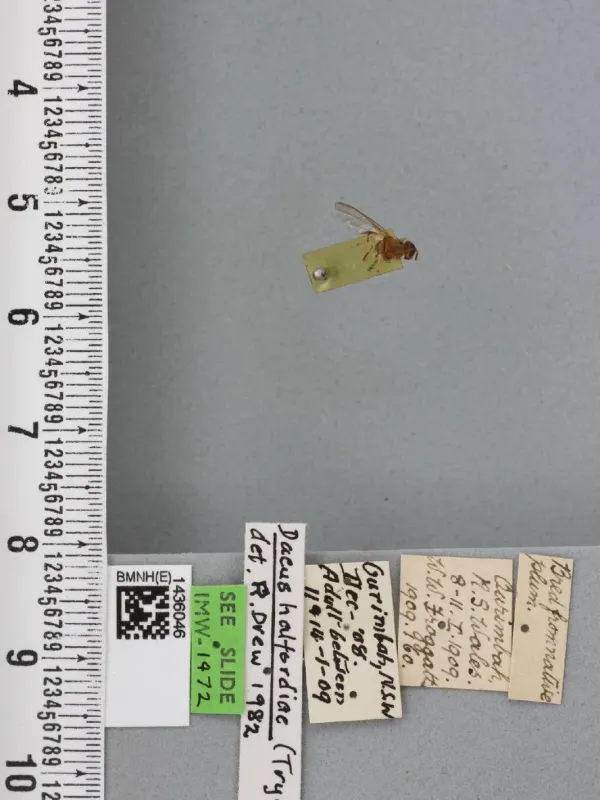
Description
How to identify
The Halfordia fruit fly, Bactrocera halfordiae, belongs to the family Tephritidae, commonly known as fruit flies or picture-winged flies. It is a specialized insect species often found in subtropical environments where its host plants reside.
Adult flies are relatively small and exhibit the distinct coloration and wing patterns typical of the Bactrocera genus. Identification often requires expert entomological examination of morphological features, particularly the structure of the male genitalia and abdominal patterns.
The life cycle encompasses four developmental stages: egg, larva (which undergoes three instars), pupa, and the adult stage. The larvae are the primary destructive stage, developing entirely inside the host fruit.
Adults are highly mobile and rely on visual and olfactory cues to locate host plants for feeding and oviposition. Their survival and reproductive success are heavily influenced by ambient temperature and relative humidity levels.
Monitoring programs often employ specialized traps utilizing food-based or synthetic chemical attractants to detect the presence of Bactrocera halfordiae populations within an orchard or plantation.
What it damages
This species primarily targets fruits of the Rutaceae family, specifically those within the Halfordia genus. The damage is caused by the larvae feeding inside the fruit, which effectively compromises the integrity of the flesh.
As the larvae feed, they tunnel through the fruit tissue, leading to structural breakdown and rapid decomposition. This internal damage often makes the fruit inedible and unsuitable for commercial distribution.
The presence of larvae also promotes the development of secondary bacterial and fungal infections. These pathogens take advantage of the wounds created by the larvae, resulting in premature fruit drop and significant economic loss.
High infestation levels can result in the loss of a large percentage of the harvest, making Bactrocera halfordiae a pest of significant agricultural concern in affected geographical areas.
Early-stage damage to developing fruits can cause stunted growth and abortion, further reducing the overall yield of the orchard during the active growing season.
Signs of infestation
The most common sign of infestation is the presence of small puncture marks on the fruit skin, known as oviposition stings. These marks may sometimes show minor discoloration or indentations depending on the maturity of the fruit.
When an infested fruit is opened, the internal flesh typically shows tunnel-like tracks created by the developing larvae. In advanced stages of infestation, the flesh becomes mushy and develops a foul, putrid odor due to decomposition.
Externally, affected fruits may display irregular ripening patterns, premature yellowing, or abnormal softening. In severe cases, the fruit might lose its shape completely as the interior is consumed by the larvae.
Dropping of unripe fruit is a major indicator of an underlying larval infestation. Observation of the orchard floor often reveals the presence of larvae migrating from the dropped fruit into the soil to pupate.
Increased activity of adult flies around the fruit canopy, particularly during calm weather or early morning/late afternoon, is a strong behavioral sign of an active infestation in the area.
Control measures
Managing Bactrocera halfordiae requires an Integrated Pest Management (IPM) strategy that combines sanitation, monitoring, and, when necessary, targeted chemical interventions.
Sanitation is perhaps the most effective non-chemical control measure. Regularly collecting and disposing of fallen or infested fruit prevents larvae from completing their life cycle in the soil.
Chemical control usually involves the use of insecticide-impregnated baits that attract and kill adult flies. It is critical to apply these materials in a way that minimizes exposure to beneficial insects and pollinators.
Mass trapping programs using species-specific attractants can significantly reduce the adult male population, thereby disrupting the mating cycle and reducing the number of fertile eggs laid by females.
- Continuous monitoring using pheromone and food-based traps
- Aggressive sanitation through the destruction of infested fruits
- Application of bait sprays targeted at adult fly populations
- Implementation of quarantine and movement controls to prevent further spread
Taxonomy
- Latin name
- Bactrocera halfordiae
- Order
- Diptera (flies)
- Family
- Tephritidae
- EPPO code
- DACUHA
Discussion
No discussions yet — be the first.