
Honeysuckle moth
Athrips mouffetella
Description
How to identify
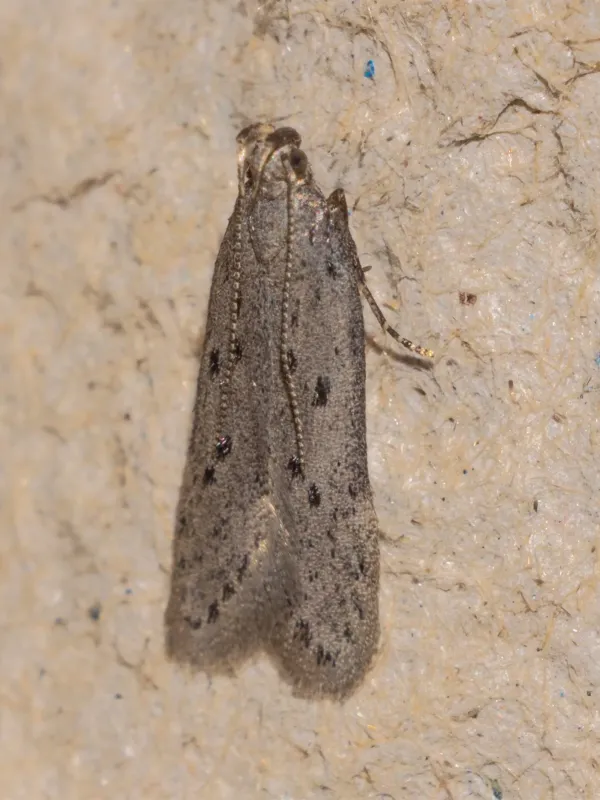
The honeysuckle moth (Athrips mouffetella) is a member of the Gelechiidae family, within the order Lepidoptera. It is a small moth known as a specific pest of various honeysuckle species.
The adult moth has a wingspan of approximately 14–16 mm, with forewings that are mottled greyish-brown, allowing it to blend perfectly with the bark of the shrub.
The larvae are small, measuring up to 12 mm in length, and are usually greenish-yellow to brownish, featuring a darker head capsule and distinct thoracic shields.
The pupal stage occurs inside silken cocoons spun within folded leaves or near the base of the plant in the soil surface, providing protection from predators.
As a specialist species, its life cycle is tightly synchronized with the phenology of honeysuckle, ensuring the larvae have access to fresh buds and leaves upon hatching.
What it damages
The primary hosts for this pest are honeysuckle shrubs, both edible (Lonicera caerulea) and decorative varieties grown in gardens.
Larvae primarily feed on emerging buds, young leaves, and developing flower clusters, hollowing them out and leading to significant tissue loss.
Feeding on flower buds destroys the potential fruit, leading to a substantial decrease in berry production and reduced harvest quality.
In addition to direct tissue consumption, the larvae stunt the growth of young shoots, as the plant directs resources toward recovery rather than new development.
Wounds caused by larval feeding often serve as entry points for fungal pathogens, which can exacerbate the damage to the overall health of the shrub.
When it appears
The species overwinters as mature larvae inside cocoons, typically hidden in leaf litter or bark crevices at the base of the plant.
In the spring, as temperatures rise above 10 degrees Celsius, the larvae emerge from their overwintering sites to feed on the swelling buds.
The adult flight period typically occurs between late May and June, coinciding with the flowering phase of the host plants.
The total development time for one generation lasts approximately 30 to 45 days, depending on local climatic conditions and ambient temperature.
In warmer regions, the species may complete two generations per year, leading to a more prolonged and damaging effect throughout the growing season.
Signs of infestation
The most noticeable sign of infestation is the presence of webbed, rolled-up leaves, which house the feeding larvae.
Affected buds often fail to open or appear dry and partially eaten at the tips of the shoots during early spring.
Skeletonized leaf patches appear where the larvae have consumed the green tissue, leaving behind a delicate network of veins.
The presence of frass (larval droppings) caught within the silk webbing is a definitive indicator of an active infestation.
- Rolled leaves tied together with silk
- Damaged and dried-up flower buds
- Skeletonized foliage patterns
- Stunted growth of apical shoots
Control measures
Cultural control practices, such as removing and destroying fallen leaf litter in autumn, can significantly reduce the overwintering population.
Manual removal of webbed leaf clusters is highly effective for small-scale plantings and home gardens before pupation occurs.
Biological control using microbial insecticides is recommended to manage populations while preserving the safety of beneficial insects and pollinators.
Chemical control should be limited to the pre-flowering stage, utilizing systemic insecticides if population thresholds are exceeded.
Always time chemical applications carefully to avoid contact with pollinators, as honeysuckle relies heavily on bees and other insects for fruit set.
Taxonomy
- Latin name
- Athrips mouffetella
- Order
- Lepidoptera (butterflies)
- Family
- Gelechiidae
- EPPO code
- EPIHMO
Discussion
No discussions yet — be the first.