
Pigeon tick
Argas reflexus
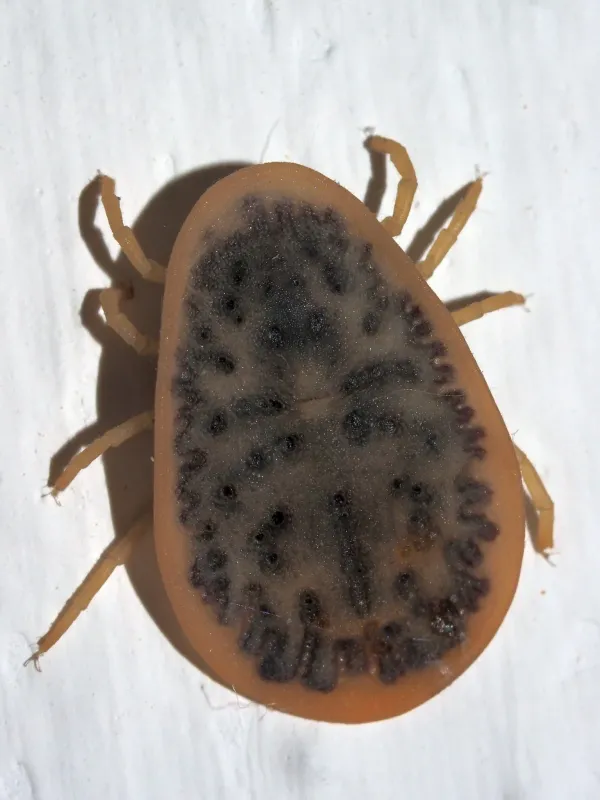
Description
How to identify
The pigeon tick (Argas reflexus) is a member of the Argasidae family, belonging to the order Parasitiformes. It is a nocturnal ectoparasite that primarily infests birds.
The adult tick has a flat, oval-shaped body, typically measuring 4 to 10 mm in length. Its color ranges from pale yellow to dark brown depending on its engorgement status.
A distinctive feature of this species is the presence of a distinct lateral margin (rim) along the entire edge of the body, which helps in its identification.
The tick's skin is leathery and flexible, allowing it to expand significantly after taking a blood meal from its avian host.
These ticks are extremely resilient and can survive for several years without feeding, making them very difficult to eradicate from established poultry environments.
What it damages
This parasite causes significant physiological stress to pigeons and other poultry, leading to reduced growth, weight loss, and general weakness.
While not a direct pest of agricultural crops, it causes severe damage to poultry farming infrastructure by rendering housing unusable.
Humans are also susceptible to bites from the pigeon tick, which can cause severe allergic reactions, skin inflammation, and discomfort.
In addition to blood loss, the ticks act as vectors for various pathogens, compromising the overall health of bird populations.
Heavy infestations can lead to high mortality rates among young birds due to acute anemia and the constant stress of parasitic attack.
When it appears
Activity is highly dependent on ambient temperatures, with the parasite being most active during warmer months of the year.
During the peak season, reproduction accelerates, and ticks move frequently between the nesting sites and their hosts.
In indoor environments, such as attics or heated lofts, the tick can remain active and continue its life cycle throughout the year.
Eggs are typically laid in small crevices within structures, where they are protected from environmental fluctuations.
The life cycle involves multiple stages, including larvae, nymphs, and adults, all of which are capable of surviving long periods of food deprivation.
Signs of infestation
The primary sign of an infestation is the presence of black excrement deposits in the vicinity of bird nesting areas.
Observation of bird behavior is key; infested birds often exhibit restless behavior, frequent scratching, and poor plumage condition.
Using a flashlight during nighttime inspections can reveal the presence of adult ticks crawling on surfaces near resting birds.
The presence of shed exoskeletons in wall cracks and crevices indicates that the tick population has been established for a long duration.
Visible bite marks and severe skin reactions in humans who enter the pigeon coop are clear indicators of a high tick population density.
Control measures
Successful control requires a rigorous cleaning routine, including the removal of all nesting materials and debris where ticks hide.
The application of contact-action acaricides to walls, floorboards, and ceiling cracks is essential for eliminating sheltered populations.
Sealing gaps and cracks in building structures is a critical preventative measure to reduce the number of available breeding sites.
Regular sanitation programs, including the use of high-pressure cleaning and specialized disinfectants, are necessary to maintain control.
- Thorough chemical treatment of all cracks and crevices.
- Removal of old nesting sites and sanitizing of bird housing.
- Use of protective gear when cleaning infested areas to prevent tick bites.
Taxonomy
- Latin name
- Argas reflexus
- Family
- Argasidae
- EPPO code
- ARGSRF
Discussion
No discussions yet — be the first.