
Ardices canescens
Ardices canescens
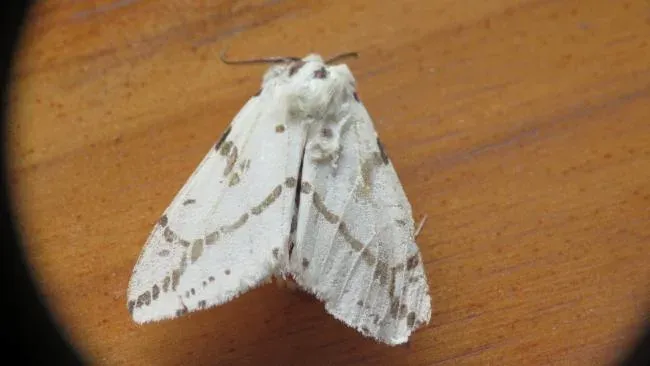
Description
How to identify
Ardices canescens belongs to the order Lepidoptera and the family Erebidae (subfamily Arctiinae). This insect has a characteristic appearance, common to many members of the family, with dense body hair and a specific wing pattern.
Adult moths have a wingspan of approximately 30–40 mm. The wing color varies from grayish-brown to almost black, often featuring white or cream streaks and spots, which helps them camouflage on tree bark.
The larvae of this species are distinguished by thick hairs, which often cause skin irritation in humans upon contact. The caterpillars' coloration can be dark, almost black, with longitudinal light stripes, making them visible against the foliage.
The insect undergoes a complete metamorphosis: egg, larva (caterpillar), pupa, and imago. Depending on the regional climate, the pest may produce one or two generations per year.
They usually overwinter as pupae or late-stage larvae, hiding under leaf litter, in bark crevices, or in the topsoil, where they are protected from low temperatures.
What it damages
The primary damage is caused by the caterpillars, which are highly voracious. They are polyphagous, meaning they feed on a wide range of plant species.
They cause the greatest damage to vegetable crops, fruit trees, and various ornamental plants. Caterpillars actively eat leaf blades, leaving only coarse veins behind, which severely impairs photosynthesis.
During mass outbreaks, this pest can completely defoliate a plant, leading to critical yield losses and stunted growth for the current season.
Beyond direct foliage destruction, damaged plants become more susceptible to secondary infections, fungal diseases, and attacks by other pests.
Young seedlings and transplants are particularly at risk of death, as larvae can destroy the growth point or a significant portion of the biomass in a very short time.
When it appears
The active development period of the caterpillars begins in mid-spring, when average daily temperatures become favorable for pupae to emerge and larvae to hatch.
Adult moth activity usually occurs at night, as they are crepuscular and nocturnal creatures. During this time, mating and egg-laying on the undersides of host plant leaves occur.
Caterpillar activity peaks in early to mid-summer, coinciding with the most intense growth of plant biomass, providing the necessary food for the pests.
In the autumn, the caterpillars finish feeding and begin searching for pupation sites or diapause locations, retreating into sheltered areas.
In regions with favorable climates, a second generation may develop in late summer, continuing to damage crops until the first hard frosts.
Signs of infestation
The first sign of the pest's presence is the occurrence of irregular holes in leaves, as well as larval frass on the surface of leaves or beneath the plants.
The presence of specific hairy caterpillars, which may cluster on the undersides of leaves or along stems, is undeniable evidence of infestation.
Upon inspection, one may find thin silk webs used by the caterpillars for protection or movement between plant parts, which is also a key diagnostic feature.
Damaged foliage often shows yellowing and premature wilting caused by the disruption of plant tissue integrity.
If the pest infests fruit trees, one can observe stripped branches and damaged fruit sets, which may subsequently drop prematurely or become deformed.
Control measures
Control of Ardices canescens should begin with agrotechnical measures, such as regular weeding, as weeds can serve as an additional food source for the caterpillars.
Hand-picking and destroying egg masses and young groups of caterpillars is an effective method if the area is small enough to monitor.
Biological products based on Bacillus thuringiensis show high efficacy against young larvae while remaining safe for beneficial insects.
When the economic threshold of damage is significantly exceeded, it is recommended to apply contact-stomach insecticides, strictly observing pre-harvest intervals.
- Using light traps to capture adult moths during the night.
- Encouraging the presence of natural enemies, such as predatory bugs and birds, in the garden.
- Autumn soil cultivation to destroy overwintering pupae.
Taxonomy
- Latin name
- Ardices canescens
- Order
- Lepidoptera (butterflies)
- Family
- Erebidae
- EPPO code
- DIAICA
Discussion
No discussions yet — be the first.