
Cream-spot tiger
Arctia villica
Description
How to identify
The Cream-spot tiger (Arctia villica) belongs to the Erebidae family, subfamily Arctiinae. The adult moth has a wingspan of 60–70 mm, with black forewings featuring large creamy-white spots and yellow or orange hindwings with black dots.
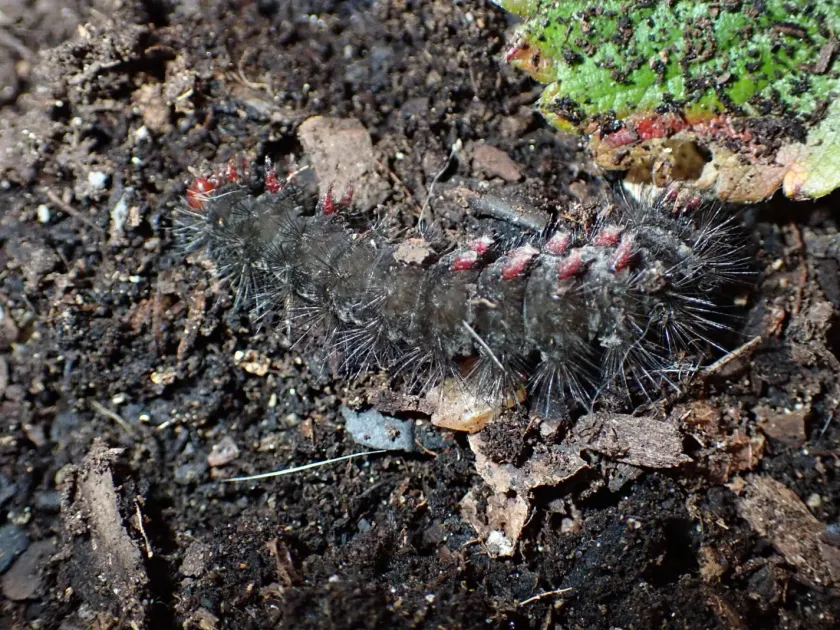
The larvae of this species can reach 50–60 mm in length. They are covered with dense, stiff dark brown or black hairs, which is why they are often referred to as "woolly bears." The head of the caterpillar is usually shiny and dark.
The life cycle includes the egg stage, five to six larval instars, pupa, and imago. Mid-stage caterpillars overwinter by hiding in leaf litter or under plant debris, allowing them to survive cold temperatures.
Pupation occurs in spring or early summer within a loose silk cocoon, which the caterpillar constructs among leaves or in the topsoil layer. The pupal stage lasts for several weeks before the adult moth emerges.
In natural habitats, the Cream-spot tiger is widespread across Europe, preferring meadows, forest edges, and neglected areas with rich herbaceous vegetation.
What it damages
This species is a polyphagous pest, meaning it feeds on a wide variety of plants. The diet of the caterpillars includes both wild-growing weeds and many cultivated plants grown in gardens and fields.
In agricultural practice, damage is frequently observed on vegetable crops, including lettuce, cabbage, carrots, as well as on various berry bushes and ornamental plants.
The damage is caused by the caterpillars, which are highly voracious. During outbreaks, they can significantly strip leaf blades, leaving only the coarse veins, which impairs the plant's ability to photosynthesize.
When young plants are attacked, caterpillars may damage the growing tips, leading to shoot deformation and a significant decrease in yields. In ornamental plants, aesthetic damage is manifested as ragged leaf edges.
In addition to direct destruction of leaf tissue, the caterpillar's excrement pollutes the plants, creating an environment favorable for the development of secondary fungal and bacterial infections.
When it appears
The flight of the single annual generation of moths typically occurs from late May through July. During this time, the insects mate and lay eggs on the undersides of host plant leaves.
Young caterpillars emerge in mid-summer and feed actively until the onset of persistent autumn cold, after which they enter hibernation in the soil or plant debris.
In spring, after the soil warms up, the overwintered caterpillars resume feeding, becoming particularly dangerous to seedlings and young spring crops in April and May.
The timing of pupation and adult emergence may shift depending on regional climatic conditions and soil temperature, which affect the developmental speed of the larvae.
Monitoring pest numbers should be conducted during morning and evening hours when the caterpillars are most active and visible on stems and leaves.
Signs of infestation
The primary sign of infestation is the presence of eaten leaves with characteristic "ragged" edges or completely destroyed leaf tissue.
The presence of the caterpillars themselves is easily identified visually: due to their large size and dense hair covering, they are quite noticeable against green foliage even at low population densities.
- Presence of holes in leaf blades.
- Eaten leaf edges near the base of the plant.
- Presence of silk cocoons on stems or under leaves.
- Traces of excrement on the soil surface under affected bushes.
Tiger moth caterpillars are primarily nocturnal, often hiding at the base of plants or under mulch during the day, so inspection of the lower layers of planting beds is recommended for diagnosis.
Control measures
The primary control method is an agrotechnical approach: deep soil cultivation in autumn and spring disrupts the caterpillars' hibernation sites and pupation areas, significantly reducing the population.
Timely weeding is crucial, as the primary population of the Cream-spot tiger often develops on wild weeds before migrating to cultivated crops.
For small areas, manual collection of caterpillars in the morning is effective. Because caterpillar hairs can cause skin irritation, protective gloves should be worn during handling.
When pest numbers are high, the use of biological preparations based on Bacillus thuringiensis is justified, as they affect young larvae without harming beneficial insects or entomophages.
The use of broad-spectrum chemical insecticides is permissible only in extreme cases, while strictly adhering to safety intervals and application regulations for specific crops.
Taxonomy
- Latin name
- Arctia villica
- Order
- Lepidoptera (butterflies)
- Family
- Erebidae
- EPPO code
- ARCTVI
Discussion
No discussions yet — be the first.