
Soybean leaf miner
Aproaerema
Description
How to identify
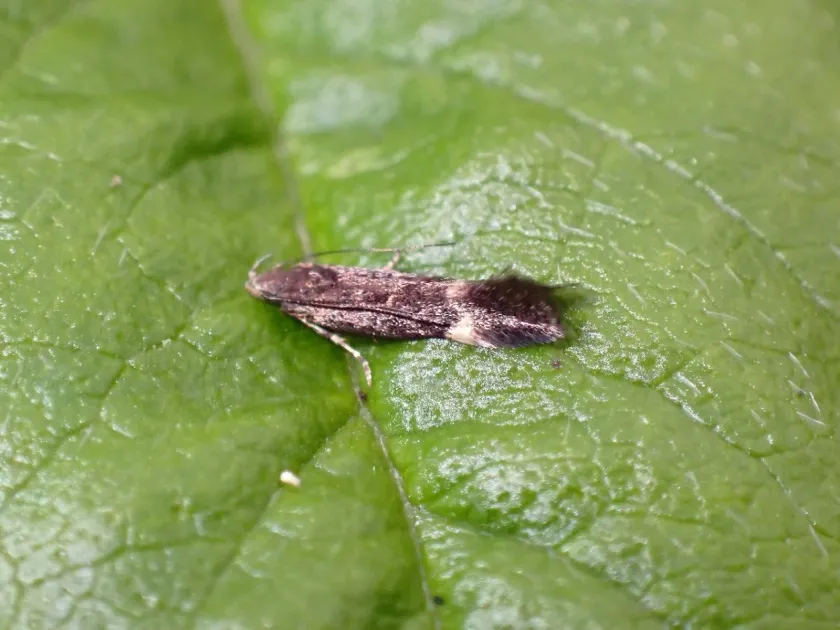
The soybean leaf miner (Aproaerema modicella) is a small moth belonging to the family Gelechiidae. Adult moths have a wingspan of approximately 10 to 12 mm, with dark brown or blackish forewings that provide excellent camouflage against foliage.
The life cycle progresses through egg, larva, pupa, and adult stages. Larvae undergo several instars, transitioning from light green to a reddish-brown color as they mature, typically reaching a length of about 8 mm before pupation.
Eggs are tiny, oval-shaped, and usually deposited on the underside of leaves. A single female can produce up to 200 eggs, facilitating rapid population growth under favorable environmental conditions.
Pupation occurs within a light silken cocoon, often inside a folded or webbed leaf. The pupal stage typically lasts from 5 to 10 days, allowing the insect to complete multiple generations within a single growing season.
The species thrives in warm, humid climates with temperatures ranging from 25°C to 30°C. In such conditions, the pest can complete its cycle rapidly, leading to significant outbreaks if left unmonitored during the soybean vegetative stage.
What it damages
While soybeans are the primary host, the pest also attacks other legumes such as peanuts and beans. The damage is primarily caused by the larvae, which feed internally within the leaf tissue.
Larval feeding creates characteristic "mines"—irregular tunnels or blotch-like patches on the leaves. This feeding pattern severely disrupts photosynthesis, leading to reduced plant vigor and leaf necrosis.
During heavy infestations, larvae web together multiple leaves, forming nests. This action causes massive defoliation, stunted growth, and in severe cases, the termination of apical dominance, leading to bushy, unproductive plants.
Damage to the leaf canopy significantly impacts the plant's ability to fill pods, leading to yield losses of up to 50% or more. The reduction in seed size and quality is a major concern for commercial soybean producers.
Economic damage is most pronounced when infestations coincide with the pod-filling stages, as the plant lacks the necessary leaf surface area to support grain development during this critical period.
Signs of infestation
Initial signs of infestation are small, pale spots or streaks on the foliage, which are the early stages of larval mining. Observing the underside of the leaf can often reveal the small entry points made by the larvae.
Webbed and folded leaves at the terminal ends of the plant are a clear indicator of a more advanced infestation. Inspecting these "nests" usually reveals the larvae and frass deposited within the rolled leaf tissue.
Premature yellowing and drying of leaves, particularly in the lower canopy, signal significant feeding pressure. As the infestation progresses, entire fields may take on a scorched or withered appearance.
Adult activity can be detected using light traps or pheromone monitoring systems. The presence of moths indicates that egg-laying is occurring, providing a window for early intervention.
Farmers should look for "window-paning" or thinning of the leaf tissue where the larvae have consumed the green cells, leaving only the transparent epidermis behind.
Control measures
Effective management requires an integrated pest management (IPM) approach. Cultural controls, such as crop rotation and the destruction of alternate legume hosts (weeds), are essential to break the pest's life cycle.
Chemical control is often necessary during peak outbreaks. Systemic insecticides are preferred as they penetrate the leaf tissue, reaching the larvae protected within the mines, which contact insecticides often fail to do.
To prevent the development of pesticide resistance, it is crucial to rotate chemical classes. Applications should be timed based on economic thresholds rather than prophylactic schedules to maximize efficiency and preserve beneficial insects.
Biological control, including the use of entomopathogenic fungi, bacteria like Bacillus thuringiensis, or the release of parasitoid wasps, can play a significant role in managing population levels.
Regular field scouting is critical. Farmers should monitor for egg clusters and small larvae to apply control measures before the leaf rolling stage, as this significantly limits the insect's ability to create protected nests.
Taxonomy
- Latin name
- Aproaerema
- Order
- Lepidoptera (butterflies)
- Family
- Gelechiidae
- EPPO code
- AROASP
Discussion
No discussions yet — be the first.