
Apophua
Apophua
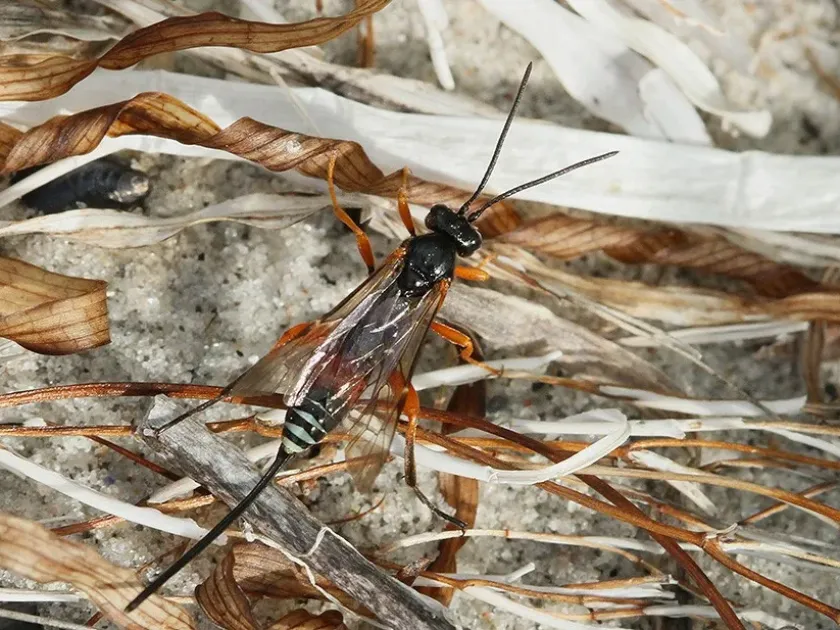
Description
How to identify
The genus Apophua belongs to the order Hymenoptera and the family Ichneumonidae. These are typically slender parasitoid wasps that play a complex role within agricultural ecosystems.
Adults exhibit the classic morphology of ichneumonids, featuring a long, thin body and, in females, a prominent ovipositor used for laying eggs within or upon host larvae.
As endoparasitoids, they rely on specific lepidopteran hosts to complete their lifecycle, making them essential players in the natural regulation of insect populations.
The lifecycle includes complete metamorphosis, progressing through egg, larval, pupal, and adult stages, with larvae spending their critical development time inside the host.
Correct identification often requires expert analysis of wing venation and abdominal structure, as the genus contains several closely related species.
What it damages
Apophua species primarily target larvae of leafrollers (Tortricidae) and other moth species that are significant pests on fruit crops such as apples, pears, and plums.
While often classified alongside pests, they are actually beneficial entomophages; their 'damage' is the termination of the life cycle of the agricultural pests they parasitize.
They inhabit orchards and woodlands where their host larvae are abundant, exerting natural pressure on pest populations during the growing season.
In an agricultural setting, they function as natural control agents, significantly reducing the need for synthetic insecticide applications when their populations are well-managed.
The larva develops by consuming the host from within, which ultimately results in the death of the pest larva, serving as a biological safeguard for the crop.
When it appears
Adult activity is most pronounced during the spring and summer months, effectively coinciding with the peak presence of pest caterpillars in orchards.
Their flight period typically peaks in June and July, triggered by favorable temperatures and the availability of suitable hosts for oviposition.
Depending on the climatic zone, the genus may complete multiple generations per year, allowing them to track host population spikes effectively.
Overwintering usually occurs in the larval or pupal stage, often protected within the remains of the host or a silk-like cocoon tucked away in bark or debris.
Temperature fluctuations in early spring can impact emergence timing, making synchronized host-parasitoid interaction vital for the wasp's survival.
Signs of infestation
Signs of Apophua presence are generally subtle and rarely involve visible damage to the fruit or foliage of the host plants.
The primary indicator of their activity is a noticeable decline in pest caterpillar populations that cannot be attributed to chemical interventions.
In-depth field monitoring, such as collecting larvae and observing them for signs of parasitism or emergence holes, is the only reliable way to confirm their activity.
The presence of adult wasps can be detected using specialized Malaise traps or by direct observation of flowering plants near pest-infested areas.
Experts often differentiate these wasps by their flight patterns and behavior around leaf-rolling colonies during the late spring period.
Control measures
Effective management focuses on creating a stable environment where these beneficial parasitoids can thrive, reducing the reliance on broad-spectrum pesticides.
By promoting habitat diversity and implementing Integrated Pest Management (IPM), growers can harness Apophua as a primary defense mechanism.
- Avoid the use of non-selective, toxic chemical insecticides during peak flight times.
- Plant floral margins to provide nectar sources for adult wasps.
- Monitor pest levels closely to justify intervention only when thresholds are exceeded.
- Maintain hedgerows and natural areas adjacent to orchards as refugia.
- Use pheromone traps to monitor both hosts and beneficial species levels.
By protecting these natural enemies, farmers can achieve long-term suppression of leafrollers and other moth pests through sustainable biological means.
Strategic timing of any necessary chemical applications ensures that the most vulnerable stages of the parasitoids are not compromised.
Taxonomy
- Latin name
- Apophua
- Order
- Hymenoptera
- Family
- Ichneumonidae
- EPPO code
- APOPSP
Discussion
No discussions yet — be the first.