
Aphytis melinus
Aphytis melinus
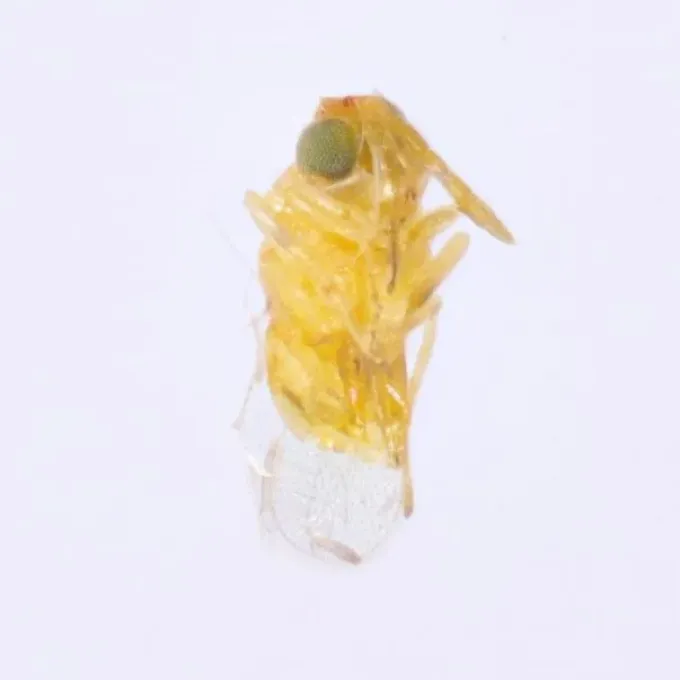
Description
How to identify
Aphytis melinus is a minute parasitic wasp belonging to the family Aphelinidae. These insects are exceptionally small, typically measuring less than 1 millimeter in length, with a distinct yellowish body color.
Adult females are highly active searchers. Equipped with well-developed wings, they efficiently navigate through orchards and greenhouses to locate populations of scale insects on leaves, branches, and fruits.
Due to their microscopic size, identifying them in the field requires specialized knowledge or the use of magnifying tools, but their presence is a positive indicator of natural pest regulation.
As a member of the order Hymenoptera, this species has evolved a specialized parasitic lifestyle, making it one of the most reliable tools in sustainable agricultural practices.
Field identification often involves microscopic examination of scale covers to look for emergence holes, which are characteristic of successful parasitization by this wasp.
What it damages
It is important to clarify that Aphytis melinus is not a pest. In agricultural terms, it is a highly beneficial entomophagous insect, essential for controlling scale populations without damaging the crops.
The species primarily targets the California red scale and other armored scales that infest citrus trees, pome fruits, and various ornamental nursery plants.
The larva of the wasp develops underneath the scale insect's protective cover. By feeding on the internal tissues of the host, the larva effectively terminates the pest before it can cause further damage to the tree.
Its role in biocontrol is critical; by maintaining pest populations below economic injury levels, it reduces the need for synthetic chemical insecticides.
The wasp itself does not feed on plant tissues, does not produce honeydew, and does not cause any form of physical harm to the trees or the quality of the harvest.
When it appears
The activity and efficacy of Aphytis melinus are strongly influenced by the ambient temperature, performing best in a range between 20 and 30 degrees Celsius.
With the arrival of warmer spring weather, the first generations of wasps emerge and begin their search for scale hosts, which often coincides with the onset of pest reproduction.
Their life cycle is notably rapid. Under ideal conditions, a single generation can complete its development in as little as two to three weeks, allowing for a fast population increase.
Over the course of a single growing season, the wasp can produce up to six generations, providing continuous suppression of scale insects throughout the summer months.
Survival through winter depends heavily on sheltered microclimates, as extreme cold can significantly reduce the number of wasps that emerge the following spring.
Signs of infestation
The most reliable sign of Aphytis melinus activity is the presence of specific physical evidence left behind on the bodies of the host insects.
Upon close inspection of the scale covers, one can observe tiny, precise exit holes. These indicate that an adult wasp has successfully developed and emerged from the scale.
A noticeable decline in the density of live scale colonies on bark and fruit surfaces serves as a clear indicator that the parasitic wasp is exerting strong biological pressure.
Where the wasp is successfully established, the symptoms of scale infestation, such as chlorosis, leaf drop, and fruit spotting, tend to diminish significantly over time.
Furthermore, a reduction in the rate of new scale colonization in previously infested areas is a strong indicator of successful ongoing biological control.
Control measures
Agricultural practices for this object focus on habitat conservation and the prevention of insecticide misuse to protect the wasp population.
- Minimize the application of broad-spectrum pesticides that are toxic to parasitic Hymenoptera.
- Incorporate floral resources around orchard edges to provide essential nectar for adult wasps.
- Utilize periodic augmentative releases of lab-reared wasps if scale populations exceed acceptable biological thresholds.
- Maintain optimal orchard microclimates to support the survival and foraging behavior of the wasps.
- Implement regular monitoring programs to synchronize any necessary interventions with the presence of the wasps.
Taxonomy
- Latin name
- Aphytis melinus
- Order
- Hymenoptera
- Family
- Aphelinidae
- EPPO code
- APYTME
Discussion
No discussions yet — be the first.