
Aphytis funicularis
Aphytis funicularis
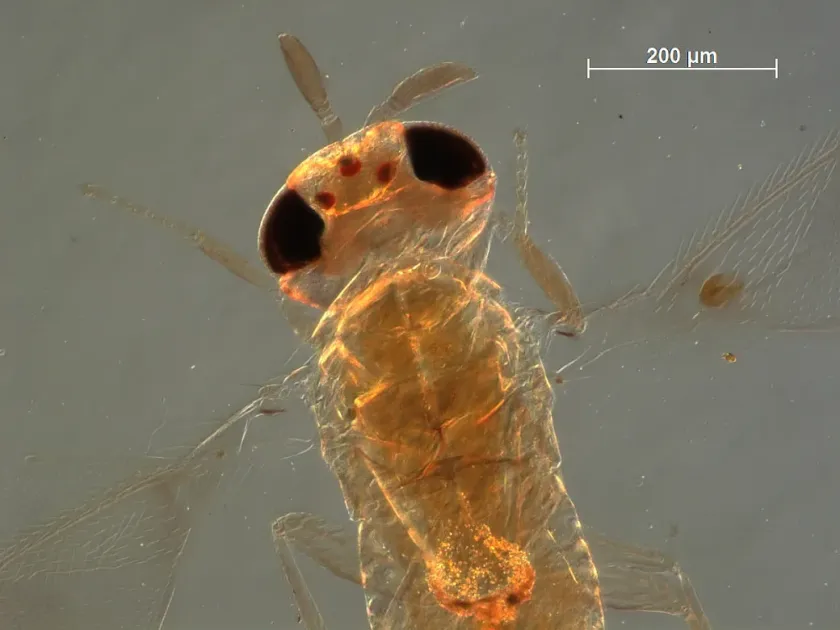
Description
How to identify
Aphytis funicularis is a species of parasitic wasp belonging to the family Aphelinidae (order Hymenoptera). It is recognized primarily as a beneficial biological control agent rather than a pest.
The insect is extremely small, typically requiring specialized equipment for precise identification. Morphological features include specific antenna segments and wing venation characteristic of the genus Aphytis.
As an ectoparasitoid, the wasp deposits its eggs under the protective scale of its host. The developing larvae feed externally on the host's body, eventually killing it.
This species is well-adapted to specific subtropical environments where citrus is grown, playing a pivotal role in maintaining the balance of the local ecosystem.
Successful management of this parasitoid involves recognizing its presence in the field and understanding its ecological requirements for survival and reproduction.
What it damages
Aphytis funicularis does not cause damage to plants. It is a highly beneficial insect that targets scale insects, which are major pests of citrus trees, including the Australian cottony cushion scale.
By parasitizing the nymphs and adult females of scale insects, the wasp significantly suppresses the pest population, thereby protecting tree health and fruit quality.
Without this parasitoid, citrus orchards often suffer from heavy infestations of scale insects, which lead to stunted tree growth, yellowing foliage, and the production of honeydew that fosters sooty mold.
The role of Aphytis funicularis is purely positive; it provides natural pest regulation that reduces the economic burden on farmers who would otherwise rely on heavy chemical inputs.
Agronomists view the presence of this wasp as a sign of a healthy, balanced orchard where biological control is actively managing pest numbers below the economic injury level.
When it appears
The life cycle of Aphytis funicularis is synchronized with its host availability. In warm climates, it is active throughout the majority of the growing season, showing several generations per year.
Activity increases as temperatures rise in the spring, which triggers the onset of pest reproduction and, consequently, the parasitoid's search for new hosts.
During the summer months, the wasps are at their most active, ensuring maximum parasitism rates as the pest populations reach their peak numbers.
As temperatures drop during the winter, the parasitoid enters a period of dormancy, overwintering as larvae or pupae protected within the host's remains.
This seasonal synchronization makes it crucial to time any necessary orchard maintenance to coincide with periods when the wasps are least vulnerable to external factors.
Control measures
The main approach to managing Aphytis funicularis is conservation biological control. This requires the preservation of its habitat and avoidance of toxic pesticides.
To encourage population growth, farmers should utilize Integrated Pest Management (IPM) strategies, choosing soft, selective pesticides when chemical control is absolutely required.
Maintaining floral strips or hedgerows within or near the orchard provides nectar sources for adult wasps, which significantly increases their lifespan and overall efficiency as parasitoids.
Regular scouting and monitoring of scale populations allow for informed decision-making, ensuring that spray programs do not inadvertently eliminate this valuable natural enemy.
- Avoidance of broad-spectrum insecticide sprays.
- Use of selective pesticides for secondary pests.
- Enhancement of floral resources in the orchard.
- Monitoring of parasitism levels before applying sprays.
Taxonomy
- Latin name
- Aphytis funicularis
- Order
- Hymenoptera
- Family
- Aphelinidae
- EPPO code
- APYTFN
Discussion
No discussions yet — be the first.