
Aphytis chrysomphali
Aphytis chrysomphali
Description
How to identify
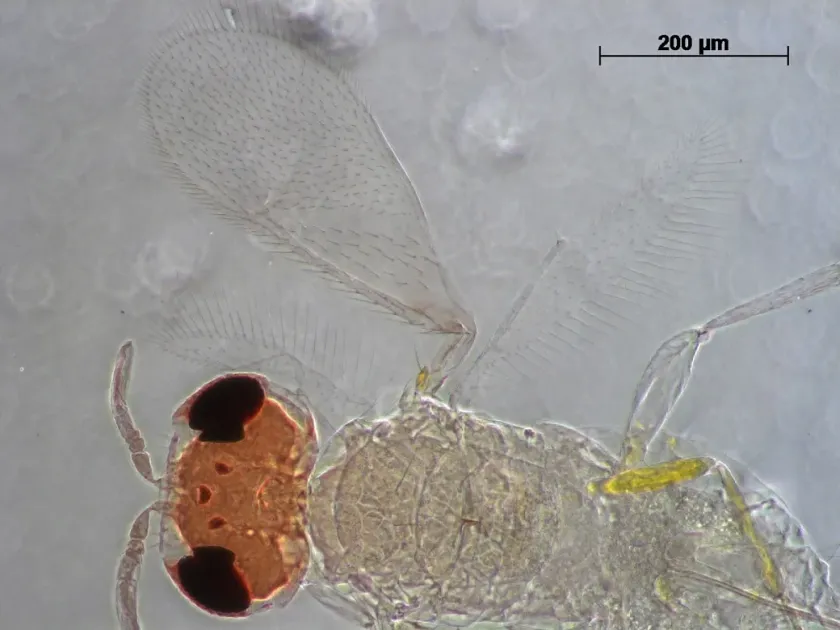
Aphytis chrysomphali is a tiny parasitoid wasp belonging to the family Aphelinidae. It is a highly specialized natural enemy that plays a crucial role in controlling populations of various scale insects.
The adult wasps are microscopic, typically measuring less than 1 mm in length. They are characterized by a light yellow to brownish body color, which serves as effective camouflage on the bark of infested trees.
The life cycle involves the female wasp laying an egg underneath the protective scale of the host insect. Upon hatching, the larva feeds externally on the soft body of the scale, leading to its eventual death.
Due to their small size, detecting these wasps in an orchard environment requires expert knowledge or laboratory analysis of collected host samples to confirm their presence.
These wasps are vital components of sustainable agricultural systems, effectively suppressing harmful pest populations and reducing the ecological footprint of crop protection.
What it damages
It is critical to note that Aphytis chrysomphali is not a plant pest. On the contrary, it is a highly beneficial organism that provides essential biological control services in orchards.
The species is a primary parasitoid for several destructive scale insects, most notably the red scale (Aonidiella aurantii), which is a major threat to citrus and woody ornamental plants.
Scale insects cause significant damage by extracting sap from foliage, twigs, and fruits, which results in yellowing, stunted growth, fruit drop, and, in severe cases, branch dieback.
By parasitizing these pests, the wasp prevents the further spread of infestation and significantly reduces the damage caused by scale insects to the crop quality and tree vigor.
Therefore, the presence of Aphytis chrysomphali should be actively encouraged by growers as a key biological factor in maintaining healthy and productive orchards.
When it appears
The seasonal activity of Aphytis chrysomphali is heavily dependent on ambient temperatures and the availability of suitable host populations for reproduction throughout the growing season.
In temperate and subtropical regions, these wasps can remain active for most of the year, provided the climate allows for the development of their scale insect hosts.
The most favorable conditions for their development and host-seeking activity occur when temperatures are between 20°C and 28°C, facilitating high reproductive rates.
Generation turnover is relatively fast, allowing the wasp to maintain its population density effectively relative to the pest population it targets in the field or greenhouse.
During the colder winter months, activity significantly slows down, and the parasitoid often survives in a state of reduced metabolic activity within the host's scale.
Control measures
Preserving populations of Aphytis chrysomphali requires an Integrated Pest Management (IPM) approach that avoids the use of broad-spectrum chemical insecticides.
When chemical interventions are necessary for other pests, growers should select pesticides that have minimal residual impact on beneficial parasitoids and predators.
Environmental management, such as maintaining refugia and diverse plant life around orchards, helps support the continuous presence of these beneficial insects in the environment.
In many intensive citrus-growing regions, mass-rearing and augmentation releases of these wasps are standard practices to ensure long-term, sustainable control of scale pests.
- Avoidance of non-selective pesticide sprays.
- Implementation of Integrated Pest Management (IPM).
- Habitat conservation for beneficial insects.
- Monitoring of parasitoid-to-pest population ratios.
Taxonomy
- Latin name
- Aphytis chrysomphali
- Order
- Hymenoptera
- Family
- Aphelinidae
- EPPO code
- APYTCH
Discussion
No discussions yet — be the first.