
Antichloris caca
Antichloris caca
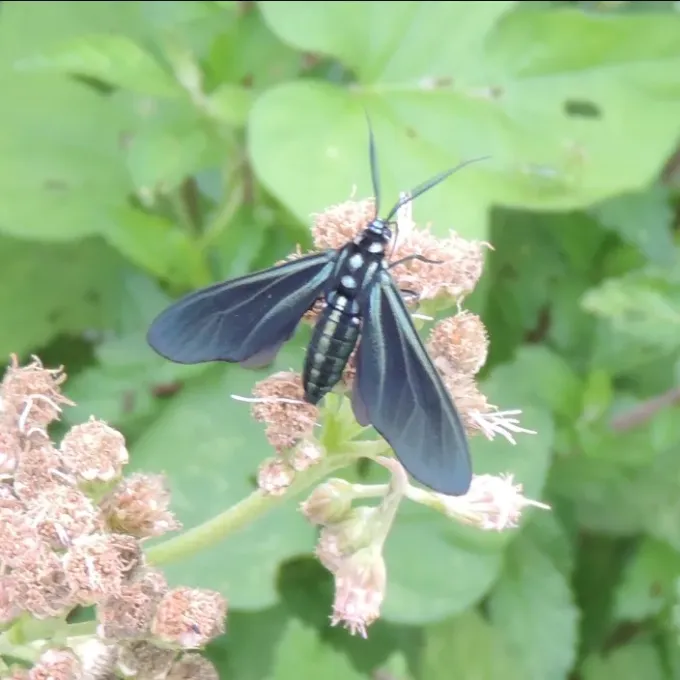
Description
How to identify
Antichloris caca is a species of moth within the Erebidae family, specifically belonging to the subfamily Arctiinae. It is recognized as a pest primarily in tropical regions where banana cultivation is prevalent.
The adult moth is typically dark-colored, adapted for nocturnal activity, which makes it elusive during daylight hours. Its morphology is consistent with other arctiid moths that pose risks to industrial agriculture.
The taxonomic classification places it within the order Lepidoptera. Understanding its lifecycle is essential for agriculturalists, as the larval stage is the most destructive phase for host plants.
Females lay eggs in clusters on the foliage of host plants, ensuring that emerging larvae have immediate access to their primary food source upon hatching.
The rapid life cycle of Antichloris caca allows for multiple generations per year, which can lead to exponential population growth under favorable environmental conditions.
What it damages
The larvae of Antichloris caca feed aggressively on the leaves of banana plants (Musa spp.). This feeding activity results in significant defoliation, which severely limits the plant's photosynthetic capacity.
As the leaf tissue is consumed, the overall vigor of the banana plant declines, leading to stunted growth and reduced fruit yield in both quality and quantity.
Young plants are particularly vulnerable, and severe infestations can result in the complete destruction of the foliage, effectively killing the plant if left unmanaged.
The damage is not limited to the leaves alone, as the stress caused by defoliation can make the plant more susceptible to opportunistic pathogens and secondary fungal infections.
In large-scale banana plantations, the economic impact of this pest is substantial, requiring significant investment in monitoring and mitigation strategies.
Signs of infestation
Visual identification of infestation typically begins with observing skeletonized leaves, where larvae have consumed the interveinal tissue, leaving only the vascular structure.
The presence of larval frass (excrement) on the leaf surfaces or trapped in the central whorl of the banana plant is a diagnostic sign of active feeding.
Larvae often web leaves together to create protective shelters; finding these rolled or webbed leaves during field scouting is a strong indicator of an Antichloris caca presence.
Yellowing or necrosis of damaged leaves often follows heavy feeding, as the plant struggles to transport nutrients through the compromised leaf surface.
Field inspections conducted early in the morning can reveal clusters of young larvae or egg masses on the underside of the leaves, which is the best time for intervention.
Control measures
Effective management of Antichloris caca relies on an Integrated Pest Management (IPM) approach that emphasizes biological control agents and sustainable practices.
The use of biopesticides, such as formulations containing Bacillus thuringiensis, is highly effective in targeting larvae while preserving the natural balance of beneficial insects.
Physical removal and destruction of infested leaves can serve as a simple yet effective method for small-scale growers to keep populations under control.
Monitoring populations using pheromone traps allows for precise timing of interventions, reducing the need for broad-spectrum chemical insecticides and minimizing environmental impact.
- Implement regular field scouting.
- Apply targeted biological insecticides.
- Promote natural predator habitats.
- Execute rigorous sanitation of plantations.
Taxonomy
- Latin name
- Antichloris caca
- Order
- Lepidoptera (butterflies)
- Family
- Erebidae
- EPPO code
- CEMDBU
Discussion
No discussions yet — be the first.