
Antianthe expansa
Antianthe expansa
Description
How to identify
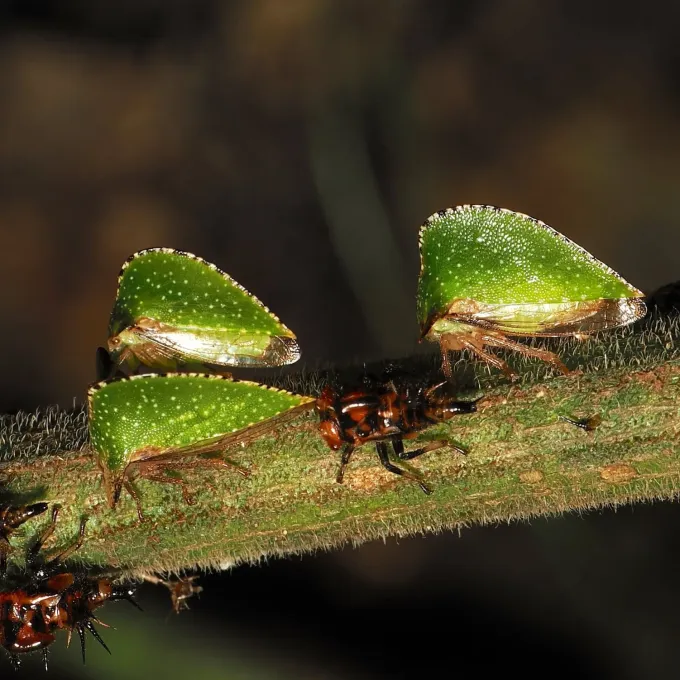
Antianthe expansa is a species of treehopper belonging to the family Membracidae. The insect is easily recognized by its enlarged pronotum, which extends forward and upward, creating a distinct, thorn-like or helmet-shaped appearance.
Adult insects are typically light green or yellowish-green, providing excellent camouflage against the foliage of their host plants. They usually measure between 8 and 10 millimeters in length.
The nymphs go through several developmental stages, gradually developing the characteristic shape of the adults. They are often found in clusters, particularly on the undersides of leaves or protected leaf axils.
A notable aspect of their biology is the mutualistic relationship with ants. The ants protect the treehoppers from predators in exchange for the sugary honeydew secreted by the nymphs and adults.
To identify this species accurately, observers should look for the unique dorsal projection and the specific bright green coloration common to individuals found on solanaceous plants.
What it damages
This pest is highly specific to the Solanaceae family. Key crops such as tomatoes, potatoes, eggplants, and peppers are the most frequent targets of its feeding activity.
Equipped with piercing-sucking mouthparts, the insects feed on the plant's phloem sap. This feeding process drains the plant's vital nutrients, leading to stunted growth and general vigor loss.
Heavy infestations can cause visible deformation of young shoots and stems. Furthermore, the loss of fluids often results in flower drop and reduced fruit set, directly impacting the final harvest.
The accumulation of honeydew secreted by the treehoppers provides a substrate for sooty mold fungi. This mold covers leaves, effectively blocking sunlight and inhibiting the plant's ability to photosynthesize.
Damage is cumulative, as both adults and nymphs feeding on the same plant can cause localized necrosis and overall plant decline over a short period.
Signs of infestation
The earliest signs of infestation include small, discolored puncture marks on the stems and leaf petioles. These points may turn yellow or necrotic as the plant reacts to the feeding injury.
A sticky, shiny residue known as honeydew on the leaves is a clear indicator of the presence of sucking insects. This substance often attracts ants and can lead to secondary fungal issues.
Visible curling, twisting, or drooping of tender new growth is a common symptom. When plants show these signs without clear evidence of drought, a closer inspection for treehoppers is recommended.
The presence of ants patrolling the stems is a secondary but strong indicator that a colony of treehoppers is present on the crop.
Disturbed plants will often reveal their inhabitants as adults quickly fly away in short, jerky bursts, making them easier to spot during bright, sunny conditions.
Control measures
Integrated Pest Management (IPM) for Antianthe expansa starts with rigorous weed control, as many local weeds can serve as alternate hosts for the pest throughout the growing season.
Manual removal of clusters of nymphs can be highly effective in small garden settings, provided the monitoring is consistent enough to catch them before they reach the adult stage.
Biological control agents, such as lacewings and predatory bugs, are important natural enemies that can help keep treehopper populations below economic damage thresholds.
Chemical control should be used judiciously, targeting the early stages of the population. Approved insecticides should be applied according to safety guidelines to protect beneficial insects.
- Regular monitoring of crop margins where pests tend to aggregate first.
- Use of insecticidal soaps for early-stage infestations to minimize chemical impact.
- Crop rotation to break the life cycle of the pest in heavily affected areas.
Taxonomy
- Latin name
- Antianthe expansa
- Order
- Hemiptera (bugs, aphids, leafhoppers)
- Family
- Membracidae
- EPPO code
- ANIHEX
Discussion
No discussions yet — be the first.