
Antianthe treehopper
Antianthe
Description
How to identify
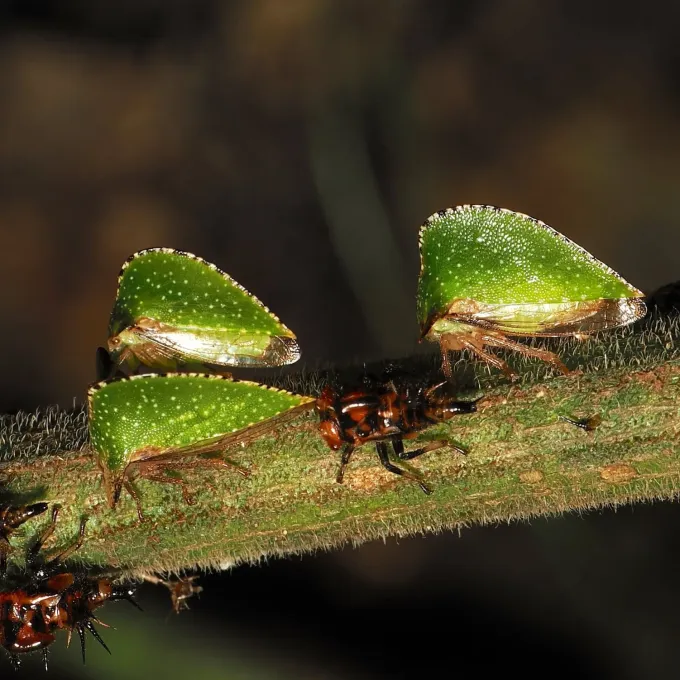
The Antianthe treehoppers are members of the family Membracidae, order Hemiptera. These insects are easily recognized by their highly developed pronotum, which extends over the abdomen and often mimics the appearance of plant thorns or small leaves.
Adult specimens typically display a bright green or yellowish-green color, providing excellent camouflage among foliage. They measure roughly 8–10 mm in length and possess strong jumping legs, enabling them to escape threats quickly.
Nymphs, or immature stages, lack fully developed wings and often feature spines or projections on their bodies. They are typically found in clusters on the stems or undersides of leaves, feeding on plant sap.
The life cycle includes eggs deposited within plant tissues, several nymphal instars, and the adult stage. The duration of the cycle depends on environmental temperature and host plant quality.
These insects are commonly found in warm climates, often inhabiting open fields and agricultural landscapes where they find abundant host plants for sustenance and reproduction.
What it damages
Antianthe treehoppers are known to infest various plant species, with a particular affinity for Solanaceous crops such as tomatoes, potatoes, and peppers. They may also utilize various weeds as alternate hosts.
Feeding damage occurs as both adults and nymphs pierce the plant epidermis with their needle-like mouthparts to extract phloem sap. This constant removal of nutrients weakens the host plant significantly.
Beyond direct feeding damage, these insects are problematic as vectors for various plant viruses. When they move from infected weeds to healthy crops, they can transmit pathogens that cause stunting, leaf curling, and mosaic patterns.
The oviposition process, where females insert eggs into plant tissue, creates wounds that can become entry points for secondary pathogens like bacteria and fungi, leading to stem necrosis.
- Stunting of young shoots and stunted growth.
- Yellowing and wilting of leaves due to sap loss.
- Increased susceptibility to viral diseases.
- Deformation of fruit and reduced marketability.
Signs of infestation
The primary sign of infestation is the presence of adult treehoppers on stems or leaves. If disturbed, they will quickly move to the underside of the foliage or jump away, which is a classic behavior.
Look for small, longitudinal slits or scars on stems, which are indicative of sites where females have laid their eggs. These sites often become slightly discolored or swollen over time.
Nymphs often produce honeydew, a sticky substance that coats leaves and stems. This substance can lead to the growth of sooty mold, appearing as a dark, powdery film on the plant surface.
Plants affected by significant infestations often display reduced vigor, with leaves showing curling or chlorosis. In severe cases, premature fruit drop or flower abortion can be observed.
The sudden appearance of viral-like symptoms (such as leaf distortion or mosaic patterns) on a few plants within a field often signals the activity of insect vectors like the Antianthe treehopper.
Control measures
Cultural control practices, such as maintaining weed-free fields and field borders, are essential. Removing alternate host plants significantly disrupts the life cycle of the treehopper population.
Biological control can be enhanced by fostering a diverse ecosystem that supports natural predators such as spiders, ladybugs, and predatory hemipterans that feed on nymphs and adults.
Chemical control involving systemic insecticides is often necessary if population thresholds are exceeded. Applications should target the nymphal stages to break the reproductive cycle effectively.
Monitoring with yellow sticky traps provides an early warning system for adult activity, allowing growers to time their insecticide applications precisely when they are most effective.
Practicing crop rotation and creating buffer zones between commercial Solanaceous fields and wild habitats helps reduce the risk of infestation by migrating treehopper populations.
Taxonomy
- Latin name
- Antianthe
- Order
- Hemiptera (bugs, aphids, leafhoppers)
- Family
- Membracidae
- EPPO code
- ANIHSP
Discussion
No discussions yet — be the first.