
Eriophyid mite
Anthocoptes
Description
How to identify
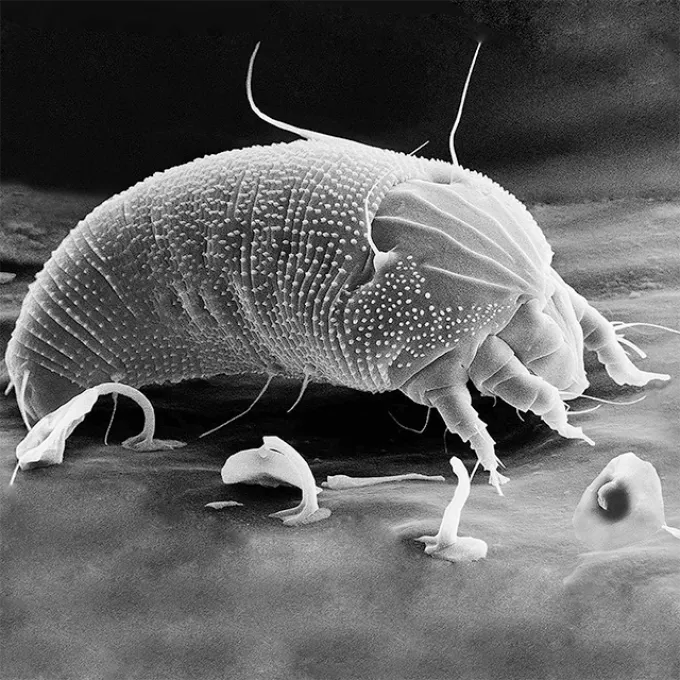
Eriophyid mites (superfamily Eriophyoidea), including the genus Anthocoptes, are microscopic pests that cannot be seen with the naked eye. They possess an elongated, worm-like body with distinct transverse striations on their cuticle.
A key identifying feature of these mites is the presence of only two pairs of legs, which are located at the anterior part of the body. They lack respiratory organs, making them exceptionally resilient to fluctuating environmental conditions.
Adult mites are typically creamy white, yellow, or reddish-brown. Despite their tiny size, they are surprisingly mobile and migrate efficiently between plant organs to feed.
Systematically, they belong to the family Eriophyidae. They are known for being highly host-specific, meaning they have evolved to feed on particular plant species or related genera.
Dispersal occurs passively through wind currents, splashing water, or hitchhiking on insects and human clothing, which often leads to rapid infestations in orchards or gardens.
What it damages
Anthocoptes mites are specialized phytophagous pests that primarily damage deciduous trees, shrubs, and berry crops. They feed by piercing plant cells and injecting saliva into the tissue.
The injection of salivary enzymes causes significant biochemical disruption within the plant. This leads to cellular deformation, abnormal growth patterns, and the formation of characteristic leaf damage.
Common symptoms include stunted growth, leaf curling, and premature leaf drop. Severe infestations weaken the plant, reducing its ability to survive winter dormancy and significantly lowering its yield.
In some plant species, the feeding activity triggers the development of galls or abnormal structures that provide shelter for the mites while disrupting normal plant development.
Economic damage is substantial, as infested fruits often become malformed, smaller in size, and poor in quality, making them unsuitable for commercial sale.
When it appears
The lifecycle of Anthocoptes mites is strictly synchronized with the phenological stages of their host plants. Fertilized females spend the winter in protected sites such as bud scales, bark crevices, or under plant debris.
In the spring, as temperatures rise and sap flow begins, the overwintering females emerge from their shelters to feed on developing buds and young leaves, initiating the first generation of the season.
Development is very rapid, often taking as little as one to two weeks depending on the temperature. Under favorable conditions, the population can undergo multiple generations during a single growing season.
Peak population density is usually reached during hot, dry summer months. High temperatures accelerate the mite's metabolic rate and reproduction, leading to rapid expansion of the infested area.
As autumn approaches and day length decreases, the mites transition into diapause, moving back to their overwintering sites to survive the cold season.
Signs of infestation
The first sign of an Anthocoptes infestation is often the curling, twisting, or puckering of young leaves. Leaf margins may roll inwards, creating distinct shapes.
Chlorotic spots or abnormal hair growth (trichomes) may appear on the leaf surfaces due to the plant's reaction to the mite's feeding. In some cases, the leaves may turn bronze or yellow.
Shoot development is frequently stunted, resulting in shortened internodes and a bushy or "witches' broom" appearance, which drastically affects the plant's structural health.
In berries, infestations can lead to uneven ripening, reduced fruit size, and a lack of flavor, as the plant directs resources away from fruit development to combat the infestation.
- Leaf curling and deformation
- Chlorotic or bronzed spots
- Stunted shoot growth
- Reduced yield and fruit quality
Control measures
Controlling Anthocoptes mites requires an integrated approach. The first line of defense is using healthy, certified nursery stock to prevent introducing the pest to the garden.
Cultural control measures involve pruning and destroying infested plant parts immediately. Proper hydration and soil nutrition help the plant maintain its vigor, making it less susceptible to damage.
Chemical control focuses on the use of specific acaricides. Because these mites are often protected within buds or galls, systemic products that penetrate plant tissues are generally more effective.
Applications should be timed with the mite's emergence in the spring. It is essential to rotate different chemical classes to prevent the development of resistance in the pest population.
Biological control, such as introducing predatory mites from the Phytoseiidae family, can be an effective and environmentally friendly solution in greenhouses and organic settings.
Taxonomy
- Latin name
- Anthocoptes
- Order
- Mites
- Family
- Eriophyidae
- EPPO code
- ANTPSP
Discussion
No discussions yet — be the first.