
Angitia
Angitia cacoeciae
Description
How to identify
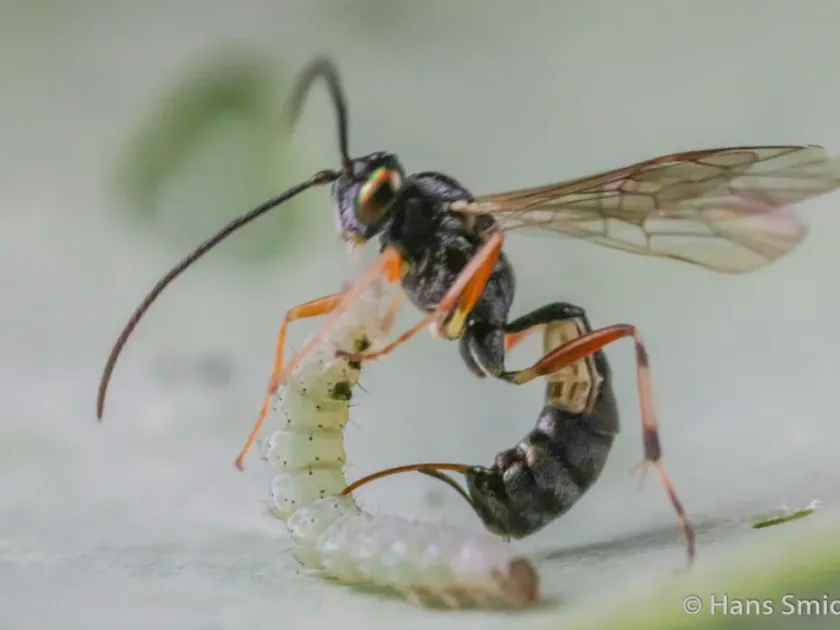
Angitia (lat. Angitia cacoeciae) is a specialized insect belonging to the order Hymenoptera and the family Ichneumonidae. These wasps act as natural parasitoids, playing a crucial role in regulating populations of harmful lepidopteran larvae.
Adult insects are characterized by their slender morphology, typical of ichneumonids, with long antennae and sensitive flight muscles. Their dark coloration serves as camouflage within the canopy of fruit trees and shrubs.
The life cycle involves the female wasp locating a host — specifically a leafroller larva — and laying an egg inside or on its body. The developing wasp larva consumes the host, eventually emerging as an adult, which completes the cycle.
Identification in field conditions can be challenging for non-specialists. Professionals usually search for the characteristic cocoons spun by the wasps within the rolled leaves that were previously occupied by the host caterpillars.
As a beneficial insect, its presence is a hallmark of a healthy ecosystem. By monitoring its population, growers can gauge the biological suppression potential against common orchard pests like the European leafroller.
What it damages
Angitia does not cause damage to plants; on the contrary, it acts as a protector. Its biological target, the leafroller (Tortricidae), is a significant pest that damages buds, blossoms, and fruits, directly reducing crop yield and quality.
Plants commonly associated with the presence of Angitia include apples, pears, and various stone fruits. By parasitizing the larvae that feed on these trees, Angitia significantly reduces the cumulative leaf area damage.
The economic contribution of this parasitoid is significant in reducing the frequency of necessary chemical treatments. It effectively keeps the leafroller population density below the economic threshold in many integrated fruit production systems.
While the parasitoid is beneficial, it is essential to consider the balance of the ecosystem. If the pest population grows too quickly, the natural parasitism rate may lag, requiring growers to intervene with selective measures.
In essence, Angitia serves as a biological tool that works in favor of the grower, turning the pest's own larvae into food for the next generation of beneficial wasps.
When it appears
The seasonal activity of Angitia is perfectly synchronized with the phenology of its leafroller hosts. The adult wasps emerge in early spring, coinciding with the first flight and egg-laying period of the target pests.
Multiple generations of the parasitoid can occur throughout the growing season, providing continuous suppression of various leafroller cohorts. This synchronicity is vital for the biological control success in orchards.
Environmental factors such as temperature and humidity levels directly influence the wasp's development rate. Favorable conditions lead to shorter generation times, allowing the wasp population to spike alongside the pest outbreak.
As the season draws to a close, the parasitoids prepare for overwintering. The final larvae of the season form cocoons to endure the cold period, often remaining in the foliage or bark crevices until spring returns.
Understanding these timings allows agronomists to optimize orchard management. Avoiding broad-spectrum pesticides during peak parasitoid emergence is one of the most effective ways to ensure natural control continues year after year.
Control measures
To preserve Angitia in the field, growers must adopt an Integrated Pest Management (IPM) approach. The avoidance of broad-spectrum insecticides is critical, as they indiscriminately kill beneficial insects along with pests.
The use of selective biological pesticides, such as those based on Bacillus thuringiensis or specific insect growth regulators, helps protect the parasitoid population while managing pest numbers effectively.
Providing nectar-rich plants as cover crops or border plants is highly recommended. These resources provide essential sugars for adult wasps, increasing their lifespan and egg-laying capability significantly.
Regular field scouting using pheromone traps allows for precise timing of interventions. By using these traps, growers can avoid unnecessary sprays, thereby maintaining the density of the beneficial wasp population.
- Prioritize biological control agents over chemical ones.
- Avoid spraying during the peak flowering stage.
- Maintain biodiversity in and around the orchard.
- Use pheromone monitoring to establish treatment thresholds.
Taxonomy
- Latin name
- Angitia cacoeciae
- Order
- Hymenoptera
- Family
- Ichneumonidae
- EPPO code
- ANGICA
Discussion
No discussions yet — be the first.