
Andrena regularis
Andrena regularis
Description
How to identify
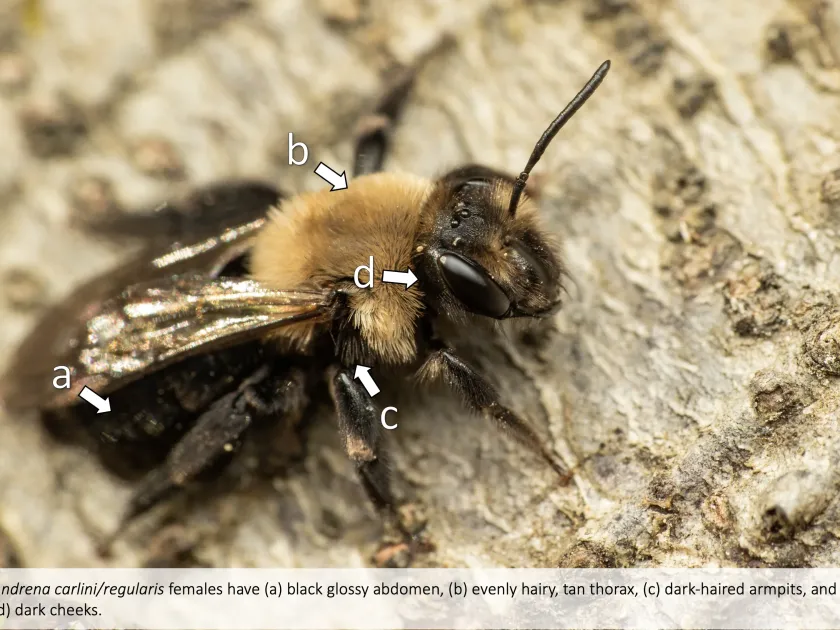
Andrena regularis is a species of solitary bee belonging to the family Andrenidae, which is part of the order Hymenoptera.
These bees are relatively small, typically reaching about 10 to 12 millimeters in length, and are covered in dense, protective hair.
The species is primarily recognized by its nesting habits, as females construct individual tunnels in the soil to deposit their eggs.
Identification often requires expert examination, as the morphological characteristics are similar to many other species in the genus Andrena.
They possess specialized pollen-carrying hairs on their hind legs, which are vital for collecting floral resources for their larvae.
What it damages
Andrena regularis is generally considered a minor concern, as it does not directly consume foliage or fruit of agricultural crops.
The primary concern arises from the mechanical disruption of soil around young plants caused by the construction of deep nesting tunnels.
In commercial nurseries, significant burrowing activity can potentially injure the delicate root systems of young seedlings and shrubs.
While the bees themselves are harmless to humans, concentrated nesting areas can lead to localized wilting or reduced plant vigor.
In most ecosystems, the benefits provided by these bees as pollinators far outweigh any minor physical damage caused to the soil structure.
When it appears
The life cycle of Andrena regularis is strictly tied to the spring season, as adults emerge from overwintering cells.
Activity is highest during April and May, coinciding with the peak flowering period of many early spring plants and trees.
Females spend the majority of this period building their nests and providing nectar and pollen provisions for the next generation.
By mid-summer, adult activity ceases as the bees complete their reproductive duties and perish in the natural course of their life cycle.
The larvae develop underground throughout the summer months, overwintering as prepupae and pupating in the following spring.
Signs of infestation
The most visible sign of an Andrena colony is the presence of small, conical mounds of soil scattered over the ground surface.
During sunny spring days, one can observe a high frequency of bee activity, with individuals flying low over the nesting site.
Plants located directly above nesting colonies may exhibit signs of nutrient deficiency or stress due to root disturbance.
Small holes, approximately 5–8 mm in diameter, can be observed on the soil surface, marking the entrances to the underground nests.
If plant wilting is observed without signs of common fungal or viral pathogens, inspecting the soil beneath for tunnel systems is advised.
Control measures
Chemical control is rarely recommended, as Andrena regularis acts as a natural pollinator that supports overall ecosystem health.
Cultural control methods, such as regular soil cultivation or tilling in early spring, can effectively deter these bees from nesting.
Establishing dense ground cover or mulch layers makes the soil less suitable for the bees to burrow and create their nesting tunnels.
In severe infestation cases within nurseries, manual barriers can be used to protect the root zones of the most valuable young plants.
Encouraging biodiversity and avoiding unnecessary pesticide use helps keep populations in balance without targeting these essential insects.
Taxonomy
- Latin name
- Andrena regularis
- Order
- Hymenoptera
- Family
- Andrenidae
- EPPO code
- ANDERE
Discussion
No discussions yet — be the first.