
Andrena carantonica
Andrena carantonica
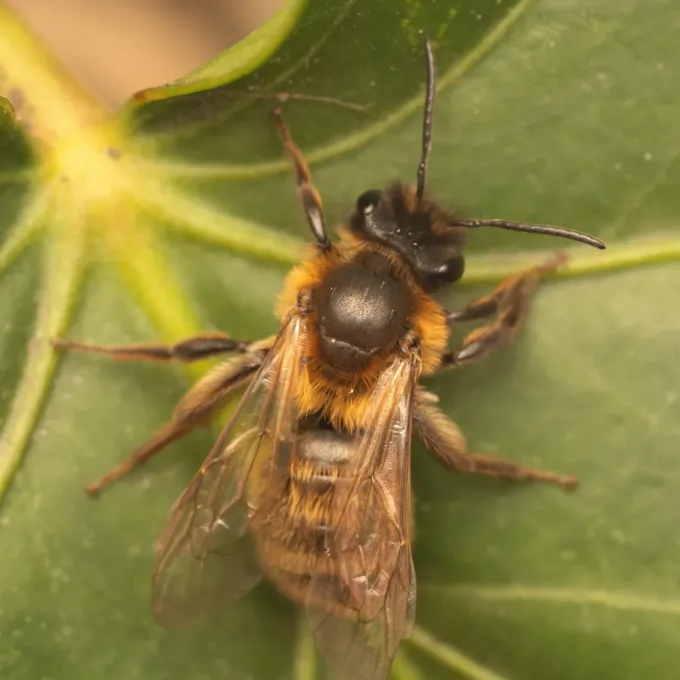
Description
How to identify
Andrena carantonica is a solitary bee species belonging to the family Andrenidae, order Hymenoptera. Unlike social honey bees, these insects lead independent lives, focusing on nesting and pollination.
The bees are approximately 10–13 mm long and feature dense, brownish-orange hair on their thorax, which is a key identification feature for this particular species.
They are characterized by their nesting behavior; females excavate individual burrows in the soil to lay eggs and provision them with nectar and pollen.
Colonies can form where many females build nests in close proximity in areas with suitable light, well-drained soil and good exposure to sunlight.
They are docile and rarely exhibit aggressive behavior towards humans, making them manageable neighbors in diverse agricultural environments.
What it damages
This bee is considered a beneficial insect rather than a pest. Its primary contribution to agriculture is the pollination of a wide range of spring-blooming crops.
There is no direct damage to plant tissues, leaves, or fruits. The bees depend on floral resources and do not feed on the vegetative parts of crops.
Minor soil disturbance might occur in areas with very high nesting density, such as plant nurseries, but this is usually limited and does not impact plant growth significantly.
Because they are not pests, they do not cause yield loss; on the contrary, their presence is often encouraged to boost fruit set and crop development.
Agronomists should view Andrena carantonica as a vital asset for maintaining farm productivity and ecosystem health rather than as a nuisance to be controlled.
When it appears
The primary period of adult activity is spring, typically from April to June, which coincides with the flowering time of many fruit trees and agricultural crops.
The species is univoltine, meaning there is only one generation per year, and the life cycle is tightly synchronized with early spring environmental cues.
Males typically emerge earlier than females to establish territory and locate potential mates, preparing for the nesting phase that follows shortly after.
Overwintering occurs in the larval or pupal stage within the subterranean cells, with adults emerging when temperatures reach an optimal threshold in the spring.
After the nesting season ends, the adults complete their lifespan, and the next generation remains underground until the following spring cycle begins.
Signs of infestation
Small, chimney-like mounds of loose soil surrounding a central hole indicate the presence of a nesting site in the ground.
Frequent flights of small, bee-like insects near warm, bare soil patches during spring afternoons are a hallmark of an active Andrena colony.
Observers might notice pollen loads on the hind legs of females as they return to their burrows to deposit food for their developing larvae.
The lack of visible feeding damage on plants despite the presence of bees is a strong diagnostic sign that they are pollinators, not herbivores.
Concentrated activity around south-facing slopes or open, undisturbed sandy soils is common during their peak nesting months.
Control measures
Control measures are generally not recommended for Andrena carantonica. As a beneficial pollinator, the goal should be conservation and habitat protection.
To avoid conflicts with farm operations, timing of cultivation can be adjusted to avoid areas of high nesting density during the peak spring months.
Pesticide application should be strictly minimized or avoided entirely during the flowering period to protect these populations from unintentional exposure.
Promoting diverse floral landscapes and reducing deep tillage in non-crop areas can help provide stable nesting and feeding grounds for this species.
Educating field staff on the difference between beneficial solitary bees and true agricultural pests is the most effective management strategy for farm sustainability.
Taxonomy
- Latin name
- Andrena carantonica
- Order
- Hymenoptera
- Family
- Andrenidae
- EPPO code
- ANDECA
Discussion
No discussions yet — be the first.