
Japanese grass moth
Ancylolomia japonica
Description
How to identify
The Japanese grass moth (Ancylolomia japonica) belongs to the family Crambidae. It is a lepidopteran insect known for its specialized adaptation to grassland and agricultural environments where host plants are abundant.
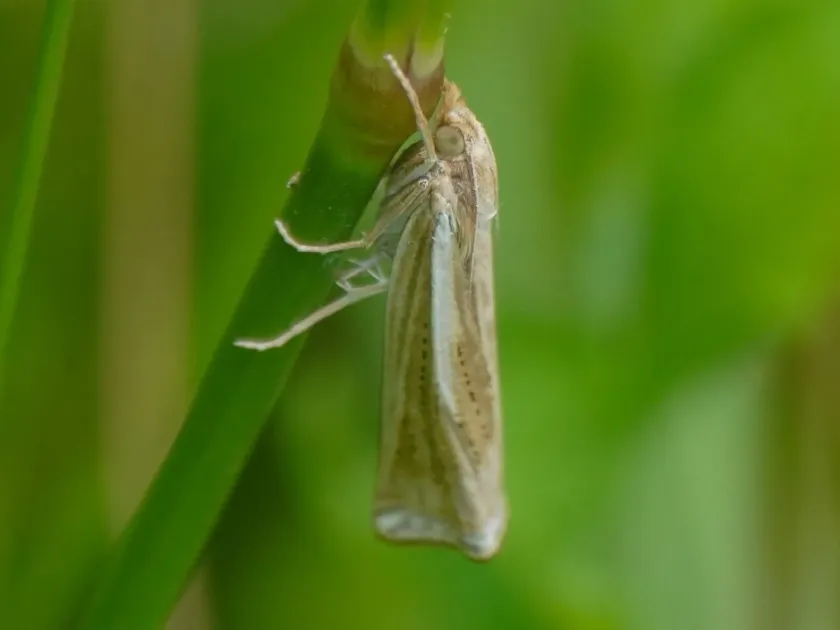
Adult moths are characterized by elongated, narrow wings with pointed tips, typically displaying shades of light brown or straw-yellow. This morphological trait allows them to camouflage perfectly against dry stalks and grass blades.
The larvae are grey or brownish with dark spots and a light covering of hairs. They are generally cryptic, spending their daytime hours hidden in the root zone or beneath the soil surface, emerging primarily to feed.
The life cycle involves complete metamorphosis, consisting of the egg, larva, pupa, and imago stages. Females lay their eggs on host plants or in the soil, ensuring that larvae can easily access food sources upon hatching.
Population density is heavily influenced by environmental factors such as soil moisture and ambient temperature, which dictate the speed of development and the number of generations occurring in a single season.
What it damages
The primary food sources for the larvae are members of the Poaceae family. While native grasses are common hosts, agricultural damage is frequently reported on wheat, rice, corn, and millet crops.
Larvae feed on leaf tissues and frequently attack the basal part of the stem, which can cause the plant to wilt and die. This is particularly devastating to young seedlings that have not yet established a robust root system.
Economic impact increases significantly during outbreaks where larval density exceeds thresholds. In such cases, entire sections of a crop can be destroyed, leading to substantial yield losses across the affected field.
The damage often creates entry points for secondary infections. Fungal and bacterial pathogens can penetrate the plant through the wounds caused by the larvae, resulting in stunted growth or systemic diseases.
Neglected fields with high weed pressure act as a breeding ground, allowing the pest population to expand rapidly before migrating to cultivated crops throughout the growing season.
When it appears
Adult activity usually begins in late spring and persists through the summer. Depending on the latitude and climate, the species can complete multiple generations within a single vegetation cycle.
The peak of larval damage is typically mid-summer, coinciding with the period of rapid larval growth when nutritional demands are at their highest to fuel the transformation process.
Overwintering often occurs at the larval or pupal stage within the soil or in sheltered plant residues, which provides protection from extreme temperatures and predation during the winter months.
The developmental duration for each stage is highly dependent on temperature and rainfall, meaning that outbreak patterns can vary from year to year based on local weather conditions.
Monitoring for adult moths using light traps is the most effective approach for forecasting outbreaks and determining the optimal timing for implementing pest control interventions.
Signs of infestation
The initial signs of an infestation include the presence of irregular, notched holes or scalloped edges on the leaves, especially those located near the base of the plant.
Withered or yellowing central leaves (often called "dead heart") are a common symptom indicating that the larva has bored into the stem or severely damaged the growing point.
Fine, silky webbed galleries or tunnels found near the soil surface are clear indicators of larval presence, as the caterpillars use these structures to hide during the day.
Observing the fields at dusk often reveals adult moths taking short, erratic flights when disturbed, which provides a visual confirmation of their presence in the area.
- accumulations of dark, granular fecal pellets on leaves;
- wilting and localized patches of stunted crop growth;
- larvae discovered during soil excavation around the base of damaged plants.
Control measures
Agricultural management practices such as deep autumn plowing are essential, as this disrupts the overwintering sites and exposes larvae to predators and desiccation.
Effective weed control is a critical component of integrated pest management, as it reduces the alternative food sources that allow the moth population to maintain itself between crop cycles.
Biological control agents, particularly formulations based on Bacillus thuringiensis, provide an effective and environmentally friendly method for targeting young larvae while preserving beneficial insects.
Chemical control involving systemic or contact insecticides should be applied during the window of peak larval emergence to ensure the highest mortality rate before the crop sustains significant damage.
Crop rotation and maintaining field sanitation are fundamental strategies to disrupt the moth's life cycle and minimize the accumulation of pest populations on specific plots of land.
Taxonomy
- Latin name
- Ancylolomia japonica
- Order
- Lepidoptera (butterflies)
- Family
- Crambidae
- EPPO code
- ANCLJA
Discussion
No discussions yet — be the first.