
Anastrepha striata
Anastrepha striata
Description
How to identify
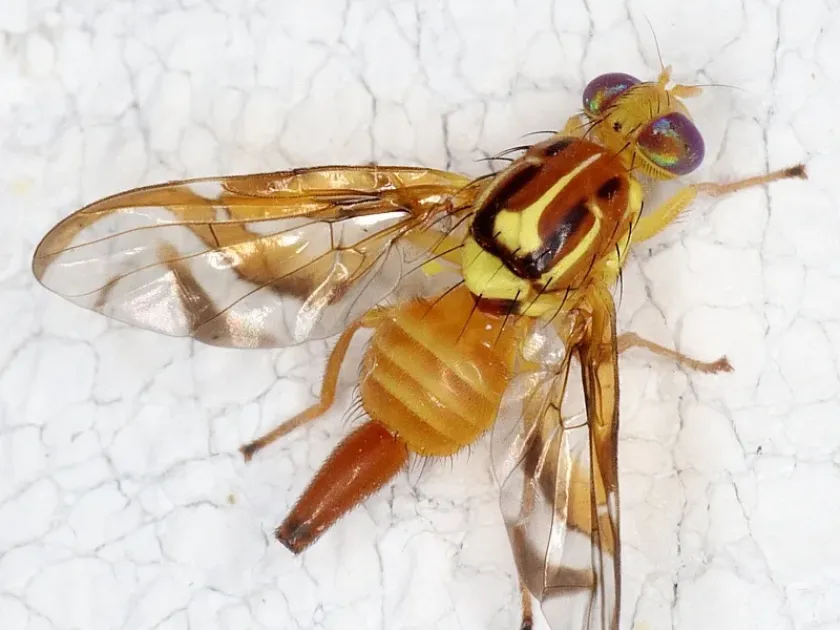
Anastrepha striata belongs to the Tephritidae family, commonly known as fruit flies. Adult flies are characterized by specific wing patterns with dark bands and a distinct yellowish-brown body.
The average size of the adult is between 6 and 8 millimeters. Their appearance is specialized, featuring a prominent ovipositor in females, which is used for piercing tough fruit skins.
Larvae are typical dipteran maggots: legless, creamy-white in color, and tapering towards the head. They grow up to 10 mm in length during their development inside the host fruit.
Pupae are found in the soil, usually protected by a dark, barrel-shaped puparium. This stage is crucial for the survival of the species during adverse climate conditions.
Identification in the field often relies on the observation of adult flies in traps or the detection of larvae during internal fruit inspection by agricultural specialists.
What it damages
The primary host for Anastrepha striata is the guava (Psidium guajava). The pest is highly specialized and poses a constant threat to guava orchards worldwide.
Beyond guava, the species can infest other tropical and subtropical fruits, including mangoes and various citrus varieties, depending on local host availability.
The economic impact is significant as the larvae consume the interior of the fruit, rendering it completely unmarketable and unsuitable for human consumption.
Infestation often leads to severe crop losses, sometimes reaching 90% in unsprayed orchards, which destabilizes local production and export potential.
Because the damage is internal, infested fruits may appear healthy from the outside until the larvae exit or rot sets in, facilitating the spread of the pest through trade.
When it appears
The reproductive cycle is heavily influenced by the availability of ripe fruit and favorable temperatures, allowing for continuous generations in tropical climates.
Adult activity peaks when trees are in the fruit-set and maturation stages. Females actively seek out susceptible fruits to deposit their eggs under the skin.
The lifecycle duration is relatively short, allowing the population to explode within a single harvest season if conditions are optimal for development.
Pupation occurs in the soil, and the emergence of adults is often triggered by changes in soil moisture, typically following periods of rainfall.
In regions with distinct dry seasons, the species may survive through pupal diapause in the soil, waiting for the return of conditions suitable for fruit production.
Signs of infestation
The most immediate sign of infestation is the presence of minute puncture marks on the fruit skin, often surrounded by small, discolored areas caused by the oviposition process.
Internal tissue breakdown is a major indicator. As larvae tunnel through the fruit, the pulp liquefies and begins to smell, leading to premature softening.
Premature fruit drop is a common symptom in infested guava orchards. Fallen fruits are often heavily infested with larvae that are preparing to leave the fruit to pupate in the ground.
Secondary infections, such as fungi or bacteria, often colonize the damaged pulp, accelerating the decay process and creating visible rot on the fruit surface.
When cutting open a suspect fruit, the presence of white, tunneling larvae confirms the infestation, distinguishing it from other types of environmental or fungal rot.
Control measures
Integrated Pest Management (IPM) is essential. Monitoring using pheromone and protein-based traps is the first line of defense to detect population spikes early.
Field sanitation is a critical practice: collecting and disposing of all fallen or infested fruits prevents larvae from reaching the soil to complete their lifecycle.
Chemical control is applied by targeting adults through bait sprays. This method is preferred as it limits environmental impact compared to full-canopy blanket spraying.
Biological control agents, particularly parasitic wasps, are being utilized in many regions to naturally suppress larval populations within the fruit tissue.
Strict quarantine protocols for the movement of fruit between regions are necessary to prevent the accidental introduction of Anastrepha striata into non-infested areas.
Taxonomy
- Latin name
- Anastrepha striata
- Order
- Diptera (flies)
- Family
- Tephritidae
- EPPO code
- ANSTST
Discussion
No discussions yet — be the first.