
Sapodilla fruit fly
Anastrepha serpentina
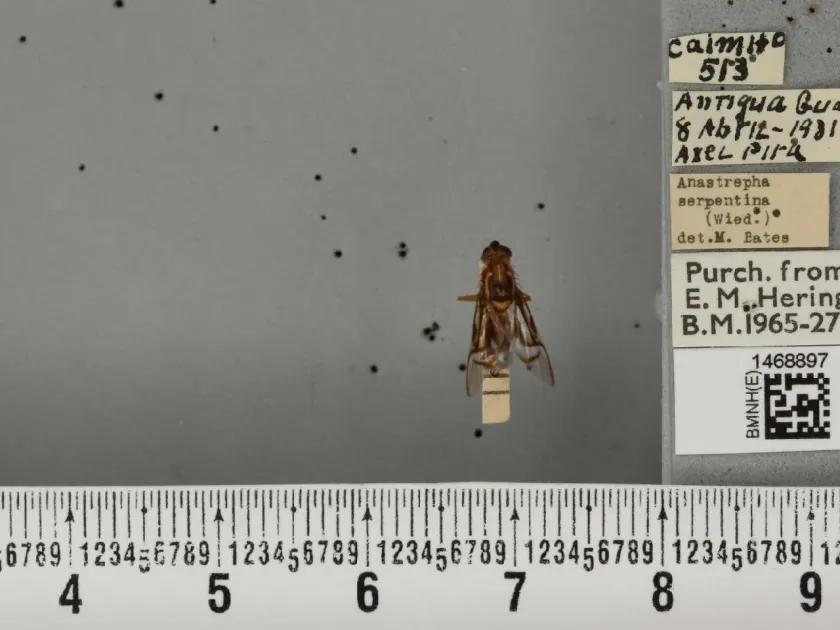
Description
How to identify
The sapodilla fruit fly (Anastrepha serpentina) is a member of the Tephritidae family, also known as fruit flies. Adult flies are characterized by their yellowish-brown to brown body color.
The wings display a distinct and intricate pattern of dark bands, which is the most reliable feature for identifying this specific species within the Anastrepha genus.
Adult insects typically measure between 6 and 10 millimeters in length, with females possessing a long ovipositor used for penetrating fruit skins.
Larvae, or maggots, are creamy-white, headless, and legless, which is the standard appearance for larvae of the Tephritidae family.
Developmental stages progress through egg, larva (three instars), pupa (puparium), and adult, with the speed of development closely tied to ambient temperature.
What it damages
The primary hosts of this pest include fruit-bearing trees in the Sapotaceae family, most notably sapodilla, caimito, and lucuma.
Female flies lay eggs directly into the ripening fruit, where the hatching larvae tunnel through the flesh, consuming it and rendering the fruit inedible.
Heavy infestations lead to widespread premature fruit drop and significant yield losses, often exceeding 80 percent in unprotected orchards.
Damaged fruits are prone to secondary infections from fungi and bacteria, which accelerate the rotting process initiated by larval feeding.
Presence of this pest in fruit orchards can lead to strict international quarantine regulations, causing substantial economic disruptions for fruit exporters.
Signs of infestation
Visible punctures on the surface of ripening fruit are the earliest sign of an infestation, created by the female's ovipositor during egg-laying.
Soft, discolored, and sunken patches appear on the fruit skin as the larvae tunnel and feed within the pulp, eventually leading to decay.
A foul, fermented, or rotten odor typically emanates from severely infested fruits, indicating that the inner tissue has decomposed.
Premature fruit drop is a common indicator; if dropped fruit is sliced open, one will typically find maggots actively moving within the rotting flesh.
In later stages of development, mature larvae emerge from the fruit through exit holes to pupate in the soil beneath the host tree.
Control measures
The implementation of food-based or pheromone traps is essential for monitoring fly populations and determining the optimal timing for control interventions.
Strict sanitation practices, such as the frequent removal and destruction of fallen fruit, are critical for disrupting the pest's lifecycle and preventing outbreaks.
Chemical control usually involves bait sprays, where insecticides are mixed with protein hydrolysates to attract and kill adult flies before they can oviposit.
Quarantine and phytosanitary measures are strictly enforced to prevent the movement of infested fruit and nursery stock between countries and regions.
Biological control programs utilizing parasitoid wasps, such as Diachasmimorpha species, can be highly effective in reducing sapodilla fruit fly populations in sustainable orchard management.
Taxonomy
- Latin name
- Anastrepha serpentina
- Order
- Diptera (flies)
- Family
- Tephritidae
- EPPO code
- ANSTSE
Discussion
No discussions yet — be the first.