
Anastrepha pseudoparallela
Anastrepha pseudoparallela
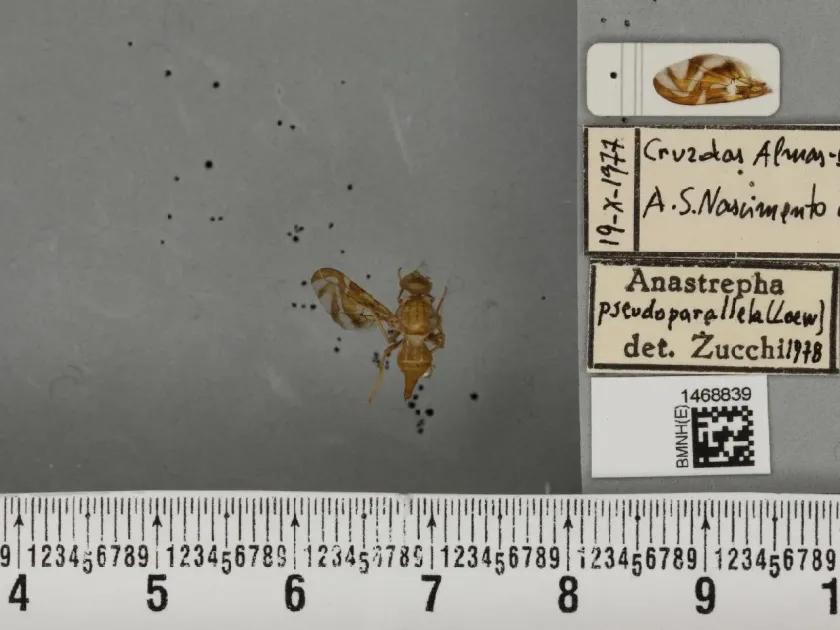
Description
How to identify
Anastrepha pseudoparallela is a fruit fly species belonging to the Tephritidae family. Like many other members of this genus, it is known for its distinct wing markings, which feature intricate dark bands and patterns used for communication and species recognition.
The adult fly has a yellowish-brown body that provides effective camouflage when resting on fruit surfaces or among leaves. Females are equipped with a sharp, elongated ovipositor, which they use to penetrate the skin of host fruits and deposit eggs into the pulp.
The larvae, which develop within the fruit, are legless and exhibit a typical cone-shaped body form common to many fruit flies. Their color ranges from pale white to yellowish, reflecting the stage of their larval development and diet.
Systematically, this insect is categorized under the order Diptera. Identifying this species correctly is of paramount importance for agricultural inspectors, as it closely resembles other Anastrepha species, requiring expert knowledge or molecular analysis to distinguish.
Adult flies exhibit secretive behavior, often remaining deep within the foliage of the canopy. They feed on sugar-rich substances like nectar and honeydew, which provides them with the energy needed for mating and searching for suitable fruit hosts.
What it damages
The primary hosts of Anastrepha pseudoparallela are plants within the Passifloraceae family. The insect has been identified as a significant pest of passion fruit (Passiflora edulis), where it causes severe agricultural losses.
Larval feeding destroys the interior of the fruit, causing the pulp to liquefy and rot. This renders the fruit completely unsuitable for both fresh market sales and industrial processing, leading to substantial economic damage.
The oviposition sites created by females serve as entry points for secondary pathogens, such as various fungi and bacteria. This infection accelerates fruit decomposition, often causing the fruit to rot while still attached to the plant.
Because of its ability to thrive on various species of passion fruit, this pest represents a persistent threat to commercial orchards. Controlling its spread is essential to maintain the quality and safety standards of the harvest.
Infested fruit often abscise and drop prematurely, which disrupts harvest logistics. Furthermore, the presence of larvae in fruit intended for export is a major quarantine violation, often resulting in rejected shipments at customs.
When it appears
The lifecycle of Anastrepha pseudoparallela is tightly synchronized with the phenology of its host plants. In tropical regions, the insect can produce several generations per year, creating constant pressure on plantations.
The activity of adults typically peaks when host plants are in the fruit-set and fruit-ripening stages. During this time, flies are highly attracted to the volatile compounds emitted by developing fruits, which guide them to suitable egg-laying sites.
Developmental speed is heavily dependent on ambient temperatures. Warmer conditions accelerate the metabolic processes of the larvae, allowing them to reach maturity faster and potentially increasing the number of generations per season.
Pupation occurs in the soil beneath the host plant, where the pupae can survive until conditions favor the emergence of a new adult generation. This makes the soil a critical reservoir for the pest.
Environmental factors such as high humidity and rainfall play a complex role in population dynamics. While excessive drought may hinder some stages, irrigation systems in commercial orchards provide consistent moisture that favors the fly's lifecycle.
Signs of infestation
Early symptoms of infestation include minute puncture marks on the fruit skin, which are the sites where the female has deposited her eggs. These spots may slightly indent over time as the fruit continues to grow.
Dissecting an infested fruit usually reveals larval tunnels and the presence of larvae themselves, often accompanied by the accumulation of frass. A fermented, pungent odor is a telltale sign of internal decay caused by larval feeding.
Infested fruit often show visible signs of premature ripening, changing color from green to yellow or brown long before reaching technical maturity. The skin may appear wrinkled or sunken in areas where larvae are most active.
Monitoring using sticky traps infused with attractants is the most effective way to detect the presence of the pest in an orchard before the infestation becomes severe. This allows for timely intervention.
Inspecting dropped fruit is another reliable diagnostic tool for farmers. If the fallen fruit exhibits holes or internal signs of rot, it is a strong indicator that the population has established itself within the orchard.
Control measures
Integrated Pest Management (IPM) is the most effective approach to control this pest. It relies on a combination of monitoring, sanitation, and targeted chemical applications to keep populations below the economic threshold.
Sanitation practices involve the rigorous collection and destruction of all infested or fallen fruit. Burying or incinerating this material prevents larvae from emerging and pupating in the soil, effectively breaking the cycle.
Biological control methods involve the release of parasitoid wasps that specifically target the larvae of Anastrepha species. This natural regulation can significantly suppress fly numbers without the need for synthetic pesticides.
Chemical control usually utilizes toxic baits that combine an insecticide with an attractant. This localized application is highly effective at targeting adult flies while minimizing exposure to beneficial insects and the environment.
Strict quarantine measures are essential to prevent the spread of the pest to new growing regions. Trade restrictions and careful inspection of fruit at borders are vital for protecting agricultural productivity on a national and international scale.
Taxonomy
- Latin name
- Anastrepha pseudoparallela
- Order
- Diptera (flies)
- Family
- Tephritidae
- EPPO code
- ANSTPS
Discussion
No discussions yet — be the first.